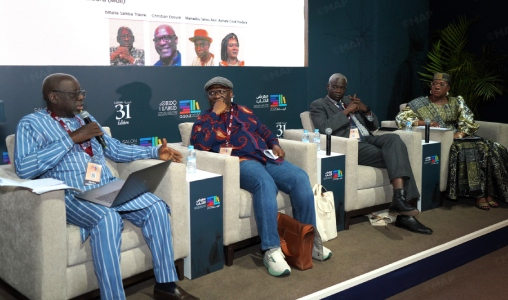
A recent panel discussion in Rabat, held as part of the 31st International Book Fair, delved into the complexities of modernity and shifting identities in Africa, with a focus on the theme 'Cultural Evolution, African Modernity, and Emerging Identities.' The discussion emphasized the need for Africa to forge its own path to modernity, leveraging digital technology and innovation to strengthen its unique cultural heritage.
Ismaïla Samba Traoré, a prominent Malian author and publisher, described African culture as a fluid, ever-changing entity shaped by movement, exchange, and digital connectivity. He advocated for a 'connected Africa' through enhanced cultural collaboration between Morocco and other African nations, harnessing the power of digital technology to promote cross-cultural understanding and cooperation.
Christian Eboulé, a journalist and writer from the Central African Republic, stressed the importance of intellectual decolonization, urging Africans to break free from imposed models and forge an independent path. He also highlighted the need to strike a balance between technological progress and the preservation of community values, ensuring that innovation strengthens rather than erodes the African community's foundation.
Saliou Akin, an author from Guinea-Conakry, examined the cultural implications of rural-urban migration, the impact of education, the internet, and science on societal behavior, and the resulting generational divides. He noted that the rapid pace of modernization can sometimes lead to a disconnection from traditional practices, as younger generations increasingly view them as outdated.
According to the panelists, African modernity is characterized by a dynamic interplay between cultural legacy and contemporary influences, shaped by adaptation, cultural fusion, and the strategic use of digital technology. This enables Africa to participate in the global landscape while preserving its distinct values and cultural identity, ultimately paving the way for a unique and sustainable path to modernity.
💬 Comments (0)
No comments yet. Be the first!
✏️ Leave a comment