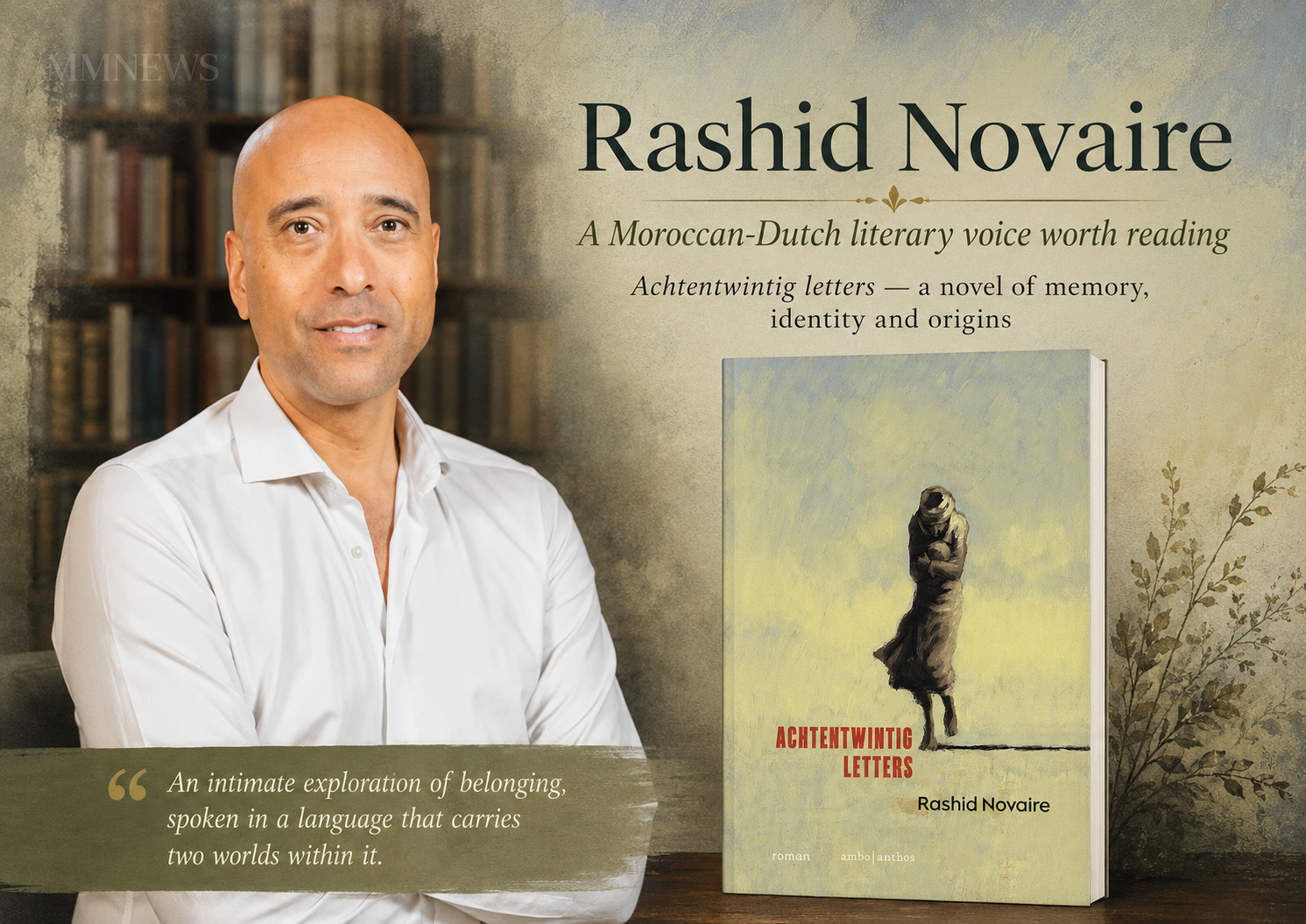
Born in Amsterdam in 1979, Rashid Novaire is one of the distinctive voices in contemporary Dutch literature. Yet for Moroccan readers, and especially for Moroccans living abroad, he is more than a writer working in the Dutch language. He is a voice from a generation born in Europe but still connected to Morocco through the father, the family, memory, language, and the questions that never fully disappear: Who are we? Where do we come from? And what have we truly inherited from our parents?
These questions are at the heart of his literary strength.
A Writer From the Diaspora, but Not Limited to the Diaspora
It would be too simple to describe Rashid Novaire only as “a writer of Moroccan origin.” He is that, of course, but he is also much more. He is a novelist of memory, fatherhood, belonging, inner disturbance, and identities that cannot be reduced to a single label.
In his work, migration is not treated as a ready-made theme or an easy slogan. It appears as a complex human experience, filled with nostalgia, distance, pride, silence, and emotional tension. Novaire does not present identity as a final answer. He presents it as an open search. He does not tell the reader, “This is where you belong.” Instead, he asks: what do we really know about where we come from?
This is why Rashid Novaire can be seen as an important voice within Moroccan diaspora literature in the Netherlands. He writes from inside the experience, but his literary approach does not turn origins into a direct speech. He transforms them into artistic and human material.
Twenty-Eight Letters: A Simple Title With Deep Symbolism
The title Achtentwintig letters literally means Twenty-Eight Letters, referring to the twenty-eight letters of the Arabic alphabet. But in the novel, these letters are not merely signs used for reading and writing. They become a symbol of lost memory, unfinished language, and a sense of belonging that has never been fully decoded.
For many children of the Moroccan diaspora in Europe, Arabic, Darija, or Amazigh is not always a language they completely possess. They hear it at home, in family phone calls, during celebrations, in prayers, and in the words of parents and grandparents. But sometimes it remains more a language of feeling than a language of writing. A language of emotion more than a language of school.
This is where Novaire touches a quiet wound shared by many children of migration: how can you belong to a language you do not fully master? And how can you carry a family memory when you do not have all the keys to read it?
In the novel, the twenty-eight letters become a thread leading the main character back toward his past. It is as if the author is telling us that what we forget does not completely disappear. It waits for the moment we are ready to return to it.
A Novel That Begins With a Child’s Question
At the heart of the novel is Jibril van der Woude. His story begins with a question that may seem simple, but which carries the emotional and political tension of the entire book: why are angels always represented as white?
This childlike question opens a much wider door onto skin color, origins, memory, and the relationship with his Moroccan father, Marouan Mbarek. When the father calls his son his “little black angel,” the phrase is no longer just a tender expression. It becomes an entrance into a deeper history: the history of family, color, African origins, and the memories that were left unspoken.
After a painful psychological experience and hospitalization following a psychotic episode, Jibril learns that his father has disappeared in Morocco. From there, the journey begins. But he is not traveling only to find his father. He is traveling to find himself.
That is one of the novel’s most powerful elements: the search for the father becomes a search for identity. The journey to Morocco becomes a journey inward.
Morocco in the Novel: Not a Backdrop, but a Memory
In Twenty-Eight Letters, Morocco is not simply a place where a child of the diaspora returns for holidays or childhood nostalgia. Morocco is a space of revelation. It is the land of the father, the land of questions, the land of family secrets, and the land of memory that was never fully told.
The novel takes the reader toward the heart of the Rif, but also toward a history that goes beyond the individual story. It touches on themes rarely explored with such intensity in narratives about the Moroccan diaspora: Black presence in Moroccan memory, the relationship between Morocco and sub-Saharan Africa, traces of slavery, the connection between skin color and belonging, and the things families sometimes hide behind silence.
In that sense, the novel does not only tell a personal story. It opens a broader question about the history we carry without always knowing it, and about the pages that were never read to us when we were young.
Why This Novel Is Worth Reading
What makes Twenty-Eight Letters compelling is that it combines inner suspense with emotional depth. There is a father who disappears. There is a son who travels to find him. There is a mysterious past. And there are questions about mental fragility, memory, skin color, language, and roots.
But the novel is not only about disappearance. It is about everything that disappears inside families: stories that are not told, pain that is buried, words that are never spoken, and languages that fade from one generation to the next.
Moroccan readers, especially those living abroad, may recognize something of themselves in this book. They may remember words they heard at home but no longer use. They may think about their relationship with their father or mother, about summer trips to Morocco, and about what it means to be “from here and from there” at the same time.
This is not a novel that asks to be rushed. It asks to be listened to, like an old box of family letters that has never been opened.
Rashid Novaire’s Literary Journey
Before Achtentwintig letters, Rashid Novaire had already built an important literary path within Dutch literature. His first work, the short story collection Reigers in Cairo, was published in 1999. He later published Maïsroest in 2004, a novel that attracted attention and earned him a nomination for the Libris Literatuur Prijs, one of the major literary prizes in the Dutch-speaking world.
He continued to develop his literary universe through works such as Het lied van de rog, Afkomst, Zeg maar dat we niet thuis zijn, and De vooravond. These books reveal his ongoing interest in questions of origin, belonging, human relationships, and memory shaped by history.
Novaire has also written for theatre, podcasts, and other narrative forms. This diversity shows a writer constantly searching for new ways of telling stories, and for different voices capable of expressing what is difficult to say directly.
Why Rashid Novaire Matters to Moroccans Abroad
For MMNews, Rashid Novaire represents an important example of Moroccan creativity in the diaspora. The Moroccan community abroad cannot be reduced to remittances, economic success stories, sports, or politics. It also produces literature, ideas, cultural reflection, and deep questions about identity.
Novaire writes in Dutch, but his texts carry Moroccan, African, and European shadows at the same time. That is what makes his experience so important. He does not write from one fixed place. He writes from an in-between space, where Amsterdam meets Morocco, where the Dutch language meets Arabic memory, and where a European present meets a long family history.
He reminds us that children of migration do not simply live between two countries. They live between layers of memory.
An Invitation to Read Twenty-Eight Letters
Reading Achtentwintig letters means entering a novel about loss, search, fatherhood, language, color, and memory. It is the story of a man trying to understand who he is after realizing that a major part of his own story was never fully told to him.
This novel may speak strongly to young Moroccans in the Netherlands, Belgium, France, and across the diaspora. It speaks to those who know Morocco through family, holidays, food, affection, and longing, but who sometimes feel that a deeper history has not yet reached them.
It is a novel that tells us identity is not handed to us fully formed. Sometimes we must search for it. Sometimes we must rewrite it. Sometimes the return to the self begins with one letter, then another, until the twenty-eight letters slowly become readable again.
At a time when identities are often reduced to quick labels, Rashid Novaire offers something different: an invitation to read ourselves slowly, to search through memory, to listen to the silence of fathers, and to understand that belonging is not always a clear answer. Sometimes, it is a long journey toward meaning.

💬 التعليقات (0)
لا توجد تعليقات. كن أول من يعلق!
✏️ اكتب تعليقك