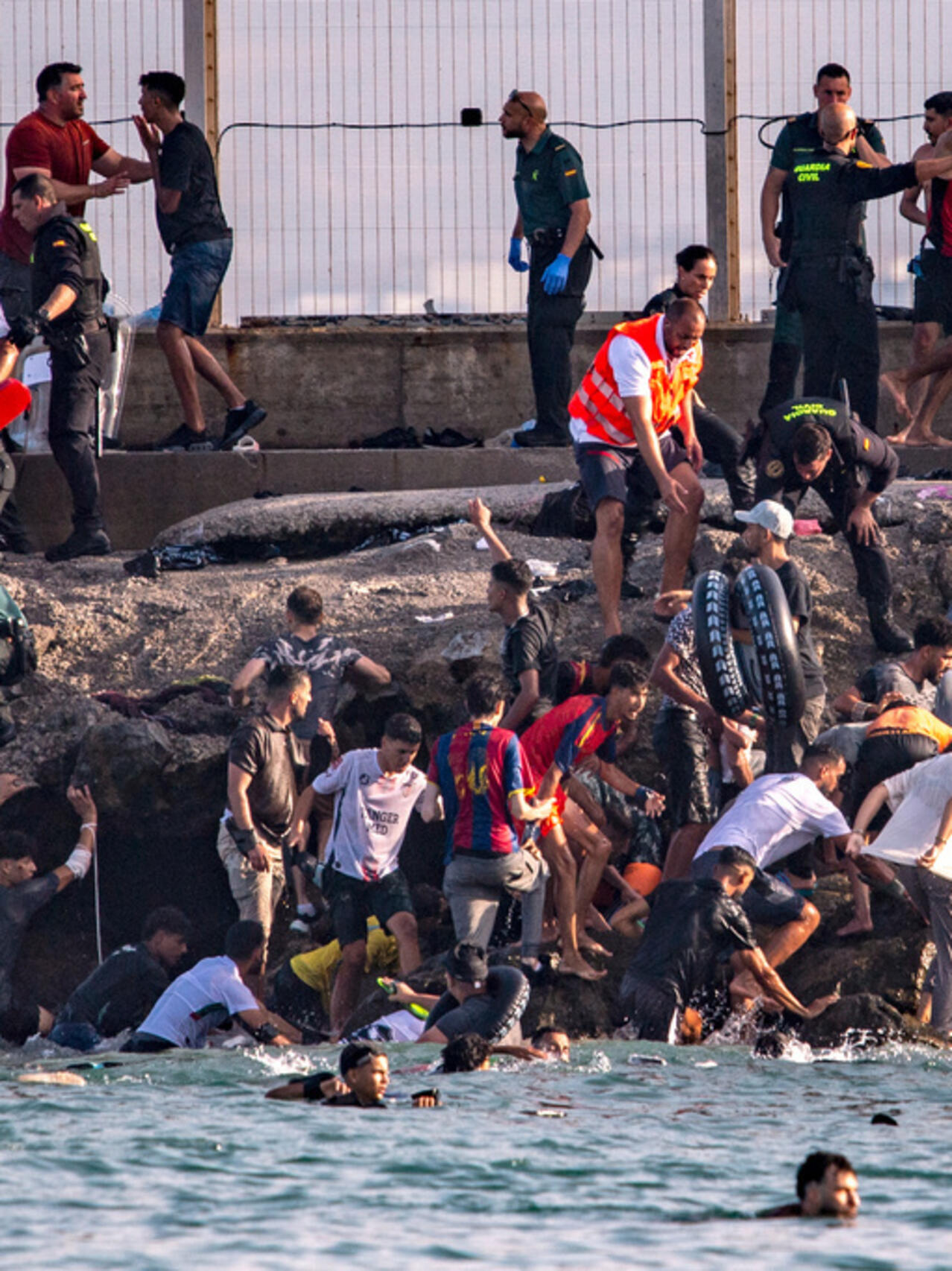
In situations like this, the word “invasion” is sometimes used in political debate and on social media. It should be handled with great caution, as it can turn a security and humanitarian crisis into language that dehumanises migrants. From a journalistic perspective, it is more accurate to refer to a major migratory influx, irregular border crossings, or a migration crisis, without minimising the seriousness of the situation.
What Do We Know About the Latest Developments?
Available reports point to a sharp rise in attempted entries into Ceuta over a very short period, creating significant pressure on security and emergency services.
Several methods appear to have been used, including swimming around maritime barriers and attempting to breach border fencing, often amid a wider group movement encouraged by messages circulating online.
Reports of deaths at sea have once again highlighted a brutal reality: the short distance between the Moroccan coast and Ceuta does not make the journey safe.
Currents, exhaustion, panic and overcrowding can turn an attempted crossing into a tragedy within minutes.
Why Did the Situation Escalate So Quickly?
There is still no single confirmed explanation for the scale of the latest movement.
However, one likely factor is the circulation of rumours and social media videos suggesting that surveillance had weakened or that reaching Ceuta would automatically allow migrants to remain there.
These messages can be extremely dangerous because they offer incomplete or misleading information and encourage young people to make life-changing decisions based on a short video or an anonymous message.
Reaching Ceuta does not automatically guarantee residence, employment, accommodation or transfer to mainland Spain.
Physically crossing a border is one thing. Building a legal and stable life is something entirely different.
Morocco as a Security Shield and Strategic Partner for Europe
This latest crisis once again demonstrates the central role Morocco plays in protecting Europe’s southern borders.
The Kingdom does not merely monitor its own territory. It also works to dismantle smuggling networks, disrupt irregular migration routes and prevent thousands of attempted crossings by land and sea.
Coordination between Morocco and Spain remains essential in managing any crisis of this scale.
Without close operational and security cooperation between the two countries, it would be extremely difficult for Spanish authorities alone to control the situation or organise returns.
In practical terms, Morocco acts as a crucial barrier against trafficking and irregular migration networks, while contributing to stability in the western Mediterranean and to European border security.
However, this partnership should not be limited to enforcement. It also requires stronger cooperation on development, vocational training, employment opportunities and the fight against human trafficking.
Social Media Can Become a Recruitment Tool for Irregular Migration
During migration crises, smugglers do not always work through traditional underground networks.
Anonymous pages and closed online groups may act as recruitment channels by sharing supposed crossing times, weak surveillance points or exaggerated stories about successful arrivals.
The problem is that these videos usually show only the first moment.
They may show someone reaching the other side, but they do not show what comes next: identity checks, temporary accommodation, lack of employment, possible removal or exploitation in the informal economy.
An undocumented migrant is often the most vulnerable person in the system because they have no legal status, no contract protecting their rights and no secure framework in which to live with dignity.
Europe Is Not a Guaranteed Paradise
It would be wrong to deny the opportunities Europe can offer. Thousands of Moroccans have built successful lives there through education, employment, training and entrepreneurship.
But that success does not come simply from arriving.
It usually requires language skills, qualifications, legal documents, a work contract or university admission, and enough financial resources to cover housing, transport and daily life.
Europe is not a place where every newcomer automatically receives a home, a job and financial support.
The reality is much more demanding.
Housing is expensive, employment requires skills, integration takes time, and living without legal status may mean constant fear, exploitation, underpaid work and exclusion from social protection.
The message to young people must therefore be honest:
Europe may offer opportunities, but it is not an automatic El Dorado. Nothing is free, and success requires preparation, effort and patience.
Returning to Morocco Is Not a Failure
Those who returned to Moroccan territory after trying to reach Ceuta should not be mocked.
For some of them, coming back may represent a second chance to rethink their path.
Many may have discovered that crossing the border does not immediately open the doors to a stable life in Europe.
Morocco needs the energy of its young people in industry, tourism, digital services, construction, healthcare, modern agriculture, crafts and other growing sectors.
Remaining in the Kingdom, or returning to it, does not mean abandoning international ambition.
A young person can study, learn a language, complete vocational training, gain experience and later apply legally for work or study abroad.
There is a major difference between a planned journey that offers rights and protection and an improvised crossing that may cost someone their life.
Legal Migration Is More Demanding, but Far Safer
There are legal routes to Europe, including employment contracts, university study, vocational training, seasonal work, family reunification and circular migration programmes.
These pathways require patience and a properly prepared application, but they provide what irregular migration cannot guarantee: legal residence, a contract, rights, insurance and protection.
Cooperation programmes between Morocco and several European countries already recruit Moroccan workers for seasonal and specialised employment.
These opportunities need to be explained more clearly to young people and should not remain accessible only to those who already have connections or privileged information.
What Should Morocco and Europe Do Next?
A security response is necessary to prevent chaos, protect borders and save lives. But enforcement alone will not solve the underlying causes.
Morocco should continue dismantling smuggling networks, monitoring online campaigns that encourage dangerous crossings and strengthening awareness efforts in neighbourhoods and cities where irregular migration attempts are increasing.
Europe, for its part, should recognise Morocco’s role more clearly, not only through political statements but through stronger support for employment, training, local development and genuine legal mobility channels for qualified young people.
Both sides also need honest communication campaigns that explain the reality of migration without exaggeration, but also without the unrealistic images often promoted online.
Conclusion: Protecting Borders Also Means Protecting Lives
What happened in Ceuta is not only a security crisis. It is also a human tragedy.
Behind the figures are young people who believed that swimming a short distance or crossing a barrier could immediately change their lives.
Some discovered that the road was far more complicated. Others paid with their lives for an illusion built on a rumour or a message received on a phone.
Morocco has once again demonstrated that it is an indispensable partner in protecting European borders and combating irregular migration networks.
But the most important message must be addressed directly to young people:
Do not place your life in the hands of a smuggler. Do not build your future on a rumour or a social media video. Study, train, learn a language, develop a profession and look for a contract or a legal route. Europe is not a free paradise, and success there requires preparation, patience and clear legal rights.
True courage is not jumping into the unknown. It is building the future with awareness, dignity and determination.


💬 Commentaires (0)
Aucun commentaire. Soyez le premier !
✏️ Laisser un commentaire