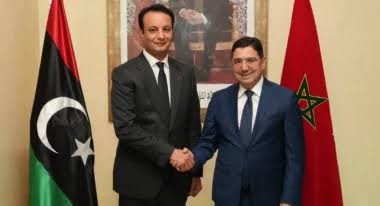
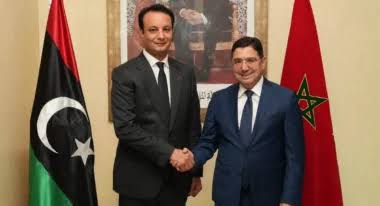
Moroccan Foreign Minister Nasser Bourita received Belkacem Haftar, director-general of Libya’s Development and Reconstruction Fund, in Rabat on 17 October 2026. According to the Fund’s communication, their talks explored strategic cooperation and the exchange of technical and institutional expertise in reconstruction, urban development and infrastructure modernisation.
That is the verified extent of the announcement. No memorandum, contract value, project list, timetable or Moroccan beneficiary was disclosed. The meeting should not be reported as a concluded reconstruction deal. But it is strategically relevant because it identifies sectors in which Libya is seeking partners and Morocco has accumulated substantial delivery experience.
Competitors are already on the ground
Egyptian companies have secured work involving roads, bridges and electrical infrastructure. Turkish groups are active in urban projects and have discussed airports, housing and water networks. Slovenian, French, Italian, Turkish and Egyptian companies have been linked to projects in Tobruk, including desalination and municipal infrastructure.
Morocco is therefore entering a functioning and highly competitive market. Political proximity alone will not dislodge companies that already have contracts, local teams and supply chains.
Libya will need more than builders. Its cities require planning, water and power systems, transport links, public buildings, financing, local training and maintenance. Morocco’s strongest proposition would be an integrated package covering the entire project cycle.
A track record built across Africa
SGTM has delivered infrastructure in several African markets. Its references include the Samendeni dam in Burkina Faso, the Bouaflé bridge and work on Cocody Bay in Côte d’Ivoire. Its capabilities span roads, bridges, ports, water infrastructure and complex urban development.
TGCC has established operations across Côte d’Ivoire, Senegal, Guinea and Gabon. Its African portfolio includes residential, education, industrial and hospitality projects. At home, it has worked on complex assets ranging from the Mohammed VI Tower and Agadir University Hospital to airport terminals and rail infrastructure.
TGCC also created a Libyan subsidiary in 2023. The presence of “TGCC Libya” in the group’s corporate documentation does not prove that it currently holds a local construction contract. It does, however, give the Moroccan group a potentially valuable legal and administrative platform should tenders emerge.
Novec supplies the upstream engineering Morocco would need to compete. The CDG subsidiary operates in more than 20 countries across water, sanitation, transport, energy and urban development. In Nouakchott, it designed infrastructure for a 130-hectare integrated residential zone, covering roads, drainage, wastewater treatment, electricity and drinking water. It has also contributed to electricity-access projects in several African countries.
Jet Contractors adds expertise in public and industrial buildings, metal structures, water, environmental systems and solar power. Together with materials suppliers, laboratories, logistics operators and vocational-training institutions, these companies form the foundations of a broader Moroccan value chain.
Diaspora talent as a competitive multiplier
Morocco’s global talent pool could turn that industrial base into a stronger international bid.
Moroccan engineers work inside major construction and energy groups in Europe, North America and the Gulf. Diaspora professionals understand project finance, EPC contracts, export-credit insurance, international arbitration, environmental standards and digital urban systems. Moroccan-founded SMEs abroad also operate in architecture, mapping, cybersecurity, AI, water management and energy efficiency.
Their value is not symbolic representation. It is execution.
A consortium combining a Moroccan contractor, a domestic engineering firm and MRE specialists with European or Gulf references can meet more demanding technical requirements. Diaspora executives in banks, infrastructure funds and multilateral institutions can help structure guarantees and supplier credit. Lawyers and compliance professionals can reduce contractual and sanctions risk. Technology entrepreneurs can connect Moroccan bidders to specialised software, equipment and research networks.
In other words, diaspora capital is not only financial. It narrows the distance between a Libyan project, a Moroccan contractor and global technology and finance markets.
From business missions to project consortia
Morocco will not catch established competitors through ceremonial delegations. It needs a Morocco–Libya task force bringing together government departments, CGEM, construction groups, engineering firms, banks, insurers and MeM by CGEM.
Its first task should be due diligence: identify funded projects, contracting authorities, payment arrangements and legal risks. Its second should be the formation of sector-specific consortia covering water, roads, hospitals, schools, housing, energy, airports and digital cities.
Libya’s institutional division and concerns about transparency make caution essential. Any Moroccan bidder would need to verify the authority of counterparties, the origin of financing, payment guarantees, dispute-settlement rules and applicable international obligations.
That discipline can become part of Morocco’s advantage. By combining African delivery experience, diaspora-led international standards and a commitment to training Libyan teams, the Kingdom can offer more than opportunistic contracting.
No market was awarded on 17 October. A possibility was signalled. Morocco’s ability to seize it will depend on whether its companies and global talent can present themselves not as separate assets, but as one competitive economic system.
💬 التعليقات (0)
لا توجد تعليقات. كن أول من يعلق!
✏️ اكتب تعليقك