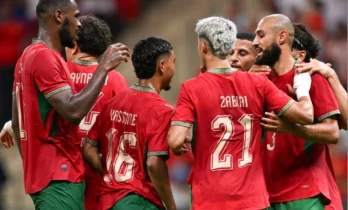
Morocco began their 2027 Africa Cup of Nations qualifying campaign with the essentials in place: three points, two goals and a clean sheet. Noussair Mazraoui broke Gabon’s resistance in the 36th minute before Soufiane Rahimi, introduced from the bench, completed the 2-0 victory six minutes from time.
The result gave Mohamed Ouahbi a successful first competitive outing of the new cycle. Without suspended captain Achraf Hakimi and midfielder Ismaël Saibari, the coach trusted a younger lineup featuring Yassir Zabiri, Yassine Gessime and Ali Maamar.
Morocco controlled possession from the start and forced Gabon into a low defensive posture. Azzedine Ounahi was central to the early pressure and struck the crossbar in the 27th minute. Nine minutes later, Mazraoui moved into an inside channel and fired from outside the box to give the home side the lead.
The goal mattered beyond the score. In Hakimi’s absence, Morocco needed another senior player to assume responsibility on the right and in the final third. Mazraoui supplied both authority and precision.
The hosts could have doubled their advantage before half-time, but Neil El Aynaoui failed to convert a delivery from Abdessamad Ezzalzouli. That lack of efficiency became the main reservation attached to an otherwise controlled first half.
After the interval, Gabon found more room as Morocco’s intensity dropped. Yassine Bounou made two important saves during the visitors’ strongest spell, preventing the game from being reset at 1-1. Ouahbi later acknowledged that his side had briefly gone to sleep and allowed two dangerous chances.
Rahimi eventually removed the uncertainty. In the 84th minute, Bilal El Khannouss delivered from the flank and the substitute finished to secure the points. The move highlighted Morocco’s depth: even when the starting attack lacked a decisive final touch, the bench provided an experienced match-winner.
Ouahbi’s starting XI — Bounou, Mazraoui, Aguerd, Issa Diop, Maamar, Bouaddi, El Aynaoui, Ounahi, Gessime, Ezzalzouli and Zabiri — also revealed his broader plan. Youth is being introduced inside an experienced structure rather than through a complete reset.
After the game, the coach defended the performance, pointing to Morocco’s control and the number of opportunities created while accepting that improvement is required. El Aynaoui struck a similar note: the players wanted to reward the home crowd, created enough chances for a larger score and must now become more clinical.
Public reaction in Morocco followed the same pattern. Visible post-match discussion was mostly positive about the result, Bounou’s clean sheet, Mazraoui’s leadership and Rahimi’s impact. Supporters also welcomed the opportunities given to younger players.
The praise came with conditions. Many reactions focused on the chances left unfinished and the loss of control during parts of the second half. The recurring concern was simple: a stronger or more clinical opponent might punish the same drop in concentration.
This is a qualitative reading of public comments and discussion, not a representative poll. Yet it shows how expectations around Morocco have changed. A qualifying win is no longer enough by itself; supporters increasingly judge the national team by the continuity of its control, its attacking efficiency and the clarity of its playing identity.
Morocco now move on to face Lesotho in Bloemfontein on 29 September. The victory over Gabon gives Ouahbi both momentum and room to develop his ideas. It also provides a useful warning: the Atlas Lions can dominate and draw decisive contributions from the bench, but they cannot afford extended lapses in intensity.
MMNEWS verdict: a solid and deserved start, encouraging for the new generation, but not yet the complete performance demanded by Morocco’s ambitions.
💬 Commentaires (0)
Aucun commentaire. Soyez le premier !
✏️ Laisser un commentaire