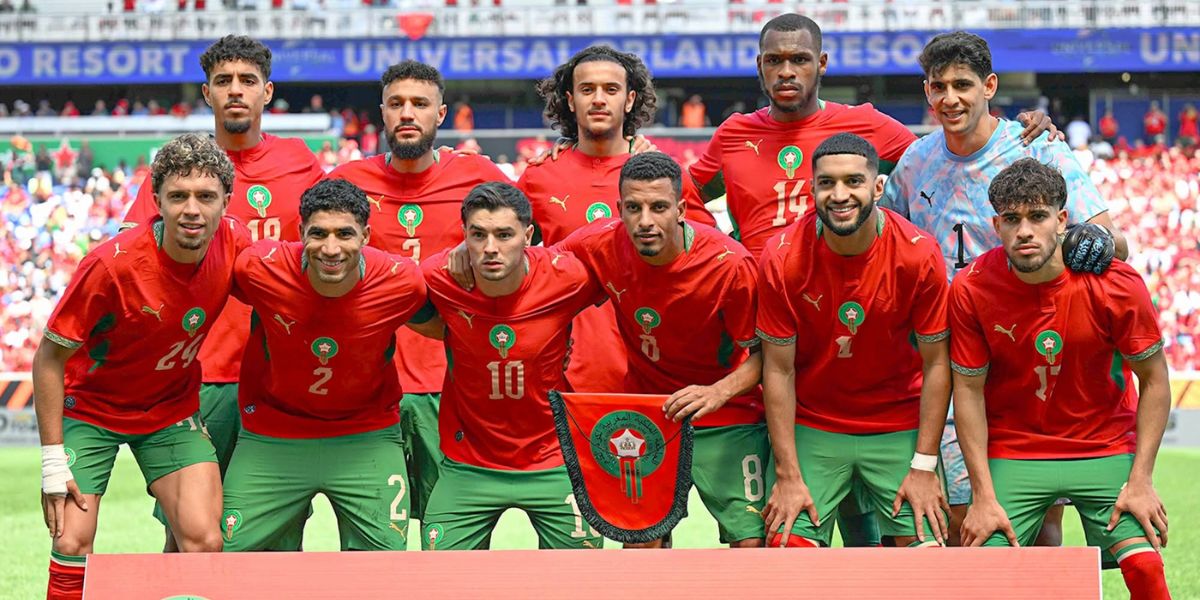
Mohamed Ouahbi’s first squad since Morocco’s 2026 World Cup quarter-final is more than a routine September selection. It sets out a policy. Yassine Bounou, Achraf Hakimi, Nayef Aguerd, Noussair Mazraoui, Azzedine Ounahi and Brahim Díaz still provide experience, but a new group is being asked to take responsibility rather than simply wait: Ayyoub Bouaddi, Samir El Mourabet, Soufiane El-Faouzi, Abdellah Ouazzane, Yassir Zabiri, Tawfik Bentayeb and Yassine Gessime.
Morocco host Gabon in Rabat on 25 September, travel to face Lesotho in Bloemfontein four days later and then meet Ghana in a friendly in Tangier on 4 October. The sequence gives Ouahbi three distinct problems: controlling a dangerous opponent, breaking down a likely low block and using a non-competitive fixture to test the depth of his squad.
The 29-player squad
Goalkeepers: Yassine Bounou, Munir El Kajoui, Ahmed Reda Tagnaouti, Alaa Bellaarouch.
Defenders: Noussair Mazraoui, Anass Salah-Eddine, Marwane Saâdane, Nayef Aguerd, Redouane Halhal, Issa Diop, Abdelhamid Aït Boudlal, Achraf Hakimi, Zakaria El Ouahdi, Ali Maamar.
Midfielders: Samir El Mourabet, Ayyoub Bouaddi, Neil El Aynaoui, Oussama Targhalline, Bilal El Khannouss, Soufiane El-Faouzi, Azzedine Ounahi, Ismael Saibari.
Forwards: Brahim Díaz, Yassine Gessime, Abdessamad Ezzalzouli, Abdellah Ouazzane, Soufiane Rahimi, Tawfik Bentayeb, Yassir Zabiri.
Four goalkeepers, one visible hierarchy
Calling four goalkeepers makes sense for a camp containing three matches and gives the staff space to assess its medium-term options. Bounou remains the natural reference because of his international experience and composure in high-pressure games. El Kajoui supplies established cover, while Tagnaouti and Bellaarouch can be measured more closely within the senior environment.
The numbers do not necessarily signal a challenge to the first-choice position. They suggest that Ouahbi wants genuine depth. The Ghana friendly may provide minutes for a reserve goalkeeper, depending on how Morocco navigate the two qualifiers.
Defensive versatility is a tactical asset
Ten defenders give Morocco several possible structures. Hakimi, Mazraoui, El Ouahdi, Maamar and Salah-Eddine can hold the width, move inside or operate higher up the pitch. That range suits a team that wants its full-backs to drive possession, while retaining the option of switching to a back three.
Aguerd remains the senior figure in central defence, particularly for his distribution. Saâdane, Halhal, Diop and Aït Boudlal offer different levels of experience and different physical profiles. Their task will change from one qualifier to the next. Against Gabon, the centre-backs must survive transitions when the full-backs advance. Against a deeper Lesotho side, they will be expected to circulate the ball quickly and play through the first defensive line.
Hakimi’s fitness is one issue to monitor. Reporting on 18 September indicated that he had resumed with individual work. His selection reflects his importance, but inclusion does not automatically mean he will be ready for three games. The squad has enough full-back depth for the staff to avoid unnecessary risk.
Midfield is where the transition becomes unmistakable
The strongest break with the recent past is in midfield. Sofyan Amrabat has made himself unavailable while Ouahbi remains coach, although he has not retired from international football. Ouahbi denied a personal dispute and said the issue concerned playing time and competition. His broader principle was more important: previous service commands respect, not guaranteed selection.
Bouaddi, El Aynaoui and El Mourabet had already become symbols of the younger midfield at the World Cup. Bouaddi’s ability to receive under pressure, protect the first pass and cover space gives the side a new foundation. Targhalline offers positional discipline. Ounahi, El Khannouss, El-Faouzi and Saibari then provide progression, movement and creativity between the lines.
This personnel allows Ouahbi to alternate between a 4-3-3 built around a holding midfielder and a 4-2-3-1 with Brahim or El Khannouss behind the striker. The key question is balance. Technical quality alone will not control Gabon. Morocco need midfielders who can manage turnovers, delay counter-attacks and cover Hakimi’s forward runs.
Saibari is the squad’s most valuable tactical variable. His effective use in a more central attacking role during the World Cup means he can play as a box-arriving midfielder, a powerful number 10 or an emergency centre-forward. That flexibility helps explain why the official list contains only seven forwards.
A rebuilt attack with no protected status
The forward line contains the biggest changes. Brahim, Ezzalzouli and Rahimi are the established names. Ouazzane, Zabiri, Bentayeb and Gessime are not merely development selections; they are being asked to offer immediate alternatives.
Zabiri arrives with notable scoring momentum. Ouazzane brings invention and an ability to operate between lines despite his age. Bentayeb offers a more central reference, while Gessime expands the options in wide areas. Collectively, the group prioritises mobility and current form over an entrenched centre-forward hierarchy.
The omissions of Youssef En-Nesyri, Ayoub El Kaabi, Younes Ebnoutalib, Eliesse Ben Seghir, Amine Adli, Chemsdine Talbi, Amir Richardson and Amine Sbaï are therefore significant. They may not all have been excluded for the same reason; fitness, club rhythm, tactical preference and competition can each play a part. Without individual official explanations, assigning a single cause would be speculation. What is clear is that the selection is no longer organised around fixed status.
Three matches, three tests
Against Gabon, Morocco’s first task is transition control. Ouahbi’s side should have more of the ball, but ambitious positioning can create large spaces after possession is lost. A double pivot, or at least one disciplined central midfielder, may be needed to protect the advancing full-backs and prevent the game from becoming stretched.
Lesotho may pose the opposite challenge. Morocco could face a compact defensive block and must create width without becoming predictable. Combinations involving Brahim, El Khannouss, Ezzalzouli and the full-backs should be central, but the team also needs runners attacking the penalty area rather than circulating endlessly around it.
The Ghana friendly is the laboratory. Ouahbi can test a younger central-defensive partnership, alter the midfield structure or give the new forwards longer minutes. Yet experimentation still needs purpose. With the 2027 tournament approaching, every international window should help establish partnerships that can survive higher-level pressure.
A squad drawn from Morocco’s global football network
The list also reflects the depth of Morocco’s diaspora talent. Several players grew up or were developed in European systems before committing to the Atlas Lions. Recruiting them is no longer a sequence of isolated decisions. It is part of a federation pathway connecting youth teams, overseas scouting and the senior side.
The reward is competition in almost every position. The danger is collecting talent without defining roles. Ouahbi must make expectations clear while preserving the sense that selection remains open. His message in the Amrabat case is demanding but coherent: history earns recognition, not immunity from competition.
This is neither a total revolution nor a cautious repeat of the World Cup squad. It is a managed handover. Morocco still have leaders capable of guiding the group, but influence is gradually shifting towards Bouaddi, Saibari, El Aynaoui, El Khannouss and a new attacking generation. The Gabon and Lesotho matches will show whether that future can deliver qualifying points immediately.
💬 Commentaires (0)
Aucun commentaire. Soyez le premier !
✏️ Laisser un commentaire