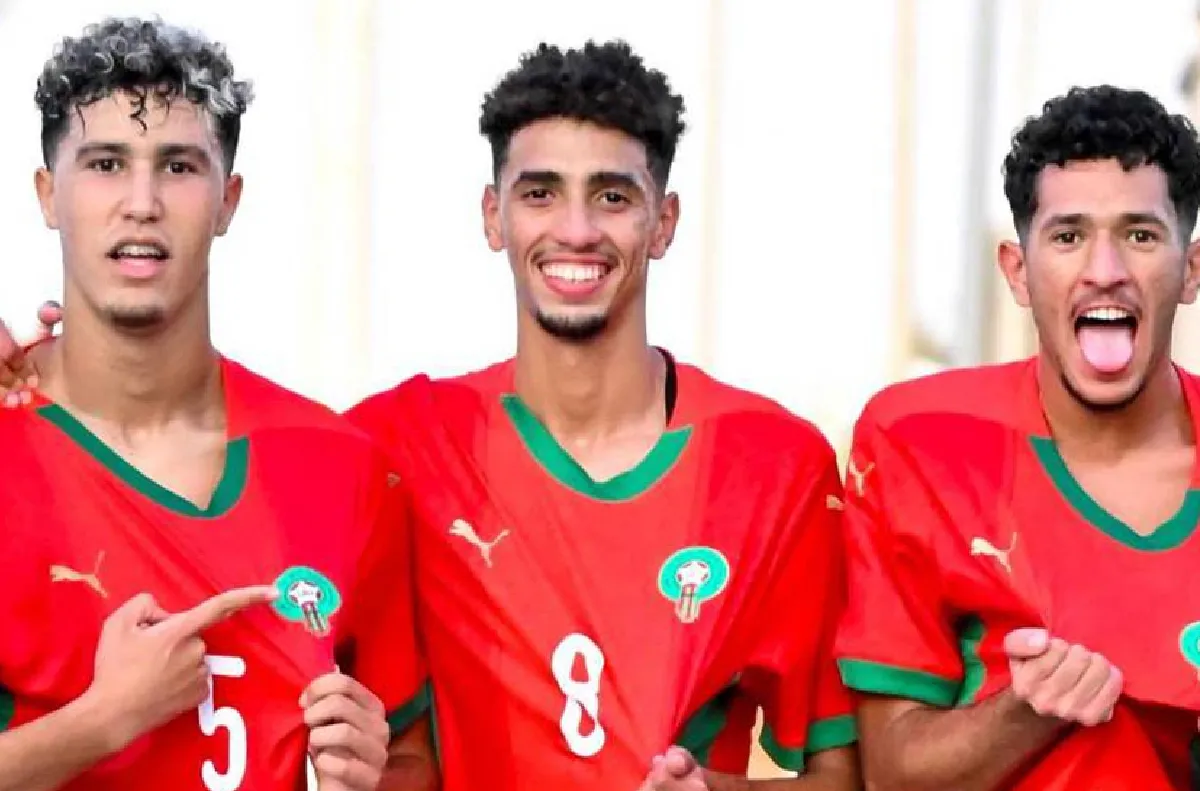
The mood around Morocco’s U20 team has changed in less than a week. On 27 September, the Atlas Cubs opened their UNAF qualifying campaign with a flat 0-0 draw against Tunisia. Their build-up was slow, central creativity limited and the attack too dependent on isolated actions.
Those concerns were legitimate. They are no longer the whole story.
Ludovic Batelli’s side responded by beating Algeria 3-1 on 30 September and Egypt 2-0 on 3 October. Morocco now lead the five-team qualifying group with seven points and cannot finish outside the two qualification places, regardless of the result against Libya on 6 October.
The turnaround in numbers
| Date | Match | Result | Morocco scorers |
|---|---|---|---|
| 27 September | Morocco–Tunisia | 0-0 | — |
| 30 September | Morocco–Algeria | 3-1 | Sami Bouhoudane, Mohamed Mounssef, Ilyass Hidaoui |
| 3 October | Morocco–Egypt | 2-0 | Adam Baallal, Sami Bouhoudane |
| 6 October | Morocco–Libya | To be played | Final round |
The Algeria game unlocked the campaign. After an even first half, Morocco scored three times in eleven minutes: Bouhoudane in the 53rd, Mounssef in the 56th and Hidaoui in the 64th. The speed of circulation improved, more runs attacked space behind the defence and the scoring was shared across different areas of the team.
Against Egypt, Morocco showed a different quality. Captain Adam Baallal struck after 25 minutes and Bouhoudane added the second eight minutes later. Instead of forcing an open contest after the break, the team protected its lead, managed space and completed a clean sheet against the hosts.
One victory was built on a sudden attacking surge. The other combined an efficient first half with controlled game management. Together they provide stronger evidence of progress than the scorelines alone.
Batelli deserves credit for the response
MMNEWS’s previous assessment focused on what Morocco had shown against Tunisia. The next two matches require that assessment to be updated.
Batelli and his staff found a response under pressure. Morocco scored five goals, conceded one and won the two fixtures that carried the greatest immediate risk. Coaches should be judged not only by initial problems, but also by their ability to correct them. On that measure, Batelli deserves credit for delivering qualification.
The result does not settle every question. At the finals in Ghana, Morocco will face a broader range of tactical and physical challenges. The team must still improve its chance creation against deep blocks, its ability to play through pressure and its consistency across an entire tournament.
World champions — but a new cycle
Morocco are the reigning U20 world champions after defeating Argentina 2-0 in the final on 19 October 2025. Yet the current qualifying team is not simply the same side returning a year later. Mohamed Ouahbi, who led the world-title campaign, has moved to the senior national-team structure, while several champions have aged out of the category.
The new squad inherits a standard, not a finished team. That distinction matters. Morocco’s real test is whether its system can renew generations without losing the principles that produced the country’s first U20 world title.
Moroccan and diaspora coaches still need a pathway
Qualification should sharpen, rather than silence, the debate about Moroccan coaching development.
The argument is not that a foreign coach should be removed because of his passport. Batelli has youth-football experience and has achieved the immediate objective. Appointments should be based on licences, tactical competence, pedagogy, results and the ability to develop young players.
At the same time, Morocco needs a transparent pathway for coaches emerging from domestic clubs and academies, former internationals and qualified former MRE players developed in European football systems. They can serve as assistants, scouts, analysts and age-group coaches before progressing on merit.
The squad itself draws from Moroccan clubs, the Mohammed VI Academy and European structures. Staff members able to understand those different football cultures can strengthen the pathway from diaspora development to national-team performance.
Qualification for Ghana is therefore both an achievement and a starting point. The Libya game offers a chance to secure first place and give minutes to the wider squad. After that, the task is to build a team capable of carrying Morocco’s newly elevated standard into another continental tournament.
The first match produced doubts. The next two produced the only response that ultimately matters in elite sport: better football and convincing results.
💬 Commentaires (0)
Aucun commentaire. Soyez le premier !
✏️ Laisser un commentaire