What actually happened on August 20, 1953? Why did the French authorities decide to depose and exile Sultan Mohammed V? Why did a decision intended to weaken the Moroccan nationalist movement ultimately produce the opposite effect? And how did a confrontation between the protectorate authorities, the monarchy and the nationalist movement accelerate Morocco’s path toward independence?
To understand August 20, one has to return to a very different world: the aftermath of the Second World War, the age of European empires and the rapid rise of anti-colonial movements across Africa and Asia.
Morocco in 1953: a country under protectorate
In 1953, Morocco was not a sovereign state in the modern sense. The Treaty of Fez of March 30, 1912 had established the French Protectorate. France exercised decisive control over much of the country’s administration, military affairs, economy and foreign relations, while Spain controlled other zones and Tangier had a special international status.
The Alaouite monarchy, however, remained in place. That distinction is essential. The protectorate did not abolish the Sultanate. Instead, it preserved the monarchy while sharply limiting its effective sovereignty. Over time, that arrangement would become one of the system’s main political weaknesses.
Mohammed V and the rise of Moroccan nationalism
Mohammed Ben Youssef, later known as King Mohammed V, ascended the throne in 1927. As the years passed, especially after the Second World War, relations between the Sultan and the French authorities grew increasingly tense. At the same time, the Moroccan nationalist movement became more organised.
In January 1944, the Manifesto of Independence gave a much clearer political form to demands for national sovereignty. The debate was no longer limited to reforming the protectorate. Independence itself increasingly became the central objective.
The international context also mattered. The Second World War had weakened the old European colonial powers. Across the world, the principle of self-determination was gaining ground, while nationalist movements increasingly understood that colonial rule was no longer as permanent as it once appeared.
Tangier, 1947: a decisive political turning point
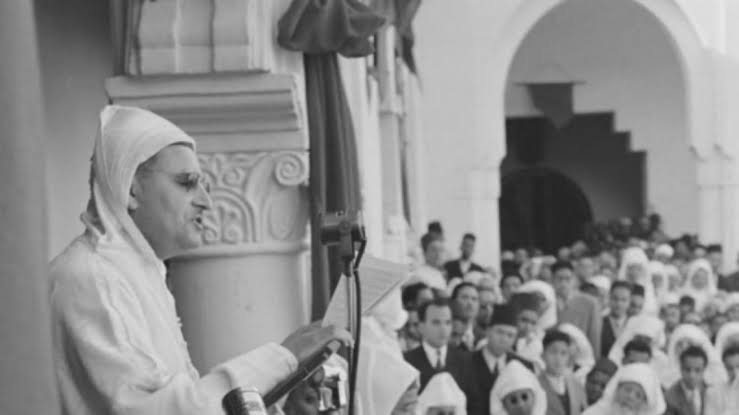
One date in particular foreshadowed the crisis of 1953: April 9, 1947. Mohammed V travelled to Tangier and delivered a speech that became a defining moment in modern Moroccan political history.
The visit strengthened the Sultan’s association with the nationalist cause and made it increasingly difficult for the protectorate authorities to separate the monarchy from the demand for greater sovereignty. From that point onward, France was no longer dealing only with political activists demanding independence. It was facing a national movement for which the Sultan himself was becoming a powerful symbol.
1953: confrontation becomes unavoidable
By the early 1950s, tensions had reached a critical point. French authorities sought to distance Mohammed V from the nationalist movement and pressure him into accepting policies more closely aligned with the protectorate.
He refused. Opponents of the nationalist movement, including powerful local figures supportive of the colonial order, backed efforts to remove the Sultan.
Among the most prominent was Thami El Glaoui, the powerful Pasha of Marrakech, who supported the campaign against Mohammed V. In the days before August 20, unrest spread in several areas of the country. Morocco was entering a major political crisis.
August 20, 1953: exile instead of abdication
On August 20, French forces surrounded the royal palace. Mohammed V was pressured to abdicate. He refused. The French authorities then deposed him and sent him into exile with members of the royal family, including the future King Hassan II. The family was first sent to Corsica, then later transferred to Madagascar. In Mohammed V’s place, the authorities supported Mohammed Ben Arafa.
From the perspective of the protectorate, the operation may initially have appeared successful. The Sultan had been removed. A replacement had been installed. But in strategic terms, the decision proved disastrous.
The decision that turned a monarch into a national symbol
The exile of Mohammed V was intended to weaken the independence movement. Instead, it greatly increased his symbolic importance. For a growing number of Moroccans, the removal of the Sultan by an outside power came to embody the loss of national sovereignty itself. The issue was no longer merely about who would occupy the throne.
It became a larger question: Who had the legitimate right to determine Morocco’s future? That is where the deeper meaning of the expression “Revolution of the King and the People” begins. The demand for Mohammed V’s return increasingly merged with the demand for national independence.
Resistance enters a new phase
The events of August 20 did not end the opposition to colonial rule. They intensified it. Political mobilisation continued, while armed resistance also expanded in several parts of the country. Rather than isolating the national movement, the exile of Mohammed V helped broaden it.
By 1955, the protectorate faced mounting political and security pressure, while the wider international environment was becoming increasingly hostile to the continuation of colonial rule. At the same time, Mohammed V had not disappeared from Moroccan political life. Quite the opposite.
An absent King who became more politically present
One of the most striking features of this period is the paradox created by exile. Physically, Mohammed V was thousands of kilometres away from Morocco. Politically, his presence became stronger.
His absence transformed him into a national symbol around which different currents of the independence movement could rally. The colonial authorities had hoped that removing him would reduce his influence. Instead, exile amplified it.
November 16, 1955: the return
After prolonged negotiations and growing instability, the return of Mohammed V became unavoidable. On November 16, 1955, the Sultan returned to Morocco with the royal family.
The reception was triumphant. In Moroccan national memory, the return came to symbolise the victory of the alliance between the monarchy and the independence movement. More importantly, it opened the final phase leading to the end of the protectorate.
A few months later, on March 2, 1956, France formally recognised Morocco’s independence. Less than three years had passed between the forced exile of Mohammed V and the end of the French Protectorate.
Why is it called the “Revolution of the King and the People”?
The term does not describe a revolution in the classical sense of overthrowing the monarchy. It refers instead to a historical convergence between monarchical legitimacy and popular demands for independence.
The protectorate authorities believed they could separate the Sultan from the nationalist movement. August 20, 1953, had the opposite effect. It strengthened the symbolic bond between the sovereign and a growing part of the population.
Historically, the movement was complex. It included different political organisations, regional actors, resistance networks and competing visions of the future. But one fact stands out clearly:
the exile of Mohammed V transformed his return into a central condition for resolving the Moroccan crisis.
What August 20 should mean to young Moroccans abroad
This is where historical memory becomes especially important for the diaspora. A young Franco-Moroccan, Belgian-Moroccan, Dutch-Moroccan or Moroccan-Canadian may learn extensively about the Second World War, the European Resistance, the Holocaust, the Cold War or European integration at school. Yet many know far less about the modern history of Morocco. That gap matters.
Identity is not transmitted only through language, food, summer holidays or football. It is also transmitted through historical understanding. Knowing what happened in August 1953 means understanding that Moroccan independence did not suddenly appear in 1956.
It resulted from a long process. Political mobilisation. Repression. Resistance. Negotiation. International change. And difficult choices made by individuals and institutions in uncertain circumstances.
Memory belongs to the diaspora too
For Moroccans living abroad, this history is not someone else’s past. It is part of the story that explains the Morocco their parents and grandparents knew, and the sovereign state that exists today.
Understanding the Revolution of the King and the People means understanding the meaning of words that can otherwise sound abstract: sovereignty, protectorate, legitimacy, resistance and independence. And the history becomes stronger, not weaker, when it is studied seriously.
Remembering without turning history into ritual
The most meaningful way to commemorate August 20 is not merely to repeat official formulas once a year. It is to study what actually happened. Great historical events remain alive because societies examine their actors, tensions, contradictions, sacrifices and consequences.
This is how the Second World War and the European resistance movements continue to be taught and debated decades later. Moroccan history deserves the same intellectual seriousness.
Young generations should know Mohammed V, but also the nationalist movement, resistance networks, regional mobilisations, the colonial system and the international context in which decolonisation unfolded. Memory becomes more powerful when it is understood.
August 20 is more than a date
More than seven decades later, Morocco is a profoundly different country. But the historical meaning of August 20 remains. The date recalls how a decision intended to reinforce foreign control produced the opposite result. By exiling Mohammed V, the protectorate authorities believed they were solving a political crisis. Instead, they helped turn the crisis into a broader national mobilisation.
Two years later, Mohammed V returned. Less than three years after August 20, 1953, the French Protectorate had ended. For young Moroccans around the world, perhaps the simplest way to understand the commemoration is this:
August 20 does not commemorate only the exile of a King. It remembers the moment when his exile helped transform the demand for his return into a broader demand for national sovereignty.
That is the historical force of the Revolution of the King and the People. And that is why, more than seventy years later, August 20 deserves to be studied as much as it is commemorated.
💬 التعليقات (0)
لا توجد تعليقات. كن أول من يعلق!
✏️ اكتب تعليقك