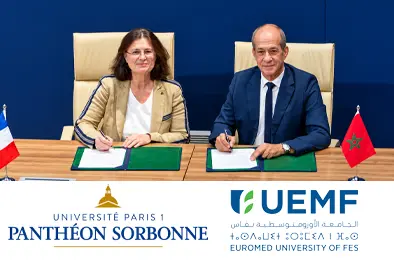
Paris and Fez brought their classrooms closer together on 15 October 2026. Paris 1 Panthéon-Sorbonne opened its first shared international campus inside the Euro-Mediterranean University of Fez’s eco-campus, formalising a partnership that began in 2016.
This is not a new French university established on Moroccan soil. It is a permanent joint space designed to support shared programmes, student and faculty mobility and collaborative research. It is also important to name the institution correctly: the partner is Paris 1 Panthéon-Sorbonne, known for law, economics, management, political science and the humanities, not the separate institution called Sorbonne University.
The partnership already supports a joint bachelor’s degree in political science, a Franco-Moroccan master’s in business law launched in 2022 and a newer master’s covering Mediterranean and African policies, migration and transitions. Future cooperation is being considered in management, history, law, political science and the relationship between artificial intelligence and society.
International education without compulsory migration
For Moroccan students, the most immediate benefit is practical. A Paris 1-linked degree can be studied in Fez, with faculty travelling from Paris and elsewhere in Europe. Depending on the programme, graduates receive both French and Moroccan degrees.
That changes the family budget. Studying in Paris requires far more than university fees: visas, travel, rent, deposits, transport and everyday expenses can turn admission into an unaffordable offer. Completing an international programme in Morocco can remove much of that burden while allowing students to remain connected to local professional networks.
The business-law master shows what the model can deliver. The two-year programme combines French and Moroccan business law with OHADA law, arbitration, international trade and intellectual property, and includes a three-month internship. The Paris 1 degree enables graduates to sit the French bar entrance examination, while the additional Moroccan master’s provides a route towards legal practice in Morocco. UEMF reported that five students from the programme passed the French entrance examination in December 2025.
A research base, not merely a teaching outpost
The project could also rebalance Morocco’s academic geography. International programmes and major professional networks remain concentrated in Casablanca and Rabat. A permanent Paris 1 presence can help Fez attract students, researchers, conferences and knowledge-based activity.
Paris 1 says its researchers will have offices, library access and a base for fieldwork and joint projects in Morocco. If that infrastructure produces co-supervised doctorates, funded research, laboratories and publications, young Moroccan academics will gain international connections without necessarily leaving the country for good.
Mobility can work in both directions. French, European and African students studying in Fez would make the campus more international and strengthen Morocco’s ambition to become an education hub linking Europe, the Mediterranean and Africa.
Prestige does not automatically mean inclusion
The decisive question is who can enter. Public information describes the programmes and their ambitions, but does not yet provide a sufficiently clear, programme-by-programme account of total tuition, available places or the share of students receiving financial support.
UEMF says its aid system can cover 25%, 50%, 75% or 100% of tuition, with social grants that may include accommodation and meals. That matters. Yet each joint programme should publish its full cost, selection criteria, scholarship numbers and graduate outcomes.
Academic selectivity is defensible. Selection by family income is not. If joint degrees remain available mainly to students who could already finance an international education, the campus will bring the Sorbonne closer geographically without broadening access socially.
Partnerships with Morocco’s public universities could change that equation. Semester exchanges, summer schools, research placements, shared digital resources and places reserved for high-performing public-university students would give the Fez campus a national reach beyond those formally enrolled at UEMF.
The final test is measurable impact: students trained, scholarships awarded, two-way exchanges, internships, jobs, joint doctorates, publications and projects with Moroccan institutions and businesses.
The Fez campus carries a powerful idea—that international opportunity should not force Moroccan youth to choose between academic quality and staying connected to their country. But its success will be measured by the doors it opens, not by the prestige of the names above them.

💬 التعليقات (0)
لا توجد تعليقات. كن أول من يعلق!
✏️ اكتب تعليقك