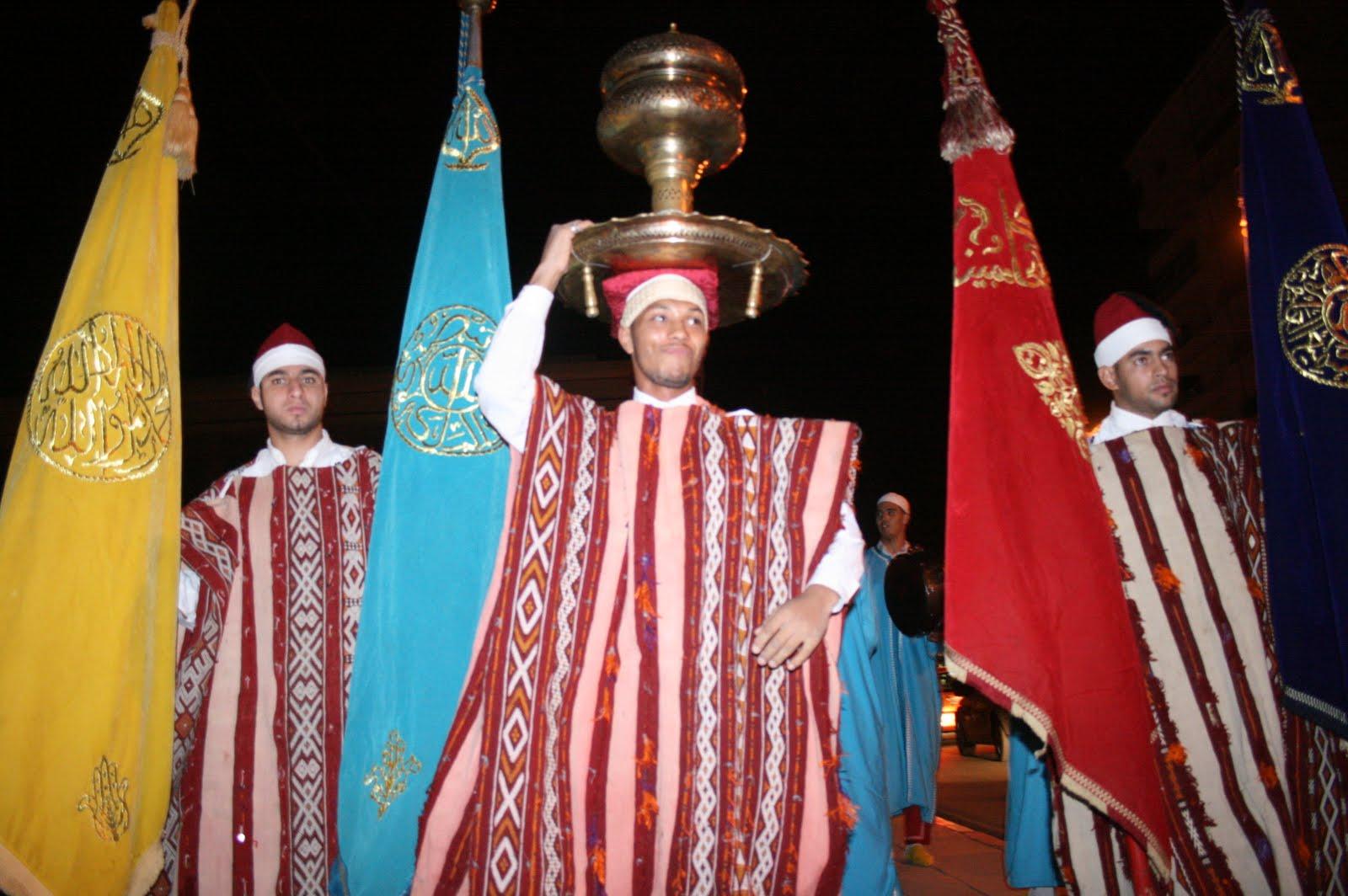
From the surroundings of the mausoleum of Sidi M’hamed Ben Aïssa, known as Cheikh Al Kamel, come the sound of drums, the piercing voice of the ghaita, collective invocations and processions carrying banners through streets where spirituality, music and memory have met for centuries.
For the Aïssawa brotherhood, Mawlid — commemorating the birth of the Prophet Muhammad — is one of the great moments of the year. In Meknes, it is inseparable from the moussem dedicated to the founder of the order, whose sanctuary has drawn disciples and visitors from across Morocco for generations.
Meknes, the spiritual home of the Aïssawa
The story begins with Sidi M’hamed Ben Aïssa, a Moroccan Sufi figure associated with Meknes and traditionally dated to 1467–1526.
Known as Cheikh Al Kamel, he became the central spiritual reference of the Aïssawa order. Historical accounts describe his zawiya as a place where disciples gathered for religious teaching, remembrance of God and devotional nights, particularly during Mawlid. Over the centuries, the brotherhood spread well beyond Meknes.
Yet the city remained its symbolic centre — the place to which groups return, especially at Mawlid, to perform the ziyara, the devotional visit to the saint’s mausoleum. This pilgrimage is not simply movement through space. It is a return to origin.
The Mawlid procession: the city becomes a stage of devotion
During the moussem, Aïssawa groups traditionally arrive in taïfas, organized brotherhood ensembles coming from different parts of the Kingdom. White garments, red fezzes, embroidered banners, incense and musical instruments give the processions a strong visual identity.
But reducing the scene to folklore would miss its meaning. For participants, these gestures belong to a devotional tradition structured around praise of the Prophet, remembrance, community and spiritual discipline. Meknes therefore becomes, for several days, a city in which the sacred leaves private space and enters the street.
The Lila: a night built in stages
At the heart of Aïssawa tradition is the Lila, the ritual night. Its sequence has been transmitted orally across generations and traditionally includes several phases: Hizb, Dhikr, Horm, Ahadun and Hadra.
The evening may begin with the Hizb, a recited devotional repertoire containing religious formulas and Quranic references. Then comes the Dhikr, with invocations and chants, often led by a solo voice to which the group responds.
Gradually, percussion becomes more insistent. The tbel and bendir establish the pulse, while the ghaita gives Aïssawa music one of its most recognizable sounds. The music is not an ornament placed around the ritual. It is part of its architecture.
The Hadra: when rhythm becomes collective movement

The Hadra is among the most intense moments of the ceremony. Participants form a group, mark the rhythm with repeated steps and coordinate breathing, voices and movements.
From the outside, the scene can appear spectacular. Within the tradition, however, it belongs to a spiritual practice in which repetition, rhythm and collective concentration seek to move the participant beyond ordinary distraction.
That is why the Aïssawa heritage should not be reduced to the word “trance”. Its meaning lies in an entire ritual grammar: prayer, praise, discipline, music, gestures and transmission.
A sound that belongs to Morocco’s cultural memory
Few Moroccan musical traditions can be recognized as quickly as Aïssawa. A single ghaita phrase can evoke a wedding, a moussem, a medina procession or a family celebration.
The sound has travelled far beyond religious gatherings and entered Morocco’s broader popular culture. Yet within the Mawlid of Meknes, it recovers its original depth.
Here, music is inseparable from the spiritual environment that produced it. This distinction matters at a time when traditional repertoires can easily be transformed into stage performances stripped of context.
Between spiritual heritage and popular celebration
The history of the Aïssawa has not been frozen. Even within the brotherhood, discussions have taken place about separating the core devotional tradition from spectacular practices that accumulated over time. In earlier interviews, Meknes Aïssawa representatives emphasized a return to religious chants, the Hizb and the teachings attributed to Cheikh Al Kamel.
That evolution reveals an important point about living heritage: preserving tradition does not necessarily mean preserving every practice unchanged. Sometimes, safeguarding means returning to the meaning beneath the spectacle.
A heritage transmitted by memory before paper
For centuries, much of Aïssawa knowledge passed from master to disciple, musician to apprentice, parent to child.
One learns how to strike the drum by watching. One recognizes the moment when a chant changes rhythm by listening. One memorizes a repertoire by repeating it through nights and processions. This oral transmission has given the tradition extraordinary resilience. But it also makes it fragile. If the chain between generations breaks, part of the knowledge can disappear without ever having been fully written down.
For the diaspora, a sound capable of bringing Meknes home
The Aïssawa tradition also travels with Moroccans abroad. In France, Belgium, the Netherlands, Canada and elsewhere, Aïssawa ensembles appear at weddings, cultural events and community celebrations. For a Moroccan born far from Meknes, the first connection to this heritage may not come from a history book.
It may come from a grandfather’s memory, a video of the Mawlid procession, or the first notes of a ghaita heard at a family celebration. This is how intangible heritage survives migration. It does not travel inside a monument.
It travels inside people.
Mawlid in Meknes: celebrating while transmitting
Meknes gives Mawlid a character unlike almost anywhere else in Morocco. The celebration combines devotion to the Prophet, attachment to Cheikh Al Kamel, the ritual identity of the Aïssawa and a strong sense of collective memory.
Its importance lies precisely in this combination. The banners, drums, chants and processions are visible. What they carry is less visible: centuries of spiritual language, family memory and artisanal knowledge of sound and rhythm. For Morocco, safeguarding such traditions means more than photographing them or putting them on a festival stage.
It means ensuring that younger generations understand why these gestures exist before learning how to reproduce them.
Because when the drums rise in Meknes during Mawlid and the ghaita answers them across the old city, what is being heard is not simply music.
It is a part of Morocco remembering itself.


💬 Comments (0)
No comments yet. Be the first!
✏️ Leave a comment