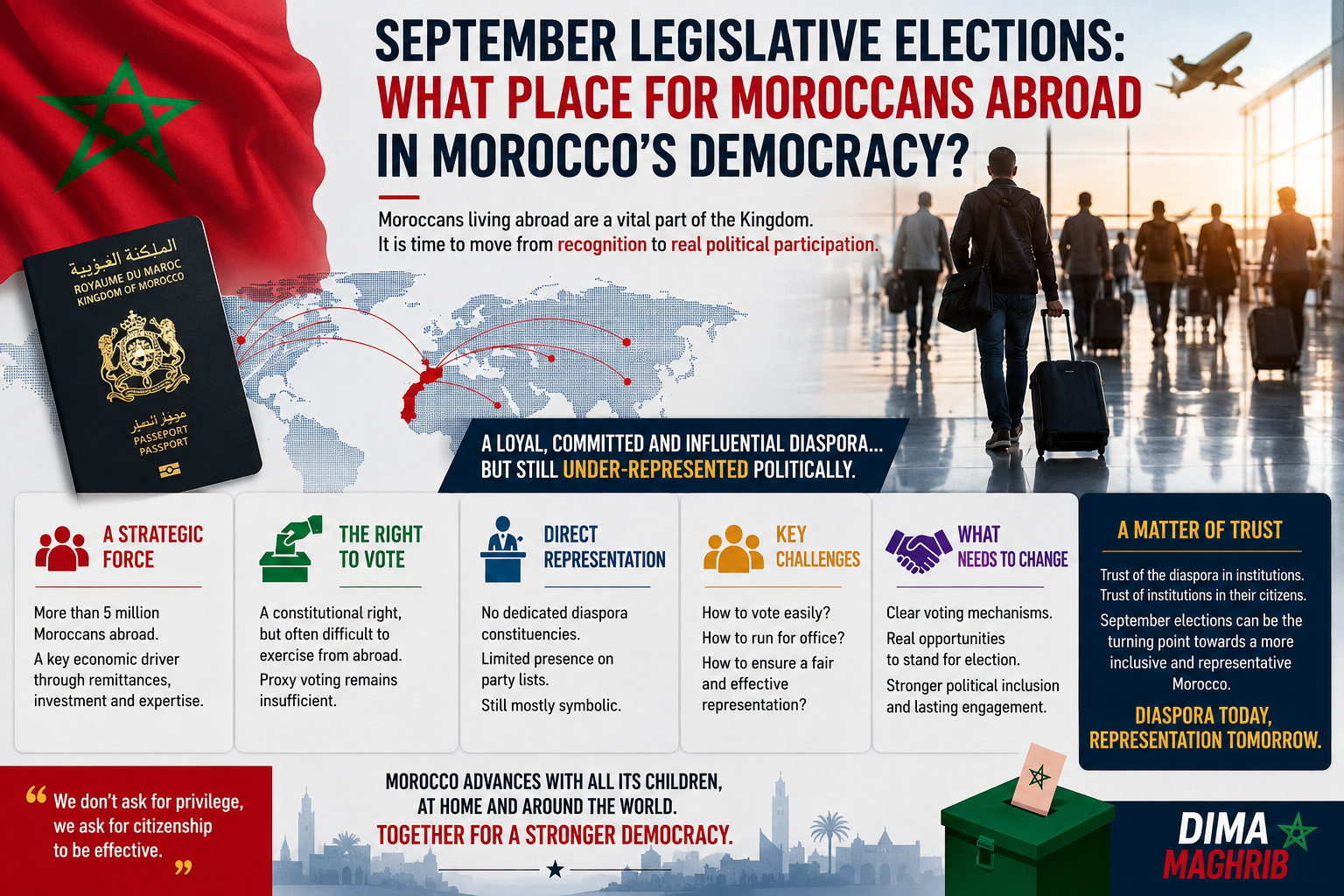
This question is not new. It resurfaces before almost every electoral cycle, like an unfinished file. Moroccans abroad are strongly present in official speeches, in the national economy, in remittances, in Morocco’s international image, and in the daily defense of the country’s cultural and emotional ties. Yet when it comes to direct political representation, their place remains limited, unclear and often close to invisible.
A Recognized Citizenship, But a Difficult One to Exercise
Morocco recognizes Moroccans residing abroad as full citizens, including the right to vote and to stand for election. But recognizing a right in principle is one thing; turning it into a practical, accessible and organized mechanism is another.
This is where the political issue begins. The Moroccan living in Madrid, Paris, Brussels, Amsterdam, Montreal, New York, Doha or Milan remains a citizen in law, but often becomes a distant voter in practice. Geographical distance, registration difficulties, weak party presence abroad and limited voting mechanisms all make political participation more complicated than it should be.
Democracy is not measured only by the formal existence of rights. It is also measured by the real possibility of exercising them.
Moroccans Abroad: Economic Actors, Political Outsiders?
Morocco expects a great deal from its diaspora. It expects remittances, investment, expertise, cultural influence, defense of the country’s image, and the transmission of Moroccan identity to younger generations born abroad.
That expectation is understandable. Moroccans abroad represent a strategic human asset. But the deeper question remains: can a country ask its citizens abroad to contribute continuously to national development without offering them clearer channels to participate in political decision-making?
This is the central contradiction. The diaspora is considered essential when it sends money, invests, supports national causes or returns home every summer. But when the discussion turns to electoral representation, the same diaspora often finds itself pushed to the margins.
Direct Representation: Democratic Demand or Institutional Puzzle?
Several proposals regularly return to the debate: creating electoral districts dedicated to Moroccans abroad, allowing voting in consulates, introducing secure electronic voting, creating a national list for diaspora candidates, or making it easier for qualified Moroccans abroad to run through party lists.
Each proposal has logic. But each also raises serious questions. How should diaspora constituencies be divided? By continent, by country, by population density, or by migration history? How can the integrity of remote voting be guaranteed? How can representation avoid being captured by only the most organized networks or those closest to party machines?
These questions are real. But they should not become a permanent excuse for postponement. Many countries with large diasporas have faced similar challenges. The difference is rarely technical alone. It is political.
Political Parties and the Test of Seriousness
The state is not the only actor responsible for the weak political presence of Moroccans abroad. Political parties also carry a major share of responsibility.
Many parties mention the diaspora in their programs. Few build a lasting relationship with it. Moroccans abroad are often approached during campaigns, conferences, summer visits or symbolic meetings. But how many parties truly open their internal structures to diaspora voices? How many develop platforms that respond to their concrete concerns? How many treat them as citizens rather than as communication material?
The risk is clear: turning the diaspora into an electoral image instead of recognizing it as a complex social and political reality.
The Diaspora Is Not One Single Bloc
One recurring mistake is to speak of Moroccans abroad as if they were a homogeneous group. They are not.
The diaspora includes workers, entrepreneurs, students, doctors, engineers, artists, retirees, dual nationals, women active in associations, young people born abroad, and generations who may speak French, Dutch, Spanish, Italian, English or German more easily than administrative Arabic, while still maintaining a deep emotional connection to Morocco.
The concerns of a Moroccan in Spain are not always the same as those of a Moroccan in Canada, the Gulf, the United States or sub-Saharan Africa. Yet one shared feeling often emerges: Moroccans abroad do not want to be seen only as a source of remittances.
From Consultation to Representation
Morocco has institutions and bodies concerned with the affairs of Moroccans abroad, and these can play a useful role in reflection, assessment and policy recommendations. But consultation is not the same as electoral representation.
A consultative institution can produce reports, advise decision-makers and organize dialogue. But it does not replace elected representatives with a direct mandate from citizens living abroad.
This is the key distinction: being heard is not the same as being represented.
A Question of Political Trust
The participation of Moroccans abroad in legislative elections is ultimately a question of trust.
It is about the trust of the diaspora in national institutions. It is about the trust of institutions in citizens who live outside the territory but remain attached to the country. It is also about whether political parties are ready to engage with voters who may be more independent, more demanding and less tied to traditional local networks.
Many Moroccans abroad live in countries where remote voting, consular voting or specific representation for expatriates are familiar practices. They compare. They observe. They ask for solutions that go beyond declarations of affection.
Without real progress, the discourse on the diaspora risks becoming emotionally warm but politically incomplete.
What September Could Change
The September elections could become an opportunity to open a serious national discussion. Not everything has to be resolved at once. But a roadmap is needed.
First, Morocco must clarify how Moroccans abroad can vote in a simple, secure and transparent way.
Second, it must define how they can run for office without being reduced to symbolic figures on party lists.
Third, it must determine what type of representation is most appropriate: dedicated constituencies, national lists, mandatory party mechanisms, or a hybrid model.
The most important step is to leave the grey zone. Political citizenship cannot be postponed after every election.
From a Useful Diaspora to a Represented Diaspora
The place of Moroccans abroad in the September legislative elections is not a technical detail. It raises a deeper question about the meaning of Moroccan citizenship in an age of migration and globalization.
Does a Moroccan citizen remain fully political when he or she leaves the national territory? Or does that citizen gradually become emotional, economic and seasonal, but not truly represented?
Morocco cannot present its diaspora as a strategic force in the economy, diplomacy and national identity while leaving its political representation at the margins. Moroccans abroad are not asking for a privilege. They are asking for citizenship to become effective.
The challenge is clear: to move from a diaspora that is celebrated to a diaspora that is heard; from a diaspora that is called upon when needed to a diaspora that participates in decision-making; from emotional citizenship to effective citizenship.
September will not only reveal the balance of power inside Parliament. It will also reveal what idea Morocco has of its citizens when they live far from the territory, but never far from the country.
💬 Comments (0)
No comments yet. Be the first!
✏️ Leave a comment