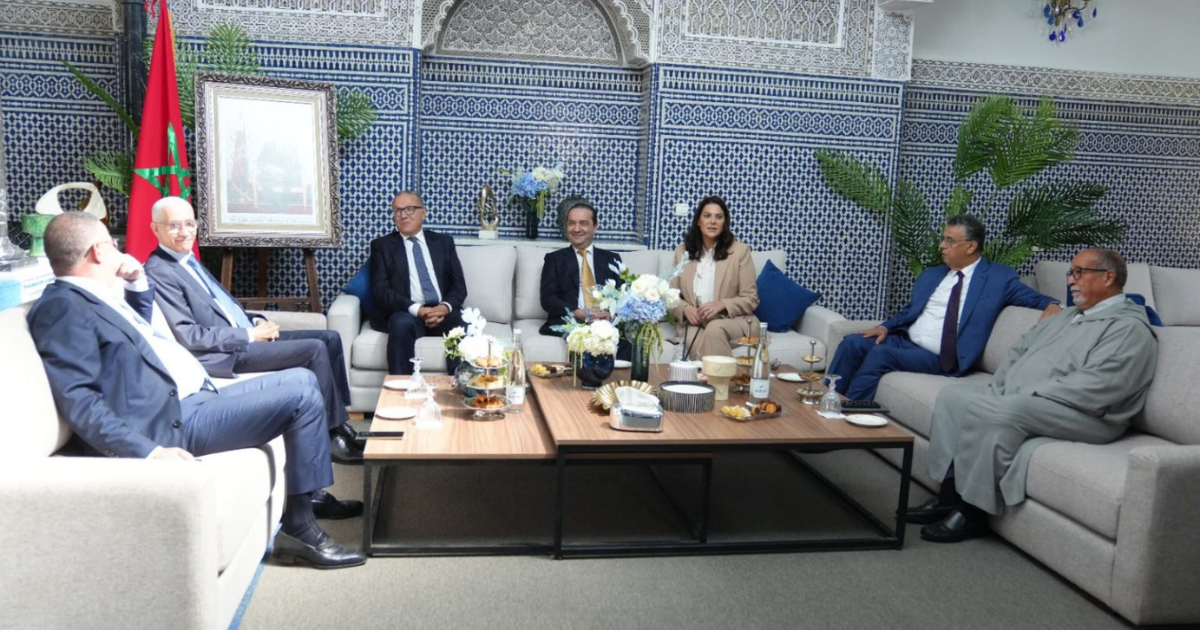
Morocco opened its 12th legislature on October 9 while negotiations over the executive remained under way. The two processes are connected, but constitutionally distinct: Parliament follows its own calendar, while El Mansouri must still complete coalition talks and submit her proposed government.
The King appointed El Mansouri on September 29 under Article 47 of the Constitution and tasked her with forming the new government. That appointment launched the process; it did not appoint the full cabinet.
A 207-seat alliance moves to the front
The leading formula now combines PAM’s 97 seats, Istiqlal’s 65, USFP’s 26 and PPS’s 19. Together, the four parties would hold 207 seats, nine above the 198 required for an absolute majority.
The arrangement would leave the RNI outside government despite its 66 seats and its publicly stated willingness to participate. This exclusion has not, however, been formally announced by El Mansouri.
Commentators have described the emerging bloc as a “Koutla around PAM”, recalling the historic cooperation between Istiqlal, USFP and PPS. The phrase is political shorthand, not the coalition’s official name and not evidence that a final agreement has been signed.
Party approvals are still being completed
USFP’s political bureau has unanimously supported joining the next government after two rounds of talks. Its National Council is due to meet in Rabat on October 10 to approve or reject that course.
PPS has authorised its political bureau to continue negotiations and settle the party’s final position. Its stated priorities include social policy, equality, public freedoms, political integrity and rebuilding trust in institutions.
Istiqlal remains the central parliamentary partner. Its leadership has authority to negotiate, but the party has said its campaign commitments must be reflected in the government programme.
The discussions therefore involve more than dividing ministries. The parties must agree on the scope of the coalition, a common programme and the political responsibility attached to each portfolio.
Cabinet numbers circulating in the press remain unconfirmed
Moroccan reports published on Friday cited party sources claiming a preliminary distribution of eight portfolios for PAM, six for Istiqlal and three each for USFP and PPS. Other reports suggested that women could account for one-third of the cabinet.
None of these details has been confirmed by the Royal Palace, El Mansouri or a joint statement from the prospective coalition parties. They should not be treated as an official cabinet composition. No individual named in press speculation can yet be described as an appointed minister.
Parliament’s opening was not a constitutional deadline
Article 65 requires Parliament’s first session to open on the second Friday of October. It does not require a new government to be formed by that date.
Under Article 47, the King appoints ministers on the proposal of the head of government. Once the cabinet is appointed, El Mansouri must present its programme to both Houses meeting jointly. Article 88 then requires a debate and a confidence vote in the House of Representatives. The government is invested only when an absolute majority of the House backs its programme.
A 207-seat coalition would clear that threshold, but with a nine-seat margin. Party discipline would therefore matter from the first confidence vote onward.
The difficult part is now political coherence
The arithmetic is increasingly clear. The programme is not.
PAM campaigned on a change of method and a stronger social focus. Istiqlal wants its electoral commitments reflected in the coalition agreement. USFP and PPS intend to influence social policy, governance and public freedoms. Each party must also justify its ministerial share to its own leadership and supporters.
El Mansouri must balance electoral weight, competence, regional representation, the presence of women and institutional continuity. The next government will immediately face the 2027 budget, employment, purchasing power, health, education, water stress, territorial inequalities and preparations for the 2030 World Cup.
The MRE portfolio will be an early test
The future administrative structure for Moroccans living abroad has not been disclosed. It is not yet known whether MRE affairs will remain fully integrated into the Foreign Ministry, receive a strengthened delegated ministry or be reorganised in another form.
For the diaspora, this will be more than an organisational choice. It will indicate the priority given to political representation, consular services, property protection, skills mobility, productive investment and the evaluation of the electronic voting proxy used during the legislative elections.
Names and responsibilities should therefore be assessed only after the official announcement, rather than through unverified cabinet lists.
What is confirmed — and what remains open
Three points are established: El Mansouri has been tasked with forming the government; two rounds of consultations have taken place; and the PAM–Istiqlal–USFP–PPS formula is the most advanced scenario in current reporting.
Three points remain unresolved: final approval by all four parties, the formal announcement of the coalition and the royal appointment of the cabinet.
The El Mansouri government is not yet constituted. But the negotiations have moved from broad coalition arithmetic to concrete decisions. The next decisive development will be an official announcement identifying the governing alliance, the cabinet and the timetable for presenting its programme to Parliament.
💬 Comments (0)
No comments yet. Be the first!
✏️ Leave a comment