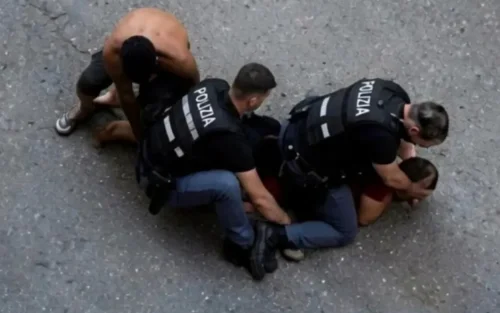
The images are disturbing. They justify a thorough, independent and transparent investigation. But they are not, on their own, enough to deliver a final verdict.
The central question is not what social media has already decided, nor what political actors may try to conclude in advance. It is whether the force used was necessary and proportionate, whether police procedures were respected, and whether the medical response came quickly enough once Fakir showed signs of distress.
A Serious Video, but Not the Entire Story
Footage filmed by witnesses is likely to become a central element in the case. It appears to document a crucial part of the intervention and shows Fakir being restrained on the ground while several people control his movements.
However, a judicial investigation cannot rely on a single angle.
Prosecutors will need to compare the witness videos with police body-camera footage, emergency calls, radio communications, medical reports and statements from everyone present.
That broader reconstruction is essential to understand what happened before the restraint, what occurred during it and when the officers or medical personnel first realized that Fakir’s condition was worsening.
The images may be powerful, but justice requires the full chronology.
The Restraint Position Is at the Heart of the Questions
One of the main issues concerns the way Fakir was held on the ground.
When a person is restrained face down, especially if pressure is applied to the back, chest or limbs, close monitoring of breathing and consciousness becomes critical. The risk may increase when the person is highly agitated, in psychological distress, suffering from a health problem or under the influence of a substance.
In the circulating footage, Fakir appears to call for help before becoming silent and motionless.
The investigation must therefore determine not only whether police had grounds to restrain him, but also how the restraint was carried out, how long it lasted, how much pressure was applied and when the emergency response began.
The decisive issue is whether the technique itself contributed to the fatal outcome.
The Autopsy Must Be Read Scientifically, Not Emotionally
In cases like this, preliminary information about an autopsy often circulates before the final forensic report is complete.
That can create confusion.
Medical examiners may need toxicology tests, tissue analysis and other examinations to identify the role played by possible physical compression, an underlying medical condition, acute agitation, chemical irritants or delayed medical intervention.
Any early conclusion must therefore be treated with caution.
The medical truth will not come from public impressions. It will come from a complete forensic analysis capable of establishing whether restraint caused the death, contributed to it or combined with other factors.
The Presence of Medical Teams Raises Further Questions
The apparent presence of emergency personnel at the scene opens another line of inquiry.
When was Fakir’s condition first medically assessed? Were paramedics able to intervene immediately? Did anyone alert the officers to a breathing risk? How much time passed between the moment he stopped responding and the beginning of resuscitation efforts?
These questions are not about blaming one profession in advance.
They are about identifying responsibility precisely.
A police intervention involving a person in severe distress can quickly become a medical emergency. At that point, coordination between officers and healthcare professionals must be immediate.
The investigation should therefore examine the conduct of everyone involved, not only the police.
A Victim Must Not Be Reduced to His Background or Past
In cases involving a person of foreign origin, public debate sometimes shifts quickly toward the victim’s nationality, prior behavior, mental state or possible criminal history.
These elements may help explain the context. They do not answer the main question.
Was the force proportionate? Were all reasonable precautions taken to protect his life?
Even a person who is agitated, aggressive or suspected of an offence retains fundamental rights.
The existence of a legitimate reason to intervene does not automatically make every method used lawful.
At the same time, asking these questions does not mean denying the difficulty of police work. Officers may face unpredictable and dangerous situations.
But precisely because the use of force can affect human life, it must always remain open to scrutiny.
Transparency Must Be a Practice, Not a Promise
In a case this sensitive, general assurances from the authorities are not enough.
Real transparency means preserving every recording, securing police body-camera footage, identifying everyone involved, guaranteeing an independent forensic examination and regularly informing the family about verified developments.
It also means ensuring that the institution concerned is not perceived as investigating itself without meaningful judicial oversight.
Public trust depends less on political declarations than on the quality and independence of the procedure.
When a person dies during an official intervention, the family and the public have the right to know exactly what happened.
Violence Must Be Condemned, but It Must Not Erase the Main Questions
The death of Abderrahim Fakir has prompted anger and calls for justice. If violence occurred during protests, it should be condemned clearly.
Such acts weaken the demand for truth and distract attention from the circumstances of the death.
But protest-related violence must not become an excuse to avoid examining the intervention itself.
These are two separate matters: the possible responsibility of those involved in the police operation, and the responsibility of individuals who may have committed offences during demonstrations.
Confusing the two would turn a judicial investigation into a political confrontation.
International Comparisons Are Understandable but Must Remain Cautious
The images of a man being restrained on the ground and calling for help have led some observers to compare the case with similar deaths in other countries.
Emotionally, such comparisons are understandable.
Legally and journalistically, however, every case has its own evidence, medical findings, sequence of events and institutional context.
The correct approach is not to import a ready-made conclusion from another tragedy, but to apply the same principle consistently: every use of force must be necessary and proportionate, and every death during an official intervention must be independently investigated.
A Case That Goes Beyond One Individual Incident
Abderrahim Fakir’s death raises broader institutional questions.
How are police officers trained to deal with people in severe psychological distress or acute agitation? Which restraint techniques are permitted? When must physical pressure be stopped and the situation transferred fully to medical professionals?
The case also highlights the importance of police body cameras.
Such devices should not be treated only as tools to defend officers or accuse them. Their purpose should be to provide a complete and objective record, provided they are activated properly, preserved securely and disclosed under clear legal rules.
The incident also touches on the trust between immigrant communities and public institutions.
When a person of foreign origin dies during a police operation, justice must not only be independent. It must visibly demonstrate that independence.
A Fair Investigation Protects Both the Victim and the Police
An independent investigation is not an attack on the police.
It protects everyone.
If the evidence shows that officers acted in accordance with the law and proper procedures, a credible investigation will confirm that and help prevent unfounded accusations.
If, however, it reveals errors, excessive force or a delayed response, accountability will be necessary, both for the family and for the credibility of the institution.
Justice should not choose in advance between the victim and the police.
Its duty is to establish the truth.
The Truth Must Be as Complete as the Images Are Disturbing
The footage of Abderrahim Fakir being held on the ground, calling for help and then becoming motionless justifies a full and independent investigation.
But the video should not become an instant verdict.
Prosecutors must determine whether the force used was necessary, whether the restraint position contributed to the death, whether signs of distress were recognized in time and whether medical assistance was provided as quickly as required.
Fakir’s family has the right to the truth. The officers have the right to a fair investigation. Italian society has the right to precise answers, free from political exploitation and premature judgment.
In a democracy, transparency does not weaken the police. It strengthens public trust. And when a man dies during an official intervention, no institution can simply ask the public to look away.



💬 Comments (0)
No comments yet. Be the first!
✏️ Leave a comment