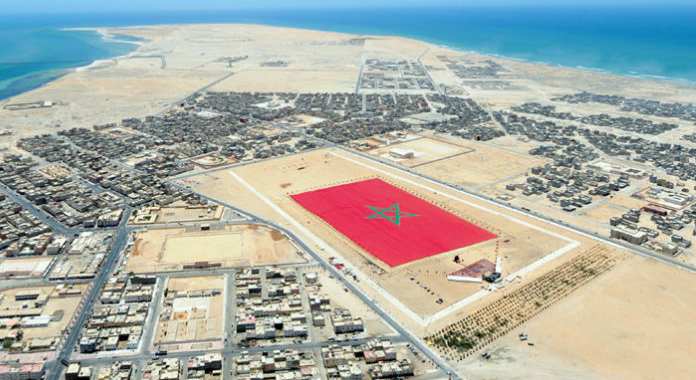
The Kingdom marks the 47th anniversary of the recovery of Oued Eddahab on Friday, commemorating the events of August 14, 1979, when tribal representatives, dignitaries and religious figures from the province travelled to Rabat and renewed their allegiance to King Hassan II. Morocco regards the event as a major milestone in the consolidation of its territorial integrity.
Nearly half a century later, however, the significance of the date is no longer expressed through history alone.
It is also visible in Dakhla’s changing skyline, infrastructure and economic ambitions.
A historic marker in Morocco’s national narrative
August 14, 1979 came after a broader sequence that included the return of Tarfaya in 1958, Sidi Ifni in 1969 and the Green March in 1975.
At the Royal Palace in Rabat, representatives from Oued Eddahab delivered the traditional Bay'ah, or pledge of allegiance, to Hassan II. Morocco has since commemorated the date as Oued Eddahab’s return to the Kingdom.
Internationally, the wider Western Sahara question remains part of a United Nations political process. The UN Security Council renewed the MINURSO mandate until October 31, 2026, while Western Sahara remains listed by the United Nations as a Non-Self-Governing Territory.
For Morocco, meanwhile, August 14 remains firmly embedded in its national understanding of territorial unity.
Dakhla is becoming a different kind of place
The modern story begins with geography.
Dakhla sits far south of Morocco’s traditional economic centres, facing the Atlantic with the Sahel and West Africa beyond.
For years, distance defined it.
Today, policy is attempting to turn that distance into an advantage.
Morocco increasingly sees Dakhla as a future logistics, energy, tourism and trade hub capable of connecting the Kingdom with Atlantic Africa.
Nothing embodies that ambition more clearly than the Dakhla Atlantic port.
A MAD 12.65 billion bet on the Atlantic
According to Morocco’s Ministry of Equipment and Water, construction of the new Dakhla Atlantic port is underway, with works valued at MAD 12.65 billion.
The idea is much bigger than a port.
The project is being developed alongside an industrial and logistics ecosystem and is meant to support fishing, trade and economic activity while giving Morocco’s southern Atlantic coastline a larger role in regional commerce.
Moroccan strategy has repeatedly framed Dakhla as a future gateway towards Africa.
If that vision works, the city will not simply become better connected to northern Morocco.
It will become a connection point in its own right.
Roads, water and energy complete the picture
The port is only useful if it connects to the rest of the economy.
That is why the transformation of the Tiznit-Dakhla corridor, stretching roughly 1,055 kilometres, is another central element of the region’s development strategy.
Water presents an even more fundamental challenge.
Dakhla is among the locations where Morocco is developing new desalination capacity. A separate agricultural project plans to irrigate 5,200 hectares using desalinated seawater powered by wind energy.
That combination — port infrastructure, road connectivity, water security and renewable energy — reveals the larger ambition.
Dakhla is being designed not simply as a city with projects, but as an economic system.
A possible new link with Moroccans abroad
That transformation may also matter to Morocco’s diaspora.
Many Moroccans living abroad work in precisely the industries Dakhla is trying to build: maritime logistics, renewable energy, water technologies, sustainable tourism, engineering, finance and infrastructure.
For younger generations of MREs, the historical meaning of August 14 may feel distant.
The economic transformation of Dakhla offers a more contemporary point of connection.
A Moroccan engineer in the Netherlands, a water specialist working in the Gulf or an entrepreneur in France may increasingly see the city not only as part of the national story, but as a potential professional or investment opportunity.
The key will be credibility.
Diaspora capital and expertise will not move simply because a project is presented as patriotic. It moves when opportunities are investable, institutions are reliable and returns — economic or professional — make sense.
That may ultimately be one of Dakhla’s more interesting tests.
From remembrance to projection
National memory looks backward by definition.
Development does the opposite.
Forty-seven years after August 14, 1979, Morocco is attempting to connect both through Dakhla.
The port, road infrastructure, desalination and renewable-energy projects will only prove their value if they translate into businesses, jobs, skills and lasting links with African and international markets.
That is what gives August 14 a contemporary dimension: Dakhla is no longer only part of a historical narrative. It is increasingly part of Morocco’s argument about where it wants to go next.

💬 Comments (0)
No comments yet. Be the first!
✏️ Leave a comment