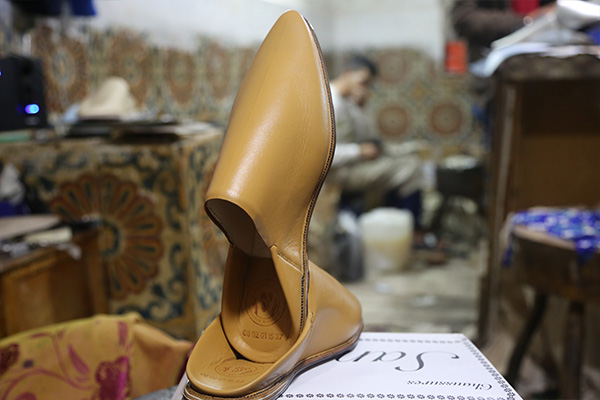
At first glance, they are traditional Moroccan shoes. In Fez, however, they are the result of an old artisanal ecosystem that begins with leather and ends in the hands of a master craftsman.
Belgha and cherbil: two different worlds
The belgha is one of the emblematic products of Morocco’s leather-working tradition. The Fez version is particularly recognizable by its pointed toe.
Historically worn by both men and women, it comes in many forms. Men’s models have traditionally favored understated shades such as yellow, grey or white, while women’s versions have allowed for greater variation in colors and decoration. The cherbil belongs more clearly to the world of female elegance.
Decorated with gold, silver or silk thread, it traditionally accompanies the caftan and ceremonial dress. In some old Fez wedding traditions, cherbil slippers even formed part of the gifts and garments prepared for a bride. The difference could almost be summed up this way: the belgha dresses the step; the cherbil also dresses the eye.
A shoe whose story begins at the tannery
Before appearing in a shop window, both the belgha and the cherbil pass through several skilled hands. Traditionally, the process begins with leather, especially goat and cattle hides, which are tanned and dyed before reaching the shoemaker. The leather is cut according to the chosen shape and size. The different pieces are then assembled and stitched onto a thick leather sole before the shoe is shaped on a last.
In Fez, master craftsman Abderrahim Zerifi, who has worked in the trade for nearly four decades, explained in 2025 that making the traditional ziwani Fez slipper involves 24 separate stages, much of the process still performed by hand. Behind the familiar label “handmade” lies a demanding reality: cutting, adjusting, stitching, smoothing and shaping, again and again, until two nearly identical shoes emerge.
A cherbil can require several days of work
Time is another major difference. A traditional belgha can take an entire working day to complete, while an elaborate cherbil may require as many as five days, especially when sophisticated embroidery and ornamentation are involved. And that embroidery reveals another story — one that has historically received less attention: the contribution of women.
Research into Fez’s traditional crafts shows that master artisans often entrusted the embroidery of cherbil uppers to women working from home. Their work was therefore less visible than that of male artisans operating in workshops and souks.
A single cherbil may consequently carry the work of several people. Perhaps that is one of the defining features of craftsmanship: one object can bring together many skills while concealing some of the hands behind it.
A tradition that has learned to evolve
The cherbil fassi has not remained frozen in the past. Over time, artisans have incorporated suede, velvet, mlifa, contemporary fabrics, metallic accessories and even small heels. Colors and embroidery have also evolved to accompany modern caftan designs and the tastes of younger generations. That ability to change may explain its survival.
It evolves enough to remain desirable without completely losing its identity.
The belgha faces the same balance between heritage and reinvention. It still accompanies djellabas, gandouras and festive clothing, while some designers are now reworking its shape for younger and international audiences.
The challenge facing the maâlems: who will learn the craft tomorrow?
This continuity is far from guaranteed. Artisans point to several challenges: fewer qualified craftspeople, rising raw-material costs and competition from industrially produced modern footwear.
The paradox is striking. At a time when Moroccan craftsmanship is gaining unprecedented international visibility, the transmission of some traditional skills is becoming more fragile.
Moroccan handicraft exports reached a record 1.232 billion dirhams in 2025, compared with 792 million dirhams in 2019. The United States accounted for 49% of exports and France for around 10.5%. Those figures concern Moroccan handicrafts as a whole rather than belgha and cherbil specifically, but they demonstrate that an international market exists.
From Fez to diaspora weddings
This is where the belgha and cherbil acquire another dimension. In Paris, Brussels, Amsterdam, Montreal and elsewhere, they reappear at Moroccan weddings, Eid celebrations and events centered around the caftan. For Moroccans abroad, their value cannot simply be measured in leather or embroidery.
Wearing belgha with a djellaba, or choosing a cherbil to match a caftan, can become a very tangible way of maintaining a connection to family heritage. A shoe produced in a narrow Fez workshop may therefore appear months later in a wedding hall thousands of kilometers away. And perhaps this is the true strength of these crafts.
The belgha and cherbil survive not simply because they belong to the past, but because Moroccans continue to give them a place in the present. In Fez, artisans are therefore making far more than shoes. Pair after pair, they are still crafting a portable piece of Moroccan memory.


💬 Comments (0)
No comments yet. Be the first!
✏️ Leave a comment