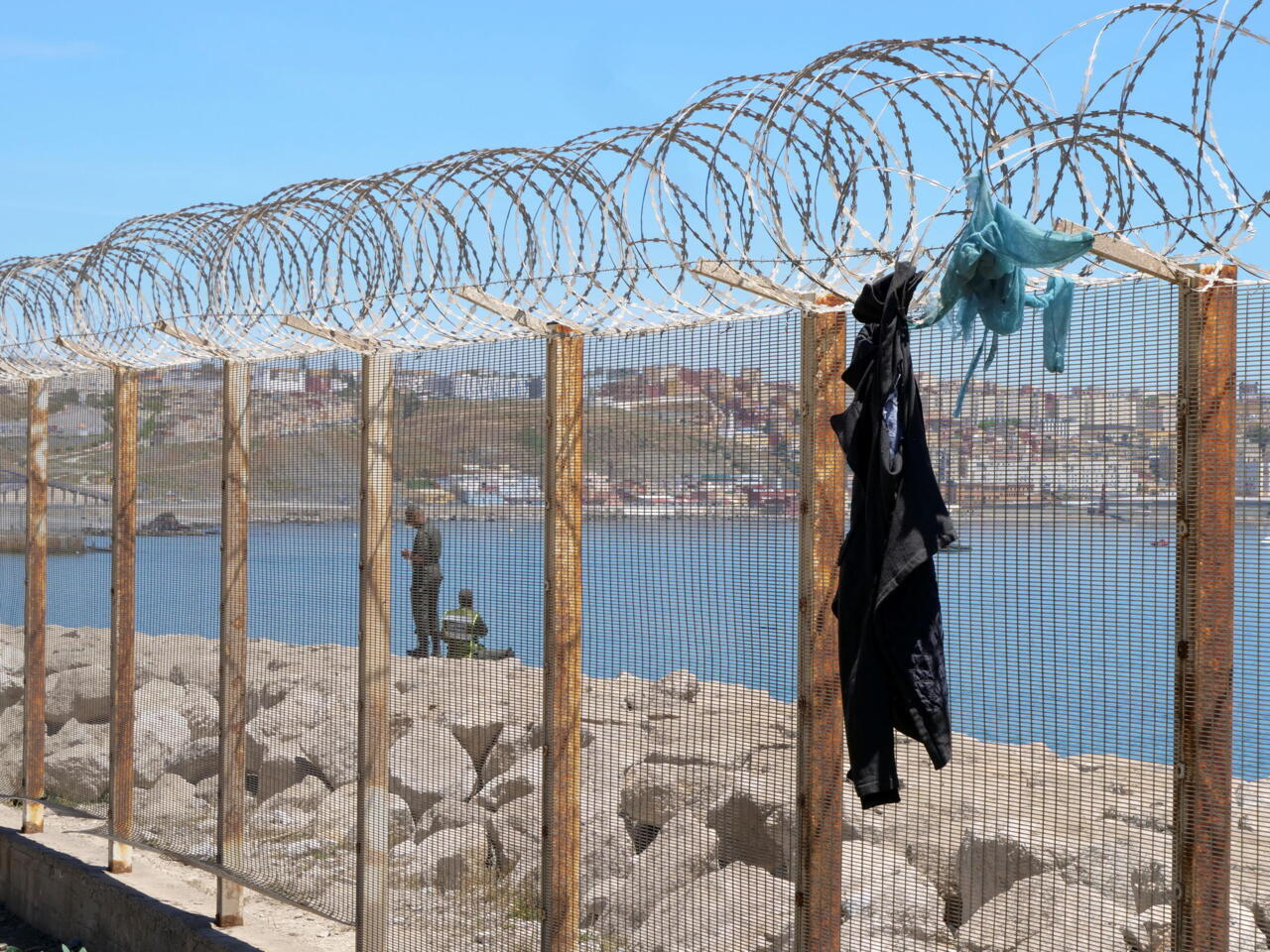
Security has been reinforced around Fnideq and the approaches to the enclave, while Spain has significantly increased its police presence on the other side. European authorities, meanwhile, are paying growing attention to the digital networks through which calls, rumours and misleading migration information can spread.
A digital mobilisation, not a confirmed mass crossing
Spanish security services have documented online activity surrounding August 15.
But the distinction between online mobilisation and events on the ground remains crucial.
The identity of those behind the call has not been conclusively established, and there is no dependable estimate of how many people might respond.
This is why describing August 15 as a confirmed “mass assault” would go beyond the available evidence.
It is a risk being monitored — not an event that has already been determined.
Morocco moves first
The most visible change is taking place on the Moroccan side.
Hundreds of security personnel have been deployed around Fnideq, alongside additional physical security measures and military support. The purpose is to prevent large groups from forming and reaching the most sensitive areas near Ceuta.
Moroccan authorities have also detained individuals suspected of encouraging irregular migration online.
The strategy is preventive: disrupt mobilisation before it becomes a border crisis.
And Spain itself has acknowledged Morocco's importance in stabilising the situation.
Interior Minister Fernando Grande-Marlaska has described cooperation with Rabat as “extraordinary” in relation to the return of people who crossed during the previous crisis.
Madrid reinforces the enclave
Spain has increased the combined deployment of National Police and Guardia Civil officers in Ceuta to around 1,600, while additional units are working on identification, security and return procedures.
The Spanish authorities are also attempting to counter false online claims directly, warning potential migrants that irregular arrival does not guarantee transfer to mainland Spain or legal status.
In that sense, the confrontation is no longer only physical.
It is informational.
Ceuta and Melilla remain part of a wider sovereignty dispute
The migration crisis is unfolding alongside renewed political debate over the status of Ceuta and Melilla.
Moroccan Justice Minister Abdellatif Ouahbi has reiterated Rabat's sovereignty claims over both enclaves. Spain responded by saying their status is not open to negotiation and continues to regard them as integral Spanish territory.
Morocco takes the opposite position and claims sovereignty over the two Spanish-administered enclaves.
For MMNEWS, that distinction matters.
Ceuta and Melilla should not simply be described as “Spanish cities” without context. They are Spanish-administered enclaves in North Africa whose sovereignty is claimed by Morocco.
That formulation reflects the existence of a genuine and renewed political dispute.
Europe's border management increasingly depends on Morocco
The current episode also highlights a broader strategic reality.
Whatever the political dispute over Ceuta and Melilla, European migration management in the western Mediterranean depends heavily on cooperation with Rabat.
Moroccan controls, intelligence sharing, anti-smuggling operations and cooperation on returns have direct consequences for Spain and, by extension, the European Union.
The relationship therefore cannot be reduced to Europe asking Morocco to police departures.
A sustainable partnership also requires European governments to take Moroccan security costs and strategic interests seriously.
Brussels is watching the digital frontier
European authorities have increasingly focused on the role of online platforms after the late-July events.
The concern is that false information, smuggling networks and coordinated social-media activity can move large numbers of people towards a border far faster than traditional security systems can respond.
That means part of the frontier now exists on a smartphone screen.
For Morocco, Spain and Europe alike, preventing another crisis therefore requires not just barriers and patrols, but a faster response to information manipulation.
August 15 remains uncertain
As of August 14, the situation can be described carefully.
The calls are real. The risk is being taken seriously.
Morocco has reinforced its preventive deployment.
Spain has strengthened security inside the enclave.
But a mass crossing on August 15 remains unconfirmed.
If the day passes without another major crisis, Morocco's decision to act early around Fnideq will be an important part of the explanation.
And beyond the migration emergency, another issue has returned to the political foreground: the unresolved dispute over Ceuta and Melilla, administered by Spain but claimed by Morocco.
💬 Comments (0)
No comments yet. Be the first!
✏️ Leave a comment