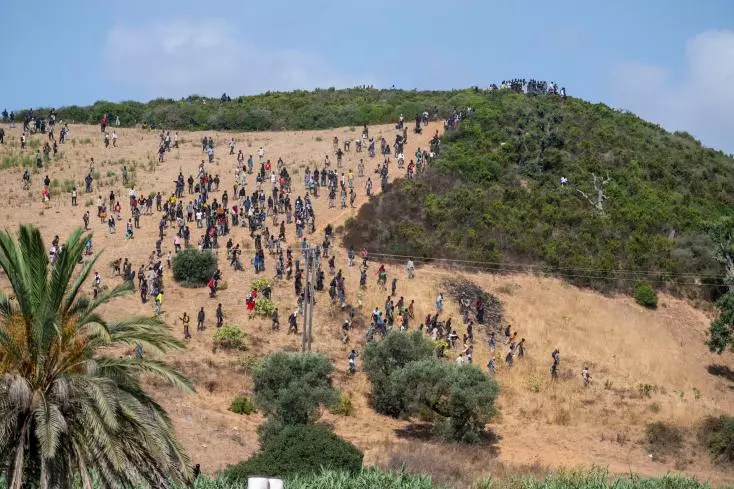
That breakdown changes the way the day should be understood. This was not simply a movement of young Moroccans responding to social-media calls.
More than four out of five of those intercepted were from sub-Saharan Africa, placing the episode firmly within the broader migration route running through Morocco towards Europe.
In practical terms, Morocco contained a transnational migration movement on its own territory before it could become a direct crisis for Spain and the European Union.
248 out of 294 were from sub-Saharan Africa
The numbers are striking. Of the 294 people intercepted, 248 were from sub-Saharan African countries.
The remaining 46 were from the Maghreb. Some Moroccan reporting described them as Moroccan nationals, while El País, citing the Tetouan prefecture communiqué, referred more broadly to Moroccan, Algerian and Mauritanian nationals within that group.
The safest conclusion is therefore clear: the sub-Saharan component is the dominant one. That matters politically.
It demonstrates that Morocco is not only managing the movements of its own citizens. It is also carrying a substantial part of the responsibility for migration flows originating elsewhere on the African continent and heading towards European-controlled territory.
Morocco stopped the movement before it reached Ceuta
Moroccan security forces did not wait for the groups to reach the immediate border area. People were intercepted and dispersed in the hills around Fnideq, while police controls remained in place on roads arriving from Tangier and Tetouan.
The strategy was preventive.
Rather than confronting thousands of people at the fence or the crossing itself, Moroccan forces sought to break up concentrations earlier. That appears to have worked. The pressure existed, but it did not become another large-scale breach inside Ceuta.
A European border partly protected from Moroccan territory
From the European Union’s operational perspective, this is highly significant. Ceuta forms part of the EU’s external migration-control architecture. When Moroccan forces intercept a group in Fnideq, they are not simply carrying out a domestic security operation.
They are also preventing that group from reaching territory administered by Spain and therefore from immediately becoming a European border-management issue. This is what externalised migration control looks like in practice. Part of Europe’s border is effectively being managed before migrants reach it. And on the Western Mediterranean route, Morocco is carrying much of that burden.
The sub-Saharan majority changes the narrative
The presence of 248 sub-Saharan migrants among the 294 intercepted also highlights Morocco’s evolving position within African migration.
The Kingdom is not simply a country of emigration. It is also a transit country and, increasingly, a destination for migrants from across sub-Saharan Africa. That creates its own security, administrative and social pressures.
For Europe, it means that cooperation with Morocco is not just about preventing Moroccan citizens from reaching Spain. It is about managing a wider continental migration route.
Responsibility cannot flow in only one direction
A pragmatic reading of the situation requires shared responsibility. Morocco has a duty to control its territory and fight trafficking networks.
But Spain and the EU also shape the incentives surrounding migration through asylum rules, return policies, court rulings and public communication.
If European decisions create confusion or expectations among would-be migrants, the operational consequences are often felt first in Morocco. That imbalance cannot be ignored.
A territorial dispute remains in the background
MMNEWS also maintains a precise formulation regarding Ceuta. It is a Spanish-administered enclave whose sovereignty is claimed by Morocco. Spain considers Ceuta and Melilla integral parts of its territory. That means Morocco is using significant state resources to prevent migration towards territory whose status it disputes. This makes the relationship with Spain and the EU more than a technical border-security arrangement. It is part of a wider political balance.
What August 15 ultimately showed
The picture is now much clearer. No mass crossing comparable to the late-July crisis occurred. 294 people were intercepted. 248 of them were from sub-Saharan Africa.
Larger groups were prevented from reaching the enclave. And the bulk of the preventive action happened on Moroccan territory. There is no need to exaggerate the conclusion. The facts themselves are significant.
On August 15, most of those intercepted near Ceuta were sub-Saharan migrants heading towards Europe, and Morocco stopped them before they reached the enclave.
That underlines a strategic reality that Madrid and Brussels cannot ignore: on the Western Mediterranean route, part of Europe’s border security begins in Morocco.
💬 Comments (0)
No comments yet. Be the first!
✏️ Leave a comment