But the most politically significant development may be coming from Brussels. The European Commission is now openly stressing the importance of Moroccan authorities maintaining control of the situation around Ceuta, while Spain tries to deal with those who have already crossed. That wording matters. It shows how central Morocco has become to Europe’s management of this crisis.
The crisis is no longer only about the border
Ceuta remains a Spanish-administered enclave claimed by Morocco, while Madrid considers it an integral part of Spain.
But since the events of late July, the immediate challenge is no longer simply how to stop people from crossing. Spain must now accommodate, identify and process a population whose exact size is still unclear.
The European Commission itself has acknowledged that there is no consolidated figure for the number of migrants still present irregularly in Ceuta, referring instead to “several thousand” people. That uncertainty is significant in itself. After a crisis of this scale, European and Spanish authorities are still working to establish precisely how many people remain to be housed, identified or processed.
Brussels is now saying more clearly what it expects from Morocco
This is perhaps the most important political shift. The European Commission’s priority is now not only to support Spain inside Ceuta, but also to ensure that Morocco continues to contain pressure on its side and cooperates on the return of people who have no legal basis to remain.
European officials have also taken note of Morocco’s stated willingness to readmit people who entered irregularly, including unaccompanied minors, subject to the legal safeguards required in such cases. The implication is clear. Europe is not looking only at Madrid.
It is looking at Rabat. In practical terms, stability at this part of Europe’s external border depends heavily on what happens on Moroccan territory before people reach the enclave.
2,168 minors identified: the figure that changes the scale of the crisis
The most striking official figure concerns minors. Spanish police say they had identified 2,168 minors between July 30 and 9 a.m. on August 18.
That number must be interpreted carefully. It does not necessarily mean that all 2,168 remain in exactly the same administrative situation today. It means that Spanish authorities have had to identify and place thousands of minors under the responsibility of the relevant services over the period.
That changes the nature of the crisis. An unaccompanied minor cannot be treated administratively in the same way as an adult irregular migrant. Age, identity, family circumstances, vulnerability and safeguards surrounding any possible return all have to be examined. That requires time, personnel and legal procedures.
How many people are actually still in Ceuta? There is still no definitive answer
This is one of the most sensitive points. Ceuta’s local government has cited a figure above 8,000 people still present. The Spanish Commission for Refugee Aid, CEAR, has suggested a lower range of roughly 4,000 to 6,000. Brussels is refusing to endorse one precise figure and continues to speak of several thousand.
For MMNEWS, the safest formulation is therefore straightforward: Several thousand people remain in Ceuta, but there is still no single consolidated figure accepted by all authorities and organisations involved. That is more accurate than turning one estimate into an official total.
Spain begins installing 1,500 additional emergency places
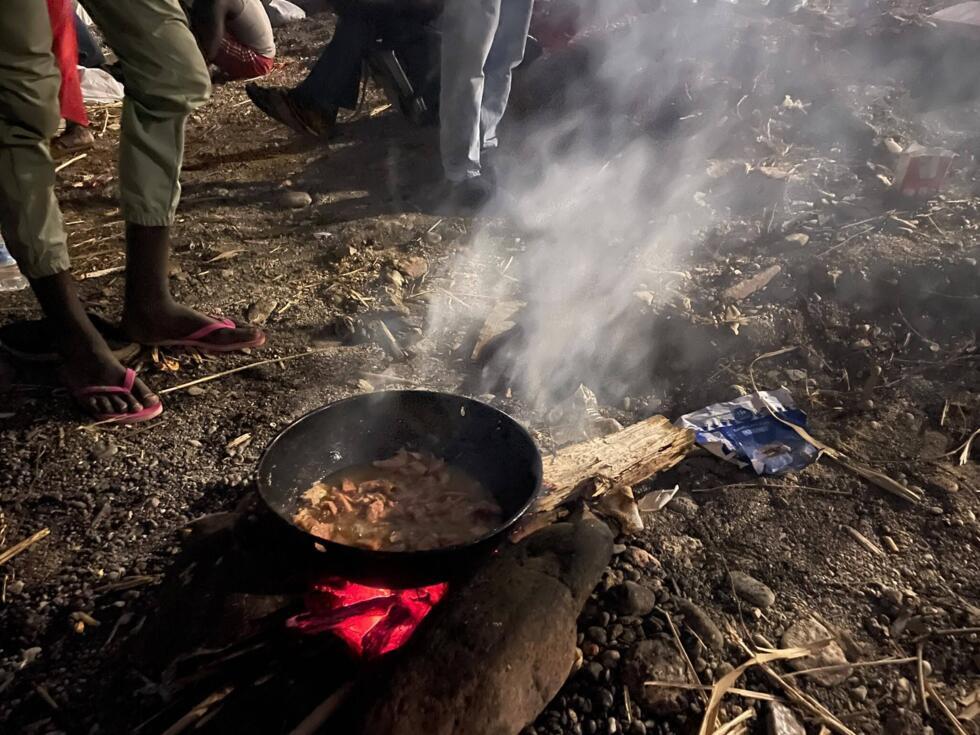
Madrid is now moving from improvised crisis management to more structured emergency accommodation. The Spanish military has begun installing tents at Loma Colmenar, one of several sites selected for temporary reception.
The initial plan is to create 1,500 additional places, with capacity to expand further if necessary. These sites are also expected to include facilities for meals, showers and basic hygiene. This marks an important change. Spain is no longer merely reinforcing a border. It is building an emergency infrastructure to manage the consequences of a border crisis that has already happened.
Women and girls are emerging as another urgent concern
The humanitarian dimension is also becoming more serious. Women living in improvised camps near reception facilities have described fears of harassment and assault, particularly at night.
Spanish health authorities have confirmed that several women have received medical treatment after sexual violence. Some police-union figures circulating publicly are higher, but those have not all been confirmed by the Interior Ministry. That distinction matters. What can be said with certainty is that the protection of women, minors and other vulnerable people has become a central part of the crisis response.
Emergency accommodation is therefore not simply about providing beds. It is also about security, supervision and protection.
Spain’s justice system is beginning to feel the strain
Another sign of the crisis entering a new phase comes from the judiciary. Spain’s General Council of the Judiciary has called for additional resources for courts in Ceuta. The need now extends beyond police and border guards. Judges, prosecutors, forensic staff, interpreters and administrative personnel are also being drawn into the response.
A major border rupture creates legal consequences almost immediately: asylum claims; cases involving minors; possible return procedures; criminal investigations; identity verification; forensic work; and disputes over legal status. The institutional cost spreads quickly.
Morocco’s role is mostly upstream
That is precisely what makes the Moroccan role strategically important. When Moroccan security forces intercept groups around Fnideq before they reach Ceuta, the issue remains on the Moroccan side as a matter of migration control, public order and anti-smuggling enforcement.
Once the border is crossed, the same movement can become for Spain a matter of policing, accommodation, asylum, child protection, health care and judicial processing.
That distinction is fundamental. On August 15, Moroccan authorities reported intercepting hundreds of would-be migrants around Fnideq before they could converge in large numbers on Ceuta. The effect of that preventive strategy is now easier to understand because Spain is dealing with the opposite scenario inside the enclave.
Protecting a European border does not make Morocco Europe’s border guard
It would be simplistic to conclude that Morocco’s role is simply to hold back migrants for Spain and the EU. The Kingdom has its own interests. It is policing its own territory, combating trafficking networks, preventing dangerous mass movements and dealing with migration flows coming from across Africa. The August 15 figures were particularly revealing: a very large majority of those intercepted near Fnideq were from sub-Saharan African countries.
That means Morocco is not simply managing the movement of its own nationals. It is also absorbing part of a wider African migration route towards Europe. This is why the relationship cannot be reduced to a one-way expectation that Rabat should permanently shield Europe from migration pressure.
Ceuta is becoming a laboratory of European dependence
The current crisis has allowed Europe to observe two different scenarios. When preventive controls work before the border, pressure is contained before large groups reach European-administered territory.
When they do not, Spain faces an immediate chain reaction: emergency accommodation; pressure on courts; health-care needs; child-protection cases; asylum procedures; political conflict; and disputes over returns. That is why the European Commission’s emphasis on continued Moroccan cooperation is so significant. It reflects a pragmatic conclusion: this section of Europe’s external border cannot be stabilised from the European side alone.
After the border crisis comes the management crisis
The central question has therefore changed. It is no longer simply: “When will the next crossing attempt happen?” It is now:
How will Spain deal with the consequences of the crossings that have already taken place?
Authorities must identify those still present. Protect minors. Process asylum claims. Organise returns where legally possible. Create accommodation. Reinforce courts. Protect vulnerable people. And, at the same time, prevent a new crisis from developing on the other side of the border. On that final point, Brussels is looking directly towards Morocco.
What the Ceuta crisis is really showing
The lesson is increasingly pragmatic. Preventive border control is expensive. Managing a crisis after the border has been crossed is even more expensive.
Spain is now mobilising the military for accommodation, reinforcing its justice system and processing thousands of individual situations. Morocco, meanwhile, remains the key actor in preventing renewed mass pressure before it reaches the enclave. And Europe is becoming less ambiguous about the importance of that role.
Ceuta is therefore confirming a strategic reality: on the Western Mediterranean route, Europe’s external border is not protected from Europe alone. A significant part of its stability begins in Morocco.
The next question is whether Brussels will translate that recognition into a more balanced partnership — financial, operational and political — rather than simply expecting Rabat to absorb pressure indefinitely on the southern side.
💬 Comments (0)
No comments yet. Be the first!
✏️ Leave a comment