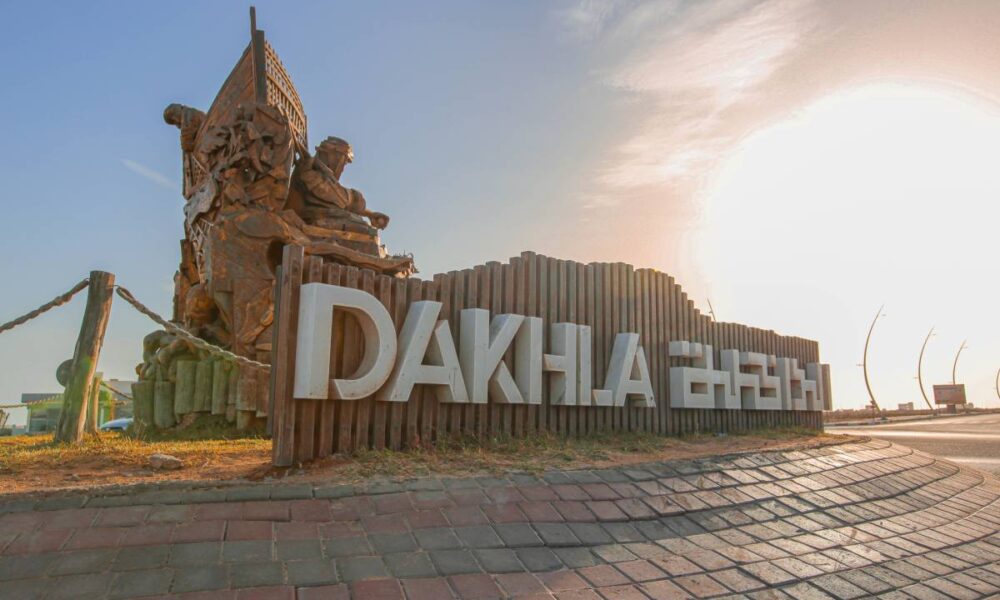
In Dakhla, wind is no longer merely a selling point for kitesurfers. It is becoming an energy resource, an industrial asset and a possible engine of regional growth. The peninsula now sits at the intersection of several Moroccan priorities: Atlantic trade with Africa, low-carbon industry, seafood processing and high-value tourism.
The region counted 219,965 residents in Morocco’s 2024 census. HCP’s 2023 regional accounts put its GDP at MAD 18.7 billion, only 1.3% of national output, while GDP per capita reached MAD 89,533, more than twice the national average. Regional growth stood at 10.1% that year. This is an economy with strong productive assets, but also a small domestic market and significant exposure to a limited number of sectors and public investment.
The Dakhla Atlantic deep-water port is the central infrastructure bet. In July 2026, a Moroccan Equipment Ministry source cited by Médias24 said construction was 65% complete, with completion targeted for late 2028 and operations expected in 2029. Equipment Minister Nizar Baraka told Reuters that the roughly $1 billion facility would reach a depth of 23 metres.
The port is meant to support fisheries, logistics, industry, energy exports and trade with West Africa and the Sahel. But infrastructure alone does not create an economic hub. Dakhla will need processors, freight operators, repair and maintenance services, exporters and finance. Otherwise, it could become a transit point rather than a centre of value creation.
The blue economy remains the region’s strongest comparative advantage. Fisheries and aquaculture can support more local processing, premium packaging, traceability, cold-chain services, algae products and marine biotechnology. Yet all these activities rely on the same natural asset as tourism: a healthy lagoon. Environmental monitoring, concession planning and stock management should therefore be treated as productive investment, not red tape.
Water and renewable energy are opening another frontier. Official plans combine a desalination plant with stated capacity of 100,000 cubic metres per day, a 5,000-hectare irrigation scheme and a 40 MW wind farm. In June 2026, the Agricultural Development Agency launched a tender covering 35 projects over about 1,090 hectares. The model may generate employment, but it will require transparent water accounting, careful crop selection, brine management and strong local supply chains.
Dakhla also features in Morocco’s green-hydrogen strategy. The government selected investors for six projects worth a combined MAD 319 billion across all three southern regions—not Dakhla alone. In June 2026, officials said monitoring committees had validated initial study deliverables for integrated projects involving ORNX Morocco and TAQA–Moeve. The opportunity is real, but commercial-scale delivery still depends on electricity costs, water, off-take contracts, export facilities and Moroccan industrial content.
Technology is the newest layer. Two agreements signed in November 2025 announced the renewable-powered Igoudar Dakhla green data-centre project and the Jazari Institute for AI and Energy Transition, designed around training, research, the Internet of Things and energy applications. This could turn local challenges in water, fisheries, tourism and energy into real-world innovation markets. But data centres do not automatically create a technology cluster: connectivity, research capacity and local engineers will determine whether the promise becomes an ecosystem.
Tourism offers a different model. Dakhla’s lagoon, wind sports, desert landscapes and natural heritage give it a distinctive global identity. The rational path is not mass coastal tourism but higher-value, lower-impact stays: integrated accommodation, environmental standards, Hassani cultural experiences, trained local guides and improved air links. Capacity should grow no faster than the territory’s ability to manage water, waste and fragile ecosystems.
For Moroccans abroad, the strongest opportunity may lie in expertise rather than consumer demand. Diaspora entrepreneurs can build businesses in logistics, cold chains, industrial maintenance, traceability software, cybersecurity, water treatment, marine engineering, tourism platforms and vocational training. They can also connect regional firms to clients and capital abroad. Yet patriotic commitment cannot replace bankable data, clear land rules, predictable permits and professional due diligence.
Dakhla has the ingredients of a virtuous cycle: a port that attracts industry, renewable power that supports water and digital infrastructure, a blue economy that feeds processing, and tourism that monetises natural heritage. It also faces concentration risk, skills shortages, environmental pressure and the possibility that large projects will bypass local SMEs.
The true measure of attractiveness will therefore not be the volume of announced investment. It will be the number of skilled local jobs, the share of contracts won by regional firms, the amount of processing performed locally and the ecological health of the bay. Dakhla can become a major Atlantic platform—if infrastructure strengthens the territory, not merely passes through it.


💬 Comments (0)
No comments yet. Be the first!
✏️ Leave a comment