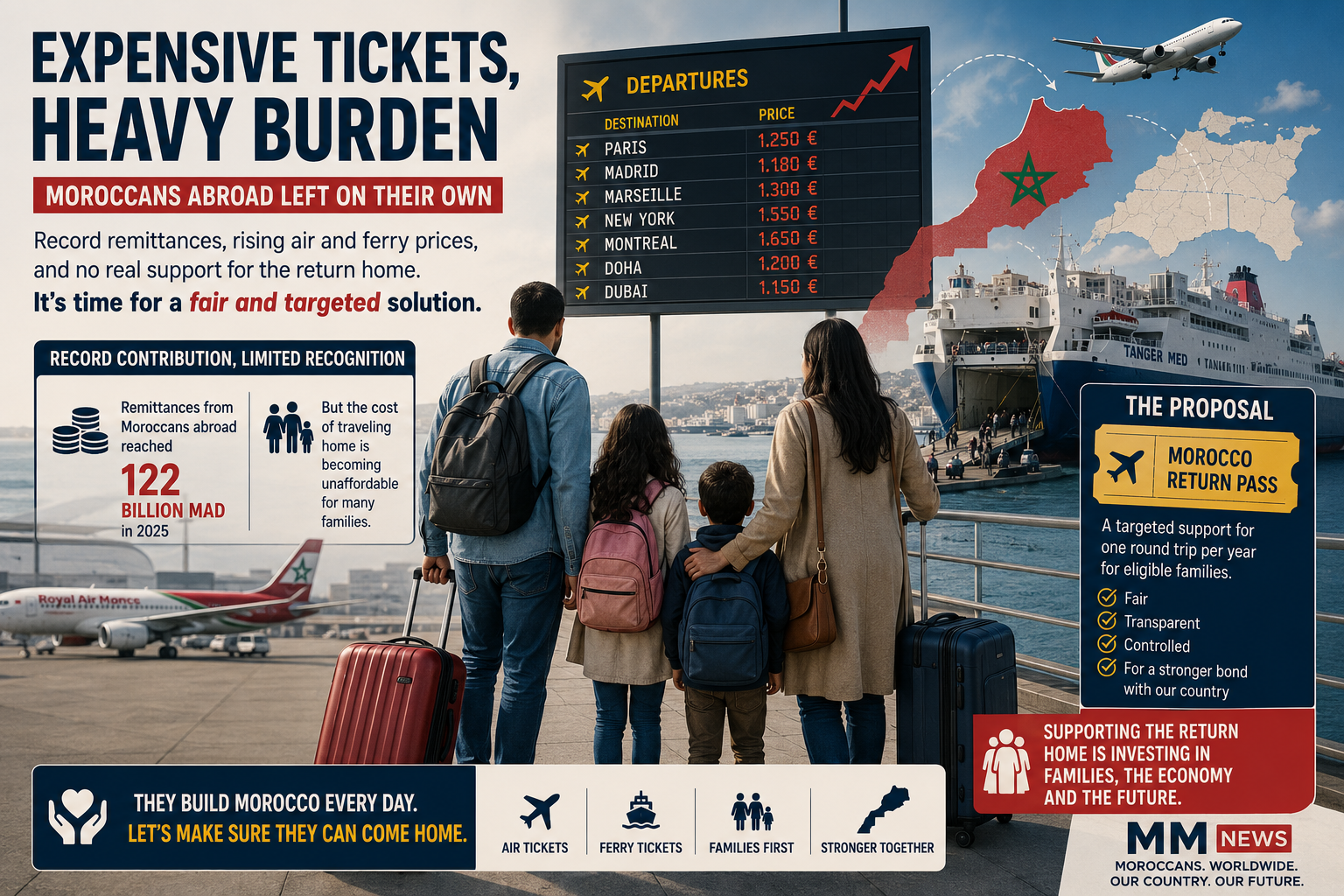
The frustration is growing because Moroccans abroad are constantly praised for their economic contribution to the Kingdom. Their remittances have reached record levels, supporting households, foreign currency reserves, consumption, housing and investment.
Yet when the time comes to return home, many feel abandoned by a system that welcomes them at ports and airports but offers little help with the cost of getting there.
This raises a legitimate question: should Morocco create a permanent support mechanism to make air and sea travel more affordable for its diaspora?
Record Remittances, but Little Help With the Cost of Returning Home
Moroccans abroad are far more than summer visitors. They support relatives, finance housing, invest in businesses, contribute to local consumption and strengthen Morocco’s foreign currency position.
Their annual remittances have exceeded 122 billion Moroccan dirhams, confirming once again the strategic importance of the diaspora to the national economy.
These figures are regularly celebrated in official reports and public speeches. But when families try to travel to Morocco, they are often left alone to face the pricing strategies of airlines and ferry companies.
No one is asking for free travel. The real issue is whether a country with millions of citizens abroad should continue treating their return as a purely commercial matter.
Europe, North America and the Gulf: Different Routes, the Same Financial Pressure
For Moroccans living in Europe, several options may exist: flying, driving through France and Spain, or taking a ferry. But none of them is cheap.
A road journey includes fuel, tolls, accommodation, meals and ferry tickets. Flying means paying peak-season fares, baggage charges and airport costs for every family member.
For Moroccans living in the United States or Canada, alternatives are even more limited. Long-distance flights are often the only realistic option, and a family of four or five can face an extremely heavy bill during school holidays.
Moroccans based in Qatar, the United Arab Emirates, Saudi Arabia and other Gulf countries face a similar problem: limited direct connections, expensive transfers, baggage fees and high prices when the whole family travels.
The challenge is global, even if the distances and travel options differ.
Operation Marhaba Helps Travelers, but Not Their Purchasing Power
Operation Marhaba plays an essential role in welcoming and assisting Moroccans abroad at ports, airports and transit areas.
But this support usually begins after the journey has already been paid for.
It does not solve the first problem facing many families: being able to afford the ticket.
Increasing the number of flights and ferry crossings is useful, but additional capacity does not automatically guarantee affordable fares. When demand is concentrated within a few summer weeks, prices can remain extremely high.
Morocco therefore needs to complement its reception policy with a genuine diaspora mobility strategy.
Territorial Continuity Is Not an Unrealistic Idea
Public mechanisms designed to reduce transport costs already exist in other regions.
In Corsica, territorial continuity allows residents to benefit from preferential airfares on routes to mainland France. The system is based on public-service obligations, regulated pricing and financial compensation.
Corsican authorities have also explored the idea of a special diaspora fare for people of Corsican origin living elsewhere, recognizing that mobility is central to maintaining family and cultural ties with the island.
Morocco cannot copy this model exactly because its diaspora lives across many countries and uses international routes. But the principle can inspire a Moroccan solution: targeted public support, transparent rules and negotiated fares for eligible travelers.
The MM News Proposal: A “Morocco Return Pass”
MM News proposes opening a national debate on the creation of a Morocco Return Pass for Moroccan families living abroad.
This would not be a universal discount for every traveler, nor an uncontrolled cash payment. It could operate as a capped annual subsidy for one round trip by air or sea.
The mechanism could include:
- support for one return journey per year;
- priority for families with children, students, older people and modest-income households;
- different support levels for Europe, North America, Africa and the Gulf;
- access through several airlines and ferry companies;
- direct payment to operators or secure digital reimbursement;
- fare ceilings preventing companies from raising prices to absorb the subsidy.
A pilot program could first be tested on selected routes, during specific periods or for limited categories of beneficiaries.
Do Not Tax Remittances to Finance It
Such a mechanism should not be funded through a new tax on diaspora remittances.
That money belongs to families and should not be penalized.
However, the record level of those transfers provides a strong argument for directing a larger share of public spending for Moroccans abroad toward practical services: transport, administrative support, legal protection, investment assistance and cultural transmission.
Funding could involve the state, local authorities, Royal Air Maroc, ferry companies and other approved transport operators under transparent conditions.
Morocco has already shown that intervention is possible. In 2021, Royal Air Maroc introduced exceptionally reduced summer fares for Moroccans abroad under royal instructions. The measure responded to a specific context, but it remains an important precedent.
A Travel Subsidy Could Also Benefit Morocco’s Economy
Making travel more affordable would not only be a social expense. It could also generate economic returns.
When diaspora families arrive in Morocco, they spend money on hotels, restaurants, fuel, car rentals, local shops, family celebrations, home repairs and tourism activities.
They visit their regions of origin, support relatives and introduce their children to the country.
A more affordable ticket can therefore unlock much greater spending once the family reaches Morocco.
There is also a deeper benefit. When families are forced to skip several summers because of high prices, Morocco does not only lose tourism revenue. Younger generations may gradually lose contact with the language, relatives and cultural memory of the country.
Avoid Turning Public Support Into a Gift for Transport Companies
Any subsidy would need strict safeguards.
Without price controls, public support could simply be absorbed by airlines and ferry companies instead of reducing the final cost for families.
A Morocco Return Pass should therefore be accompanied by an independent fare-monitoring body. Its role would be to compare prices, track seasonal increases and publish transparent data before and during peak periods.
Participating operators should accept clear obligations:
- a minimum number of subsidized seats;
- maximum fares by route;
- transparent baggage conditions;
- reasonable ticket-change rules;
- protection for families in case of cancellation.
The purpose would not be to distort competition, but to purchase a genuine public-interest transport service for Moroccan citizens abroad.
Moroccans Abroad Want More Than Words of Appreciation
The diaspora often hears praise for its patriotism, financial contribution and role in promoting Morocco internationally.
Those messages matter. But they must be supported by visible measures in everyday life.
When a family has to choose between paying several thousand euros or giving up the chance to see parents and grandparents, the connection with Morocco becomes a question of purchasing power.
Morocco welcomes its citizens abroad at ports and airports. It may now be time to help them with the step that comes before that welcome: buying the ticket that allows them to return home.
Returning to Morocco Should Not Become a Summer Luxury
Air and ferry prices cannot be fully controlled by the state. Fuel costs, taxes, seasonality, operating expenses and competition all matter.
But the choice is not limited to an unregulated market or free travel. There is a third option: targeted, transparent and socially responsible support.
With more than 122 billion dirhams transferred in a single year, Moroccans abroad have once again demonstrated the strength of their commitment to the Kingdom.
Now is the time for a serious debate on territorial continuity with the diaspora.
Whether they live in Europe, North America, Africa or the Gulf, Moroccan citizens should not see their connection to their country become a privilege reserved for those able to pay the highest seasonal fares.
The Morocco Return Pass deserves serious consideration — not as a favor to the diaspora, but as a national investment in families, mobility and the future of Morocco’s relationship with its citizens abroad.

💬 Comments (0)
No comments yet. Be the first!
✏️ Leave a comment