
A record politics cannot simply dismiss
Lekjaa brings an unusual asset to electoral politics: a record associated with outcomes the public can locate. President of the Royal Moroccan Football Federation since 2014, he has overseen a period in which Moroccan football moved beyond recurring instability. The historic 2022 World Cup semi-final, Olympic bronze in 2024, advances in women’s and youth football and the award of the 2030 World Cup to Morocco, Spain and Portugal placed the country in a different sporting category.
No official wins alone. Players, coaches, clubs, technical staff, public investment and the monarchy’s long-term strategy all shaped that rise. It would be inaccurate to reduce a collective transformation to one person, just as it would be artificial to deny Lekjaa’s contribution. His distinctive record is a chain of decisions: academies, facilities, staff appointments, logistics, international diplomacy and institutional continuity.
In a campaign where promises often travel further than evidence, delivery has political value. It also creates a duty. Anyone presenting sporting performance as proof of competence must accept equally demanding scrutiny over budgets, healthcare, education, jobs, water security and regional inequality.
The diaspora as a test case
Morocco’s handling of dual-national players may contain the most transferable lesson. The federation did not wait for talent to arrive in Rabat. It built scouting networks in Europe, identified players early, spoke to families and presented a credible sporting pathway.
Achraf Hakimi, Yassine Bounou, Sofyan Amrabat, Noussair Mazraoui, Bilal El Khannouss and Brahim Diaz followed different routes. Together, however, they represent a policy shift: training acquired in France, Spain, the Netherlands, Belgium or Canada is treated as expertise Morocco can integrate rather than evidence of distance from the country.
The question extends far beyond sport. If Morocco can locate a teenage full-back in a European academy, monitor his progress and offer him a defined role, why can it not apply the same precision to a diaspora biotechnology researcher, water engineer, artificial-intelligence specialist, doctor or entrepreneur?
Moroccans abroad do not need another speech praising “skills” or an annual invitation to invest. They need defined missions, authority, resources and access to decision-making. In this respect, the football federation has often proved more operational than the state administration.
International influence as political competence
Lekjaa’s expertise is not confined to the pitch. He sits on the FIFA Council and serves as a vice-president of the Confederation of African Football, placing Morocco inside negotiations over tournaments, finance and global football governance. FIFA lists him among the CAF leadership.
The 2030 World Cup illustrates that influence. The joint bid with Spain and Portugal reflects a much broader mobilisation involving royal diplomacy, government, cities, companies and international partners. Lekjaa has nevertheless become one of its most visible negotiators.
The capacity to build alliances could serve Morocco in energy, water, industry, investment, training and African cooperation. Yet access to international decision-makers does not remove the need for transparency. Networks and major projects must be accompanied by readable procurement, independent evaluation and public accountability. Sporting diplomacy generates influence; it should not generate areas beyond scrutiny.
The PAM transfer changes the campaign
Lekjaa did not enter politics in 2026. He has been minister delegate for the budget since 2021 and previously worked as a finance inspector. He understands Treasury trade-offs, the cost of public policy and the limits of government spending. What changed was his formal party alignment.
His arrival in the Authenticity and Modernity Party on 25 July landed like a major transfer. He has since become a central presence at PAM campaign events. Yet information available on 15 September indicated that he was not personally standing on a parliamentary list. Asked about becoming head of government, he said he had never considered it and referred the next stage to Morocco’s constitutional process after the vote.
That position creates both expectation and ambiguity. The PAM benefits from the popularity of a figure associated with delivery, even though voters are not directly choosing him. The campaign must therefore move beyond the Lekjaa image and examine the party’s manifesto, its candidates, costed commitments and collective capacity to govern.
Campaign tackles—and the ball coming back
Aziz Akhannouch accused rivals of running a political “transfer market” after waiting until the end of the term to recruit new names. Abdelilah Benkirane attacked the PAM and controversies involving some of its officials. These are campaign arguments, not judgements on Lekjaa.
They nevertheless raise a fair question: can a party borrow the reputation of a successful manager without demonstrating the quality of its full team? The question also turns on his opponents. They cannot dismiss Lekjaa as a communication exercise while failing to explain why their own party structures produce so few public figures associated with implementation.
The ball also returns to Lekjaa. As a member of the outgoing government, he cannot claim every success while treating every shortcoming as somebody else’s legacy. The record includes access to healthcare, school learning, unemployment, purchasing power and the distance between metropolitan centres and peripheral provinces. A culture of results is credible only when it accepts the entire scoreboard.
23 September is not a cup final
The temptation to describe an election as a match is powerful: favourites, signings, attacks and a final score. The metaphor attracts attention but can shrink politics. A country is not a dressing room, and citizens are neither starters nor substitutes. They may challenge priorities, demand accounts and remove leaders.
Football’s vertical structure can accelerate a decision. Government must work through Parliament, courts, the press, local authorities, civil society and public-procurement rules. Democratic effectiveness is not the removal of checks. It is the ability to act while making those checks meaningful.
This is where Lekjaa’s experience becomes politically relevant. His sporting record suggests that distant objectives require a coherent chain, clear responsibility and measurable progress. Public policy needs equally legible indicators: emergency-room waiting times, actual learning outcomes, durable jobs, water losses, small-business access to procurement and the narrowing of regional gaps.
Beyond stadiums, the test of daily life
Morocco is investing heavily in infrastructure connected to 2030: stadiums, airports, rail and urban mobility. These projects may accelerate modernisation. They will earn lasting legitimacy only if they also improve daily life, control water and energy consumption, serve local economies after the tournaments and do not displace attention from essential public services.
Campaigning in Bouarfa and Berkane, Lekjaa supported more direct agricultural assistance, a minimum pension of 3,000 dirhams, stronger protection for widows and the idea of “one-speed Morocco”. The language speaks directly to territorial justice. Yet the budget minister knows that a social pledge requires a price, funding, a timetable and an accountable implementing authority.
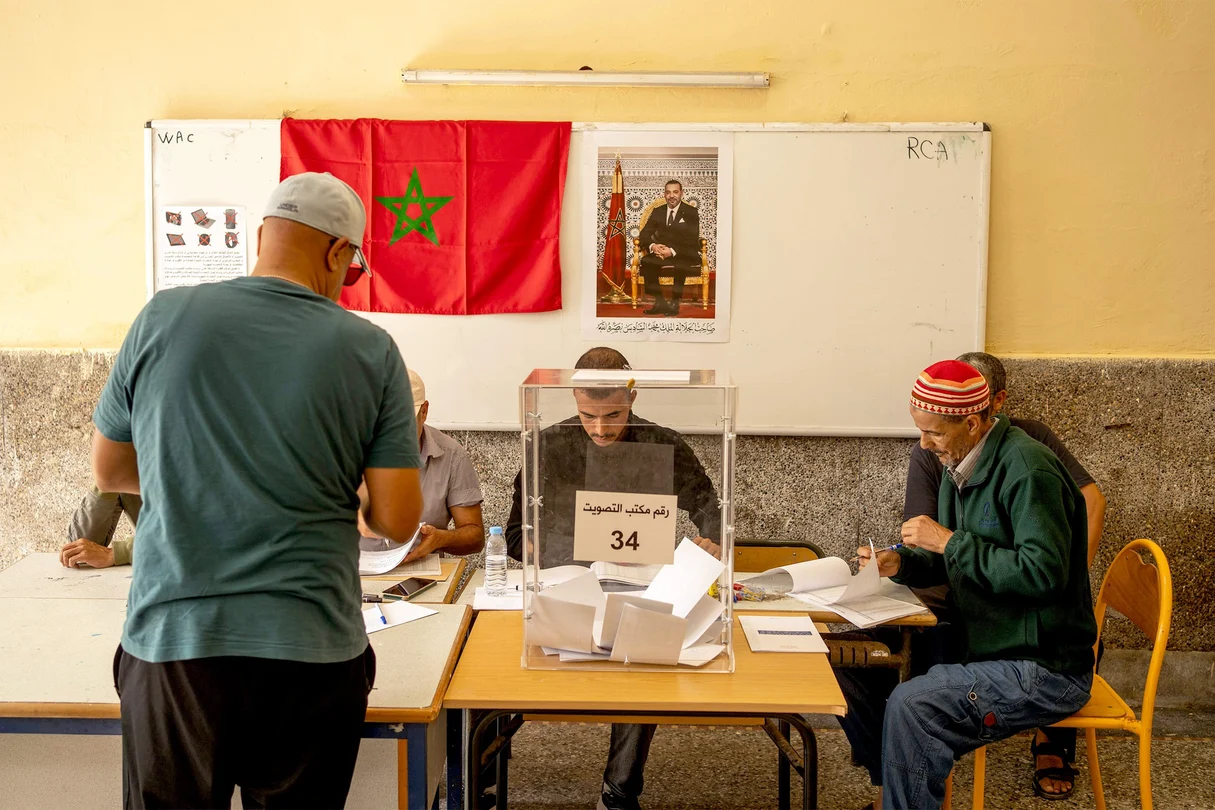
That is the real challenge of the 23 September election. The question is not whether football prestige can help a party win. It is whether management experience can become a democratic contract that citizens can verify.
Lekjaa helped persuade diaspora players that Morocco could offer a project worthy of their talent. Politics now sets a wider task: convincing citizens that public performance will include those who never enter a stadium. Election night will deliver only a political result. The meaningful table will be built afterwards—in schools, hospitals, jobs, water security and equality between territories.


💬 التعليقات (0)
لا توجد تعليقات. كن أول من يعلق!
✏️ اكتب تعليقك