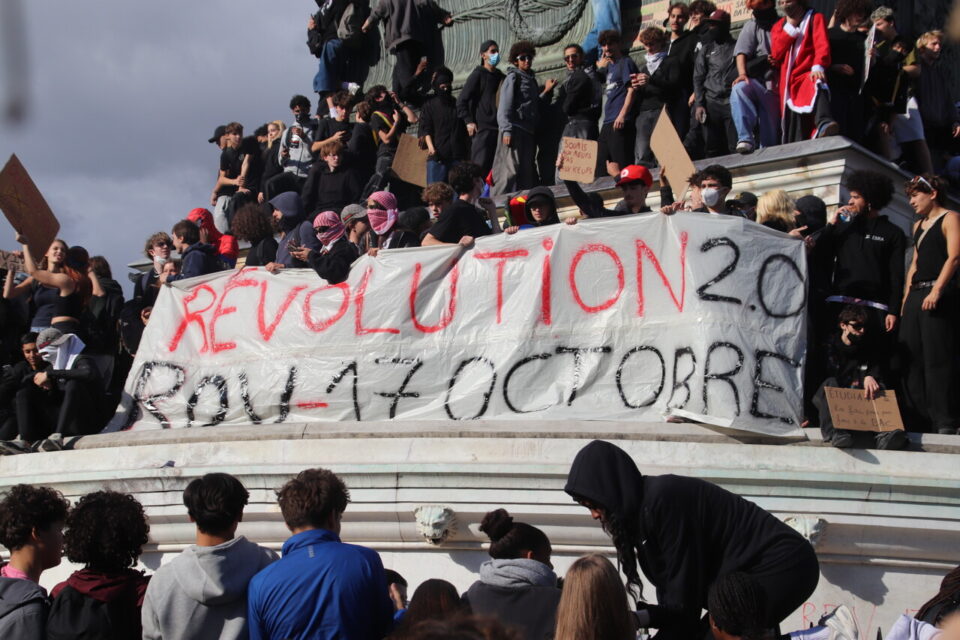
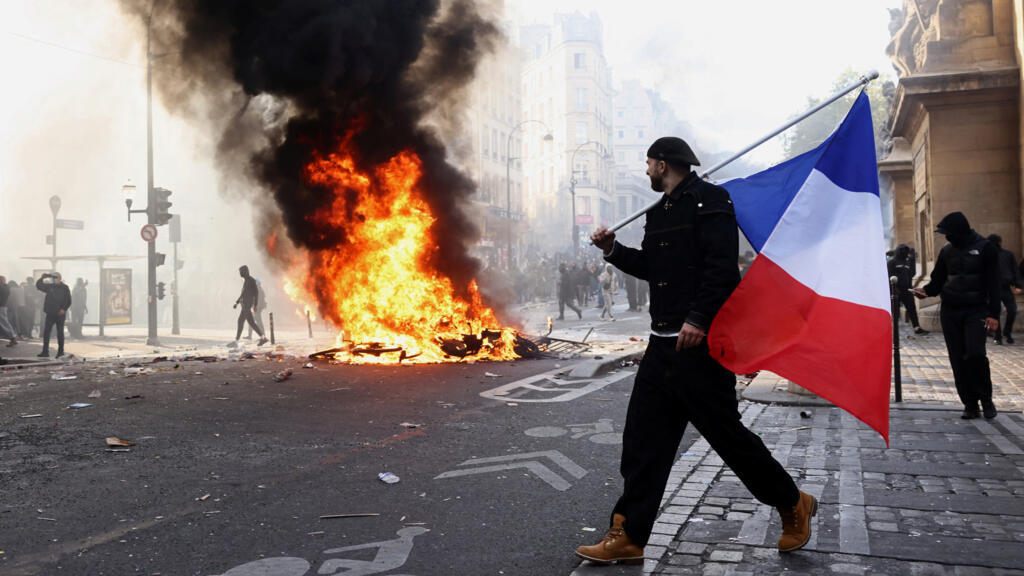
On October 18, “chaos” dominated many French front pages. Images of burning buildings, looted shops and clashes largely displaced the grievances that had brought high-school pupils, university students, employees, trade unionists and Yellow Vest activists into the streets.
The Interior Ministry counted 550,000 demonstrators nationwide, including 110,000 in Paris; the CGT union put the total at 800,000. The later official tally reported more than 1,200 arrests and at least 150 police officers and gendarmes injured. Yet reporters across the country also stressed that most participants marched peacefully.
When public-order images set the agenda
Le Parisien delivered one of the starkest accounts, foregrounding town halls attacked and shops looted. TF1 Info portrayed a country waking up “stunned” and highlighted calls from mayors for an urgent meeting with the prime minister.
Regional newspapers offered a more granular map of events. Ouest-France documented violence in Rennes and incidents in Nantes, Saint-Nazaire and Marseille. Les Dernières Nouvelles d’Alsace described a worrying escalation, while Euronews assembled scenes from Lyon, Bordeaux and other cities into a national “day of anger.”
Those events were real and serious. The editorial choice lies in making them the dominant account. La Dépêche’s report on a peaceful gathering of several hundred people in Auch provides a necessary counterweight: violent scenes did not define all of the roughly 110 demonstrations held across France.
Le Monde holds two realities together
Le Monde reported large protests ending in disorder and detailed the pressure now facing the government. But its analysis also framed October 17 as evidence of a deeper rupture between Macron-era politics and French youth.
Its reporting examined schools affected by missing teachers, deteriorating facilities and delayed renovation. An opinion piece by economist Thomas Piketty pointed to the fall in real higher-education funding per student since 2017 and to inequalities surrounding Parcoursup. In this reading, violence remains indefensible, but it cannot explain the movement on its own.
Security on the right, social convergence on the left
Before the marches, Le Figaro stressed the threat posed by black blocs and the prospect of a renewed Yellow Vest crisis, while also acknowledging anger over fuel costs, purchasing power and declining public services. That combination — legitimate anger and a threat to public order — shaped much of the right-leaning commentary.
L’Humanité instead foregrounded “social anger” and the presence of pupils, workers, trade unions and Yellow Vests. Its central question was whether these groups could build a lasting coalition around wages, schools, public services and energy prices. Libération had focused on the composition of the movement and the restrictions placed on protest routes in Paris.
The divide is therefore less about the existence of violence than about the hierarchy of facts. One camp treats disorder as the main event and asks whether the state can still enforce authority. The other argues that disorder risks erasing the social and educational crisis that produced the mobilization.
The foreign press sees a European warning
Reuters and the Associated Press led with fires, looting and arrests, but also noted that most demonstrators were peaceful and that grievances concerned education, public services and living costs. The Financial Times and The Wall Street Journal placed greater emphasis on political and economic instability ahead of the 2027 presidential election. The Guardian linked the arrest figures to questions about policing methods.
International coverage also connected France with protests in Belgium, Portugal, Italy and Albania. From abroad, October 17 appears not only as a French crisis, but as part of a wider European anger over prices, inequality and weakening public services.
French Moroccans: directly concerned, statistically invisible
The cost of living, wages, schools, transport and public services directly affect Moroccans living in France. But none of the official figures reviewed breaks down demonstrators, victims or detainees by national or family origin. It would therefore be irresponsible to assign French Moroccans any specific role in the protests or the violence.
They should be understood as a diverse part of French society. Criminal responsibility is individual; community-based claims require evidence that is currently unavailable.
What will remain of October 17?
The press broadly agrees on three points: a large mobilization, a mostly peaceful majority and serious violence in several cities. It disagrees on the legacy. If fire and broken windows monopolize public memory, October 17 will become a story about law and order. If education, wages and living costs remain on the agenda, it will be remembered as a warning about France’s social and generational divide.
💬 Commentaires (0)
Aucun commentaire. Soyez le premier !
✏️ Laisser un commentaire