Abdelilah Hlallouch did not return to Morocco through a government scheme. Born and raised in the Netherlands to a Moroccan family, he was visiting Tangier when the pandemic closed borders and left him unable to travel for months. A long-held ambition became a company: Tingis Web.
The business grew from four employees in 2020 to 26 in 2025. Revenue rose from $170,000 to $2.8 million between 2020 and 2024, according to figures the founder gave the Financial Times. Software development now accounts for most of its business, including e-commerce and telecom applications, an AI-enabled warehouse management system, energy-management work and the portal used for Morocco’s 2024 census.
Tingis Web captures a broader shift in the relationship between Morocco and its diaspora. MRE participation is no longer confined to remittances, property or family businesses. It increasingly includes brain circulation: skills acquired abroad, international clients and professional networks are connected to teams operating inside Morocco.
Morocco’s ministry in charge of expatriate affairs says more than 400,000 Moroccans abroad hold a master’s-level degree or higher. That pool does not automatically translate into productive investment. Yet it is strategically relevant as the Kingdom seeks to expand artificial intelligence, digital exports, decarbonisation and defence manufacturing.
Three routes home
The label “diaspora company” should not obscure important differences. Some businesses were incorporated in Morocco after their founders returned. Others operate across two or more countries. A third group consists of foreign companies co-founded by diaspora Moroccans that are now localising research or manufacturing in the Kingdom.
| Company | Field | Morocco footprint | Verified stage |
|---|---|---|---|
| Tingis Web | Software and AI-enabled systems | Operational team in Tangier | Established and exporting |
| SOWIT | AI, satellite data and agriculture | Casablanca base and Moroccan agricultural activity | Commercial deployment in Morocco and Africa |
| DeepEcho | Medical AI and prenatal ultrasound | Rabat team and links to Morocco’s medical ecosystem | R&D and pilots; regulatory validation remains essential |
| Nomad Labs | Sovereign AI and production systems | Moroccan company in Casablanca | Early-stage |
| Harmattan AI | Autonomous defence systems | Manufacturing and R&D capacity announced in 2026 | Strategic localisation announced; key details undisclosed |
| Gi2 / Gi3 | Energy engineering and solar manufacturing | Rabat and the Aïn Johra industrial park | Established activity and industrial scale-up |
| Sand to Green | Climate agritech, water management and solar desalination | Model developed from a farm in southern Morocco | Growing deployment |
AI designed around local constraints
SOWIT is a strong example of applied technology. Co-founder Hamza Rkha Chaham was born and raised in Morocco before studying in France and spending time in the United States. Since 2018, the company has turned satellite imagery into recommendations on irrigation, fertilisation, harvesting and agricultural risk. Its data can serve farmers, banks, insurers and public institutions.
The value lies not in an algorithm alone, but in how it addresses water scarcity, farm economics and access to finance. With bases in Casablanca, Dakar and Paris, SOWIT embodies a bridge model linking Moroccan operations to African and European markets.
DeepEcho follows a different path. Based operationally in Rabat and incorporated in the United States, the healthtech company is developing AI assistance for prenatal ultrasound. Co-founder Youssef Bouyakhf studied in France and worked in London before moving into technology entrepreneurship. The company is supported by both international and Moroccan ecosystem players, including UM6P. DeepEcho’s own disclaimer says its scientific and marketing claims remain subject to regulatory and scientific review — a crucial distinction in healthcare, where innovation must be proven clinically.
Nomad Labs is a newer bet on AI sovereignty. Founder Taha Halal, an École Polytechnique engineer with a Paris-Saclay doctorate in deep learning, says he returned after thirteen years in France. His Casablanca-registered company aims to build AI systems using Moroccan data and serving national languages. Its next test is execution: turning a persuasive sovereignty narrative into products, customers and measurable employment.
These companies are relevant to the government’s “Morocco for Artificial Intelligence 2030” roadmap, which targets MAD 100 billion in additional value added, 50,000 direct and indirect jobs and 200,000 trained or certified talents by 2030. Diaspora founders can accelerate that agenda, but they cannot substitute for risk capital, accessible data, agile procurement or sustained links between universities and industry.
Defence brings a new strategic dimension
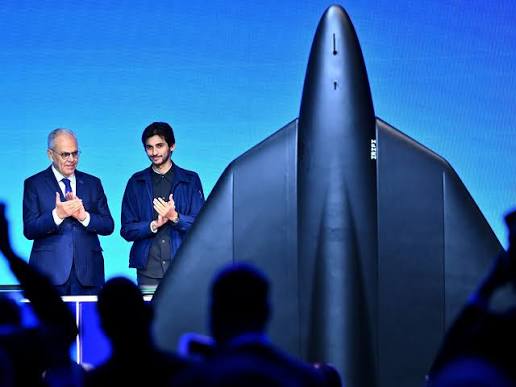
Harmattan AI is the most sensitive case in this report. The French defence technology company is co-founded and led by Mouad M’Ghari, a Franco-Moroccan entrepreneur born in Rabat. On 17 June 2026, it announced a partnership with Morocco’s Royal Armed Forces to establish manufacturing capabilities for autonomous defence systems, create a defence-AI research and development centre in Morocco, and build partnerships with Moroccan universities and research institutions.
The strategic promise is clear: Morocco is seeking not only to buy equipment, but also to localise engineering, research, maintenance skills and eventually part of the supply chain.
The evidence, however, must be described accurately. No contract value, production volume, precise manufacturing site, detailed timetable or full product list has been published. Harmattan AI should therefore be presented as a major localisation commitment, not as a completed industrial achievement. In defence reporting, normal confidentiality cannot be replaced with speculation.
Turning experience in Germany into Moroccan solar capacity
Badr Ikken offers a longer and more institutional return story. After studying industrial production and solar systems at the Technical University of Berlin, conducting doctoral research and working with Fraunhofer, he returned to Morocco in 2010. He contributed to the Noor Ouarzazate complex at MASEN, then led IRESEN for eleven years and helped establish research platforms including Green Energy Park.
In 2022, he moved into entrepreneurship through Gi2, an energy-transition engineering consultancy, and Gi3, an industrial vehicle focused on green technologies. At Aïn Johra near Tiflet, Gi3 launched a Moroccan solar water-heater manufacturing project. The initial plan cited MAD 60 million in investment and capacity of 40,000 units a year, with later expansion. Those figures are declared project targets, not independently audited annual output.
The wider objective is import substitution, university-industry cooperation and the creation of local suppliers. This is where diaspora experience has its deepest effect: international expertise becomes domestic productive capacity.
Sand to Green lies at the intersection of climate technology, agriculture and renewable energy. The company grew from a family farm in southern Morocco taken over in 2018 by agronomist Wissal Ben Moussa. Its model combines agroforestry, digital land assessment, water management and solar-powered desalination. It is not a power producer; rather, it demonstrates how renewable technology can support farming and soil restoration in arid regions.
The diaspora dividend — and the missing policy metrics
The contribution visible across these companies has five layers: skilled jobs; international standards and management methods; access to foreign customers and investors; a measure of technological sovereignty; and a demonstration effect for other founders considering Morocco.
The Kingdom already has instruments such as MDM Invest, MDM Tamwil and CGEM’s 13th Region initiative. The next step is to turn a patriotic invitation into a predictable investment journey: a genuine one-stop interface, clear administrative deadlines, access to industrial testing and land, procurement that young firms can enter, R&D co-financing and technically qualified public counterparts.
Morocco should also publish outcomes. How many diaspora-led projects survive beyond three or five years? How many skilled jobs, exports, patents and R&D investments do they produce? Without such indicators, diaspora mobilisation remains a narrative. With them, it becomes accountable economic policy.
The goal is not to demand that every Moroccan abroad return. It is to make circulation productive — by building a team in Morocco, funding a laboratory, training engineers, opening export markets or transferring technology. From Tangier’s software studios to Aïn Johra’s solar ambitions and Rabat’s emerging defence-AI ecosystem, the foundations exist. Morocco’s next challenge is to turn scattered success stories into a durable diaspora-to-development pipeline.
💬 Comments (0)
No comments yet. Be the first!
✏️ Leave a comment