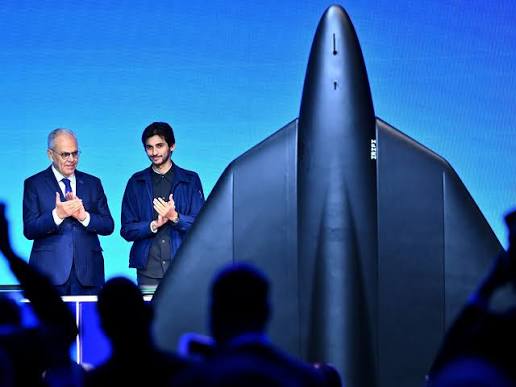
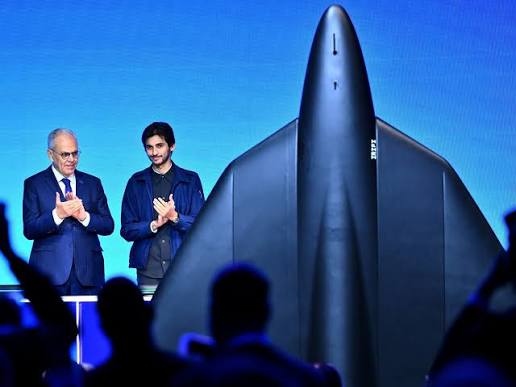
At the 2026 Marrakech Airshow, Morocco displayed more than aircraft. It signalled its intention to gradually move from being primarily an importer of defence equipment to becoming a designer, manufacturer and potential exporter.
Autonomous drones, counter-drone systems, embedded artificial intelligence, optronics and ground robotics have become central to this strategy. In this emerging sector, Moroccans living abroad can play a role similar to the one they have already assumed in automotive manufacturing, aerospace, research and digital technology.
MMNEWS’ documentary investigation identifies two particularly significant diaspora figures: Mouad M’Ghari, co-founder of France-based Harmattan AI, and Fahd Laamoumi, a Belgian-Moroccan engineer who established Ballistic Defense System in Rabat.
The legal foundation
Morocco’s Law 10-20, promulgated in 2020, and its 2021 implementing decree created the legal framework governing the manufacture, research, import and export of defence equipment and dual-use technology.
Manufacturing requires authorisation from the National Defence Administration following review by a national commission. The decree explicitly allows an authorisation to cover research and development associated with manufacturing. adala.justice.gov.ma
This framework emerged alongside an aerospace sector employing approximately 25,000 people across 160 companies. Its exports reached nearly $3 billion in 2025. www.reuters.com
The next challenge is no longer simply producing components. It is controlling software, sensors, autonomy, artificial intelligence and intellectual property.
Mouad M’Ghari: diaspora expertise returning through industry
Born in Rabat and raised in the Paris region, French-Moroccan entrepreneur Mouad M’Ghari studied at École Polytechnique, the École normale supérieure and MIT.
In April 2024, he co-founded Harmattan AI, a Paris-based defence-technology company specialising in autonomous systems and embedded AI. In less than two years, the company reached a reported valuation of $1.4 billion following a $200 million funding round led by Dassault Aviation. École polytechnique, école d'ingénieur
In June 2026, Harmattan AI announced a strategic partnership with Morocco’s Royal Armed Forces. The agreement covers manufacturing autonomous defence systems in Morocco, establishing a defence-AI research centre and working with Moroccan universities and research institutions. Harmattan AI
This is a concrete illustration of what MRE expertise can provide: world-class scientific training, access to investment, industrial networks and the ability to connect Morocco to advanced international supply chains.
The test will be the depth of the transfer. How many engineers will be trained? Where will the patents be held? Which critical technologies will genuinely be controlled by Moroccan teams?
Fahd Laamoumi: building the company in Rabat
Fahd Laamoumi, a Belgian-Moroccan aerospace engineer, followed a different path. Rather than expanding an existing European company into Morocco, he established Ballistic Defense System in Rabat.
Founded in late 2023, BDS is developing an autonomous defence drone designed to continue navigating in environments where conventional satellite signals are disrupted. A small Moroccan engineering team has completed a prototype and reported field trials.
However, BDS has not announced any contract. Its founder says the company is discussing possible demonstrations with the Moroccan military and needs access to controlled testing infrastructure before any procurement can be considered. breakingdefense.com
This exposes a structural challenge. Attracting MRE engineers is not enough. Morocco must also provide testing ranges, certification procedures, financing and institutional access if prototypes are to become industrial products.
Aerodrive and the reverse journey
Not every entrepreneur in the sector began as an MRE. Soufiane Ammagui, originally from the Chichaoua region and trained at Mohammed VI Polytechnic University, founded AERODRIVE Engineering Services in Morocco in 2017.
The company later established operations at France’s Pégase technology park to develop its R&D and commercial activity. The regional investment agency identifies the Royal Armed Forces, OCP and Managem among its references. investinvaucluseprovence.com
Aerodrive represents the reverse movement: a company born in Morocco that creates an international presence while retaining Moroccan engineering roots. It shows that diaspora contribution should not be limited to permanent return. Skills, laboratories and teams can circulate between several countries.
The dual-use ecosystem
Founded by Moroccan engineers Badr Idrissi and Younes Moumen, ATLAN Space develops artificial intelligence enabling drones to conduct autonomous maritime-monitoring missions.
The company is not publicly positioned as a weapons manufacturer. Its work is primarily civil and environmental. Nevertheless, technologies such as computer vision, autonomous navigation, mapping and real-time data processing are inherently dual-use. ATLAN Space
This civilian ecosystem can strengthen national capabilities without automatically becoming part of the arms industry.
Beyond announcements
Other Moroccan actors are emerging. ABA Technology has presented the Burj counter-drone system and the Argon reconnaissance drone, although no publicly confirmed military order or independent performance evaluation is currently available. www.siliconvalley.ma
Moroccan Military Industry is preparing to deliver locally manufactured armoured-vehicle turrets and is developing a counter-drone variant. The company says 99% of its workforce is Moroccan, although Reuters has reported close technological links with Israel’s Elbit Systems. www.reuters.com
These cases demonstrate why incorporation, assembly and employment figures alone do not prove technological sovereignty. Ownership of capital, patents, source code and maintenance capability remains decisive.
MREs as builders of sovereignty
For decades, the contribution of MREs has largely been assessed through remittances. Defence technology reveals another form of wealth: scientific, industrial and relational capital.
MRE professionals can provide advanced expertise, international certification knowledge, investment networks, links with major manufacturers and access to foreign universities and laboratories.
Morocco could build a dedicated and secure mechanism for diaspora professionals working in aerospace, cybersecurity, robotics and defence AI. It should combine regulatory assistance, controlled access to testing facilities, joint research programmes and prototype financing.
Mouad M’Ghari and Fahd Laamoumi represent two complementary models. One created a major company abroad before reconnecting it industrially with Morocco. The other brought European expertise directly into a Moroccan startup.
Their success will not ultimately be measured by exhibition announcements. It will be measured by Moroccan-held patents, trained engineers, certified prototypes, local production and companies capable of surviving beyond their first public contract.
MREs should no longer be considered only as investors. They can become architects of Morocco’s technological sovereignty.

💬 Commentaires (0)
Aucun commentaire. Soyez le premier !
✏️ Laisser un commentaire