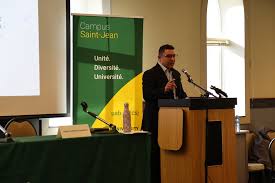
Safouhi is a professor of applied mathematics and Vice-Dean at Campus Saint-Jean. His academic journey includes Morocco and France: the University of Alberta records that he earned a master’s degree in applied mathematics from Hassan II University in Casablanca in 1994 before continuing his studies abroad.
In 2025, Campus Saint-Jean highlighted an award recognising his outstanding commitment to promoting and strengthening relations between Morocco and Canada. A university profile published in March 2026 later described his career through mathematics, education and what it called the “diplomacy of knowledge.”
From individual success to collective networks
Safouhi’s career is especially relevant because it extends beyond his own academic position.
He is involved in the Canadian Association of Moroccan Professors and Researchers, a network connecting Moroccan academic talent in Canada. The University of Alberta identifies him as a professor of applied and computational mathematics as well as a Vice-Dean at Campus Saint-Jean.
That kind of network changes the meaning of diaspora expertise.
One successful professor can build an impressive career.
A connected community of professors can help students, establish collaborations, identify funding opportunities and introduce Moroccan institutions to Canadian counterparts.
The value becomes collective.
The mathematics behind modern technology
Applied mathematics can appear abstract from the outside.
In reality, it sits underneath much of modern technological life.
Artificial intelligence needs mathematics.
Engineering simulations need mathematics.
Optimisation, logistics, financial modelling, physics and many areas of medical research depend on mathematical tools.
Researchers in this field therefore help build the invisible intellectual infrastructure on which highly visible innovation depends.
A new way to think about brain drain
Safouhi’s story also suggests a more nuanced way of discussing skilled migration.
For decades, countries worried that once a researcher left, their expertise was lost.
Digital communication, international research programmes and stronger diaspora networks have changed that equation.
A Moroccan professor based in Canada can remain useful to Morocco without permanently relocating.
He can mentor students.
Connect universities.
Support research projects.
Introduce colleagues.
And help Moroccan talent enter networks that would otherwise be harder to reach.
For Morocco, that may be one of the most important opportunities presented by its highly educated diaspora.
The goal does not always have to be return.
Sometimes the goal should be circulation.
Hassan Safouhi’s career shows how a Moroccan scientist abroad can become more than a symbol of individual success. He can become part of the infrastructure connecting two countries — one student, one university and one research relationship at a time.



💬 Comments (0)
No comments yet. Be the first!
✏️ Leave a comment