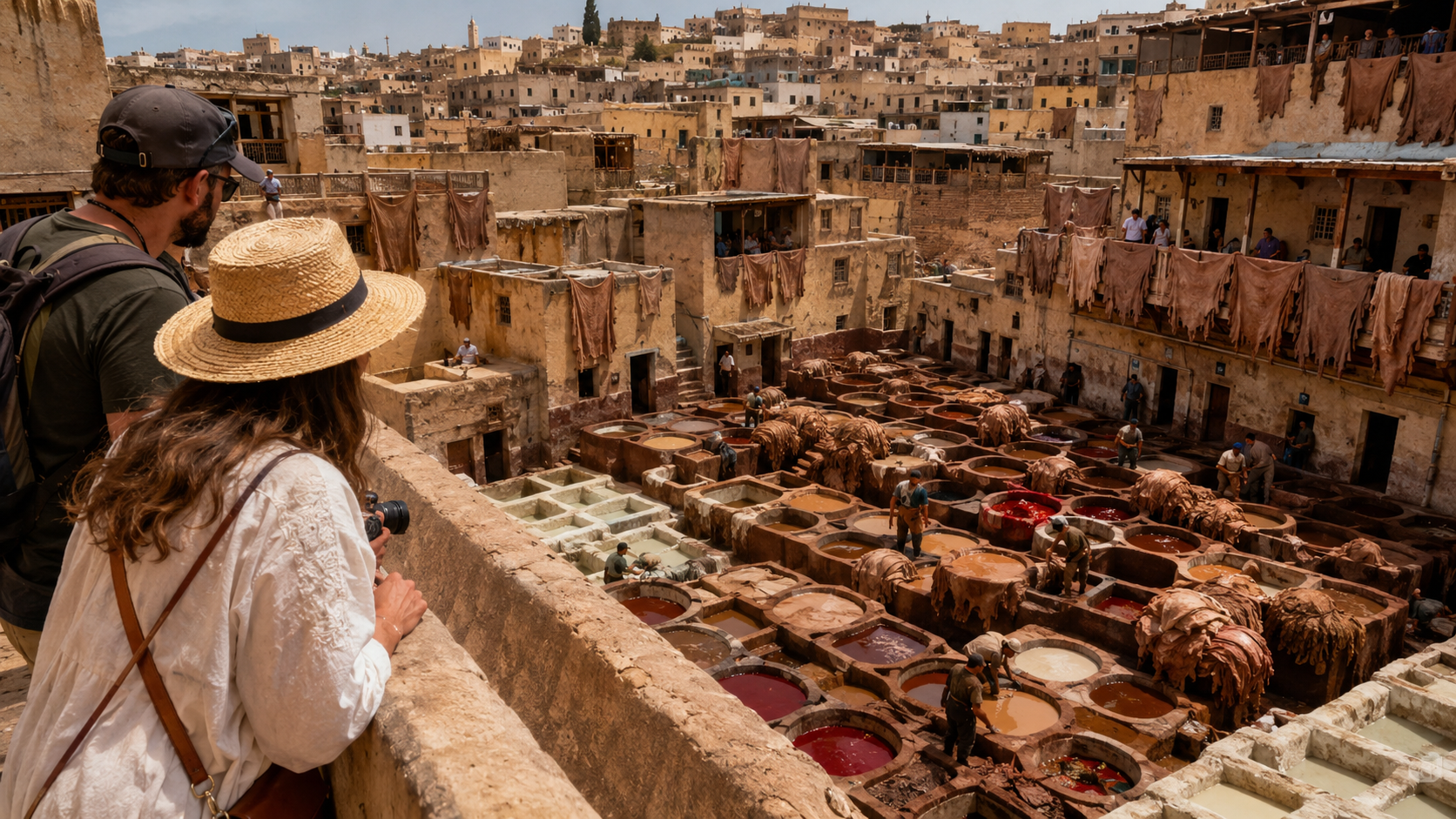
In Fez, Marrakech, Tetouan, Rabat, and other historic Moroccan cities, leather tanning remains one of the most powerful symbols of Moroccan craftsmanship. It is a craft made of water, lime, natural pigments, sunlight, physical effort, patience, and beauty. In these open-air workshops, Morocco does not simply display a traditional product. It reveals part of its deep memory.
Fez: The Beating Heart of Moroccan Tanneries
When people speak about tanneries in Morocco, the mind almost naturally turns to Fez. In the heart of the old medina, the Chouara Tannery remains one of the most famous and fascinating sites in the city. From the terraces overlooking it, the circular vats look like a living mosaic: red, yellow, brown, blue, green, and other shades mixing with the movement of workers, hides, and water.
But what tourists often see as a beautiful scene is, for the craftsmen, a demanding daily job. The tanner is not standing in front of a painting. He is inside a profession that requires physical strength, precise knowledge, and the ability to endure difficult conditions. He washes the hide, softens it, removes impurities, places it in the vats, colors it, dries it, and prepares it for the next stage.
Here, every color has meaning. Every movement has history. Every piece of leather passes from hand to hand before becoming slippers, bags, belts, furniture, or decorative objects.
A Craft That Has Crossed Centuries
Leather tanning in Morocco is not a recent activity. It is part of a long tradition linked to medinas, souks, caravans, and trade routes. Because of its position between Africa, Al-Andalus, the Mediterranean, and the Sahara, Morocco has long been a land of movement and exchange. Through these routes, many crafts developed, and leatherwork became one of the most enduring.
In Moroccan cities, tanneries were never simply production spaces. They were part of the economic and social organization of the medina. Each craft had its quarter, its market, its masters, its secrets, and its traditions. Leather was present in everyday life: clothing, travel, horse riding, decoration, furniture, and even bookbinding.
To speak about Moroccan tanneries is therefore not only to speak about a profession. It is to speak about a long relationship between people and material. A relationship built on transforming the raw into the refined, the useful into the beautiful, and the everyday into heritage.
Moroccan Leather: A Memory You Can Touch
In the narrow streets of the medinas, Moroccan leather takes countless forms. It appears in traditional babouches, handbags, belts, wallets, jackets, poufs, saddles, book covers, and decorative pieces that fill homes, riads, hotels, and markets.
Every leather object carries part of its journey. It begins as raw hide, passes through water, lime, and dyes, dries in the sun, and then takes its final form in another craftsman’s hands. In this sense, leather is not the product of one craft alone. It is the result of a chain of skills.
The item a visitor buys in Fez or Marrakech does not carry the work of just one person. It carries the trace of an entire network: the breeder, the hide collector, the tanner, the dyer, the tailor, the decorator, and the merchant. Moroccan leather is not merely a tourist product. It is a small economy, a collective memory, and a human chain of labor and knowledge.
Between Beauty, Tourism, and Hard Work
It is true that tanneries have become major tourist attractions in Morocco, especially in Fez. Visitors climb to terraces to take pictures. Guides explain the stages of tanning. Shopkeepers display leather goods in different colors and styles. But it would be unfair to reduce these places to postcard views.
Tanneries are, first and foremost, workplaces. They involve sweat, effort, strong odors, natural or semi-natural materials, physical labor, and health and environmental challenges that deserve attention. The craftsmen who keep this heritage alive do not always work in easy conditions. Respecting the craft begins by recognizing that its beauty cannot be separated from the difficulty of practicing it.
This is one of the central questions for the future: how can Morocco preserve the authenticity of its tanneries without leaving craftsmen alone to carry the cost of that heritage?
A Beauty That Does Not Pretend
What makes Moroccan tanneries so powerful is that they do not hide their truth. Nothing is completely polished. The walls carry the marks of time. The vats carry the traces of pigments. Hides are spread out on rooftops. The hands are tired. The smell is part of the experience.
And yet, from this rawness comes a rare beauty.
It is a beauty unlike mass-produced industrial objects. It carries the touch of the hand, a small imperfection, a human mark, and the memory of place. In a world where factories produce thousands of identical items, the tanneries remind us that beautiful things need time.
Leather does not become soft instantly. Color does not settle without patience. An authentic object is not born from a machine alone, but from a long encounter between human skill and raw material.
Marrakech, Tetouan, Rabat: Other Faces of Leatherwork
If Fez is the most famous, it is not the only city where leather remains alive. In Marrakech, the tanneries near Bab Debbagh still preserve part of this traditional world. There, the craft carries the energy of the Red City and its vibrant markets.
In Tetouan, with its Andalusian heritage, leatherwork forms part of a refined urban culture, linked to elegance, detail, and artisanal taste. In Rabat and Salé, leather has long been connected to everyday objects, traditional saddlery, decoration, and refined craftsmanship.
Each city adds something different. Moroccan leather is not uniform. It is plural, just like the Kingdom’s regions, accents, colors, and memories.
Visiting Tanneries With Respect
Visiting a Moroccan tannery is not like visiting an ordinary monument. It means entering a living professional world. That requires respect, patience, and attention. It is not enough to take a beautiful photo from above and leave. The real value is in understanding what is being seen.
A guided visit can help explain the history of the site and the different stages of the work. Morning is often a good time to see the tannery in full activity. Visitors should also remember that the people working below are not part of a show. They are craftsmen doing real, demanding work.
Buying leather goods should also be done consciously. Handmade products should not be treated as disposable souvenirs. Behind them are time, effort, and expertise. To value the craft is also to accept the fair price of skilled work.
The Challenge Ahead: Preserving Without Freezing
The major challenge facing Moroccan tanneries today is finding the right balance between authenticity and modernization. How can the traditional character of the craft be preserved while improving working conditions? How can production methods evolve without erasing the handmade touch? How can tanneries become more environmentally responsible without losing their soul?
There is no simple answer, but the question is essential. Protecting this heritage does not mean only photographing it or placing it in tourism brochures. It means improving conditions for craftsmen, training younger generations, supporting cooperatives, organizing cultural tourism routes, monitoring quality, and presenting the craft to new generations as both a source of pride and a real economic opportunity.
Heritage does not survive simply because it is old. It survives because it remains useful, dignified, and capable of continuing.
Why Tanneries Still Fascinate Travelers
Perhaps tanneries fascinate because they offer something rare: the visible transformation of matter. In most modern products, we no longer know who made the object, how it was made, or where the material came from. In a tannery, everything is visible. The hide in its raw state, the color in the vats, the worker in his place, the sun over the rooftops, and the finished object waiting for its next life.
This raw transparency is part of the fascination. It reminds us that behind every object we wear or use, there is a human hand, a story, and a long effort.
For Moroccans, the tanneries say something even deeper: identity does not live only in palaces, walls, and historic mosques. It also lives in small trades, alleys, markets, workshops, and the hands of craftsmen who continue their work away from the spotlight.
In the Tanneries, Morocco Breathes Its History
Entering a Moroccan tannery is like opening an old book. A book not written with words, but with colors, odors, water, leather, and sunlight. It is a book about a Morocco that works, transforms, creates, and endures.
At first, tanneries may feel intense, even difficult for the senses. But after a moment, they reveal their deeper beauty: the beauty of handmade work, continuity, patience, and a craft that has resisted time.
In the vats of Fez, Marrakech, Tetouan, and beyond, it is not only leather that is being dyed. It is memory. The memory of a country that has known, for centuries, how to turn raw material into art, daily labor into heritage, and the working hand into part of the nation’s soul.


💬 Commentaires (0)
Aucun commentaire. Soyez le premier !
✏️ Laisser un commentaire