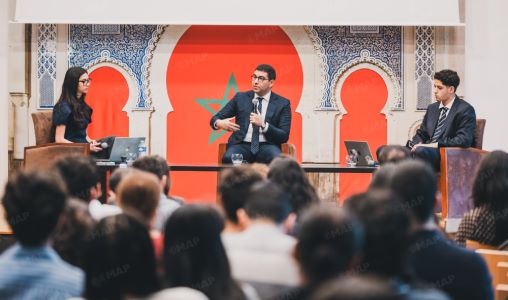
The minister was speaking at the Maison du Maroc, during a conference organized in partnership with the student collective Le Guide du Diplomate under the theme: “Moroccan Youth in France: Between Engagement and Influence.”
The event brought together students, young professionals, cultural and community figures, and members of the Moroccan diaspora in France.
A Younger Diaspora More Involved in Morocco’s Transformation
According to Mehdi Bensaïd, young Moroccans living abroad are becoming increasingly involved in the economic, cultural and social changes taking place in the Kingdom.
Their relationship with Morocco is no longer limited to family ties or emotional attachment. It is increasingly expressed through business projects, community initiatives, cultural programs and international partnerships.
“Sometimes, the farther you are from Morocco, the stronger the desire to act for your country,” the minister said, highlighting the role played by Moroccan talent abroad in strengthening the Kingdom’s image and international appeal.
New Opportunities in Gaming and the Cultural Industries
The minister highlighted examples of entrepreneurs from the diaspora who have chosen to invest in Morocco or develop part of their business activities in the country while remaining connected to international markets.
He specifically mentioned sectors such as gaming, creative technologies and cultural industries.
According to Bensaïd, these projects can improve Morocco’s competitiveness, attract international partnerships and create new opportunities for young people, particularly in digital and creative sectors.
This trend reflects a broader change in the relationship between the diaspora and Morocco. Contribution is no longer limited to permanent return or property investment. It now also includes startups, digital projects, cultural production and the transfer of expertise.
Moroccans Abroad as a Bridge Between Countries
Bensaïd also emphasized the role of Moroccans abroad as a bridge between Morocco and their countries of residence.
Academic cooperation, professional networks, knowledge-sharing and community initiatives can all support development in several sectors.
This role is especially visible among younger generations who have studied at foreign universities and gained experience in international economic environments. Their understanding of different cultures and markets can become a major asset for Morocco.
Returning to Morocco and the Challenge of Administrative Procedures
Addressing the issue of return and settlement in Morocco, the minister pointed to progress made in the digitalization of public services.
He said that digital tools can improve access to information, simplify certain procedures and help Moroccans abroad manage projects remotely.
However, he also stressed the need for continuous support. Digital platforms are only effective when they provide clear information, allow users to track their files and identify the department responsible for each request.
For many Moroccans abroad, the success of a project in Morocco depends not only on economic opportunities, but also on clear procedures and efficient administrative support.
Advanced Regionalization as a Way to Spread Opportunity
The minister presented advanced regionalization as a key tool for reducing inequalities in access to public services, cultural activities and youth programs.
The goal is to bring public policy closer to citizens and prevent opportunities from remaining concentrated in a small number of major cities.
In this context, Bensaïd referred to the Youth Pass, a program designed to give young people access to a range of services and activities. According to him, the initiative has generated strong interest in several regions of the Kingdom.
Beyond practical benefits, he argued, such programs can also help rebuild trust between young people and public institutions.
Trust Is Essential to Turn Interest Into Lasting Projects
Trust remains central to the relationship between Morocco and its young diaspora.
Moroccan professionals abroad want to invest, create, transfer knowledge and contribute to the country’s development. In return, they expect greater transparency, simpler procedures, accurate information and support adapted to their professional and geographic realities.
The challenge is therefore not simply to invite Moroccans abroad to return or invest. It is to build an environment capable of turning their interest into long-term projects.
That requires better access to information, simpler administrative processes, reliable support networks and opportunities spread across all regions.
Moroccan Youth in France at the Center of the Discussion
For her part, Malak Rafik, co-founder of Le Guide du Diplomate, explained that the theme was chosen to better understand the links between Moroccan youth in France and young people living in Morocco.
The discussion took place in a context of growing student and professional mobility between the two countries, as well as expanding cooperation in business, culture and community engagement.
She added that young Moroccans abroad already contribute to Morocco’s international standing through academic success, civic engagement, cultural initiatives and their presence in many professional sectors.
A New Generation Moving From Belonging to Action
The Paris meeting highlighted the rise of a generation that no longer wants to express attachment to Morocco only through words.
This generation wants to build companies, launch cultural projects, create partnerships and transfer experience, without necessarily cutting ties with its country of residence.
Its identity is shaped across several spaces, but its potential can become a real strength for Morocco if the right support mechanisms are in place.
The message delivered in Paris was clear: Morocco wants to involve its diaspora more deeply in the economic, cultural and social transformations currently underway.
Promising opportunities exist in entrepreneurship, digital technology, culture, research and the creative industries. But the success of this dynamic will depend on the ability of institutions to simplify procedures, strengthen trust and provide practical support.
Young Moroccans abroad do not only want their achievements to be celebrated. They want to be recognized as full partners in the development of the Kingdom.

💬 Comments (0)
No comments yet. Be the first!
✏️ Leave a comment