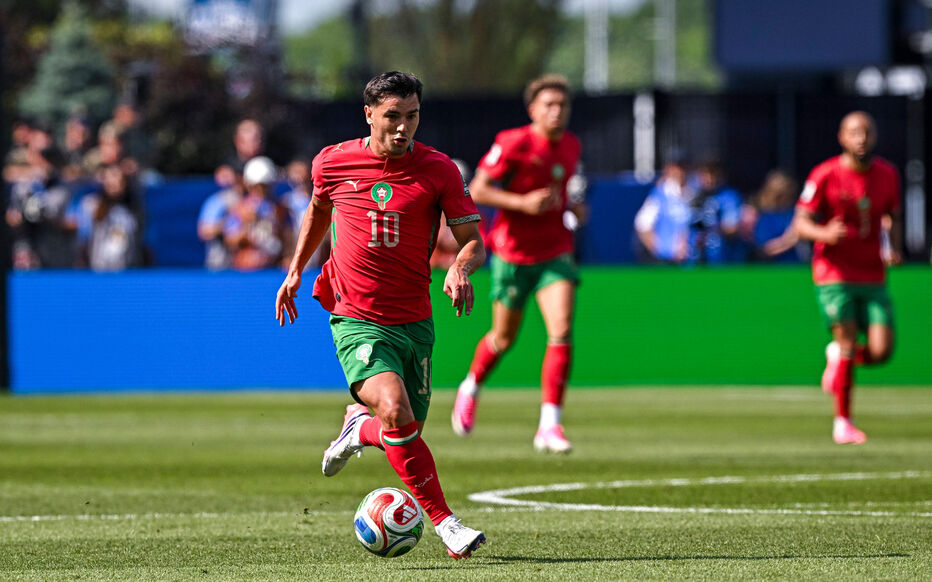
This was not a game built for spectacle. It was a study in territorial control. Morocco finished with 79 per cent possession, 19 attempts to Lesotho’s six and 39 touches in the opposition box. Yet only five of those shots hit the target.
That gap between dominance and precision is the central story of the match.
Ouahbi chose technique over a fixed striker
Mohamed Ouahbi started in a 4-2-3-1. Oussama Targhalline and Neil El Aynaoui formed the midfield base, with Brahim on the right, Ounahi centrally and Bilal El Khannouss drifting in from the left. Ismaël Saibari operated as a mobile forward rather than a conventional penalty-box reference.
The design gave Morocco several players capable of combining between the lines. It also created congestion in the zones Lesotho were most determined to protect. With three centre-backs and a midfield line of four defending narrow spaces, the nominal hosts invited Morocco to circulate the ball outside their block.
Saibari’s movement helped link attacks, but Morocco did not always have a fixed presence occupying the central defenders. Possession became heavily tilted towards the middle third, and too many attacks developed at the same tempo.
Brahim delivered before anxiety could grow
Brahim’s goal in the 45th minute changed the emotional and tactical shape of the contest. Until then, Morocco had owned the ball without producing enough clean chances. A goalless interval would have rewarded Lesotho’s resistance and increased the pressure on the favourites.
Starting from the right, Brahim repeatedly moved into the half-space while Zakaria El Ouahdi supplied width on the outside. The pairing produced Morocco’s clearest attacking mechanism. El Ouahdi stretched the defensive line; Brahim looked for combinations in tighter areas.
The goal underlined Brahim’s value. Even when a low block limits his dribbling room and some ambitious actions fail, he can decide a match in one confined moment.
Nineteen shots, only five on target
Morocco had no difficulty reaching the attacking third. Their challenge was creating the extra movement required to disorganise five defenders. Against such a structure, horizontal circulation needs to be followed by a sudden vertical pass, an overlapping run, a cut-back or a third-man movement.
Too often, the Atlas Lions searched for the perfect opening after Lesotho had already recovered their shape. At other moments, they accelerated without enough bodies attacking the finishing zones.
The statistics reflect that tension. Thirty-nine box touches and 19 shots are evidence of pressure. Five efforts on target show that the final action remained below the level of the build-up.
The bench changed the geometry
Ouahbi increased the attacking width from the 68th minute. Abdessamad Ezzalzouli replaced El Aynaoui, Achraf Hakimi came on for Noussair Mazraoui and Soufiane Rahimi replaced Brahim.
Those substitutions gave Morocco more direct running, a natural one-against-one threat and greater depth around the penalty area. Ounahi finally made it 2-0 in the 82nd minute after an action involving Rahimi.
Ounahi’s goal rewarded a performance full of movement and persistence. Rahimi’s contribution again showed how a substitute can alter a closed match without requiring a complete change of system.
Control without a full defensive test
Targhalline played an important balancing role, offering a passing option in the build-up while protecting against rare turnovers. El Ouahdi maintained the width Morocco needed. Issa Diop and Abdelhamid Aït Boudlal mainly managed space rather than sustained attacking pressure.
Lesotho registered one shot on target and only five touches in Morocco’s box. A second consecutive clean sheet is valuable, but it should not be exaggerated: Yassine Bounou and the back line were never tested intensely enough to provide a definitive defensive verdict.
A perfect return, with room to sharpen the attack
Morocco have opened qualifying with six points, four goals and none conceded after consecutive 2-0 victories over Gabon and Lesotho. They moved provisionally clear at the top of Group A before the later Gabon–Niger fixture.
The results are impeccable. The performance offers Ouahbi a more useful lesson.
Morocco can dominate territory, suffocate transitions and eventually solve a deep defensive block. The next step is to increase the speed and variety of their positional attacks. Against stronger opposition, allowing a one-goal match to remain open until the final ten minutes carries greater risk.
The friendly against Ghana in Tangier on 4 October should present a different test. Morocco leave Bloemfontein knowing they can win an attritional game. Now they must learn to unlock it sooner.
Match data
- Result: Lesotho 0–2 Morocco
- Goals: Brahim Díaz (45), Azzedine Ounahi (82)
- Morocco formation: 4-2-3-1
- Possession: Lesotho 21% – Morocco 79%
- Shots: Lesotho 6 – Morocco 19
- Shots on target: Lesotho 1 – Morocco 5
- Opposition-box touches: Lesotho 5 – Morocco 39
💬 Comments (0)
No comments yet. Be the first!
✏️ Leave a comment