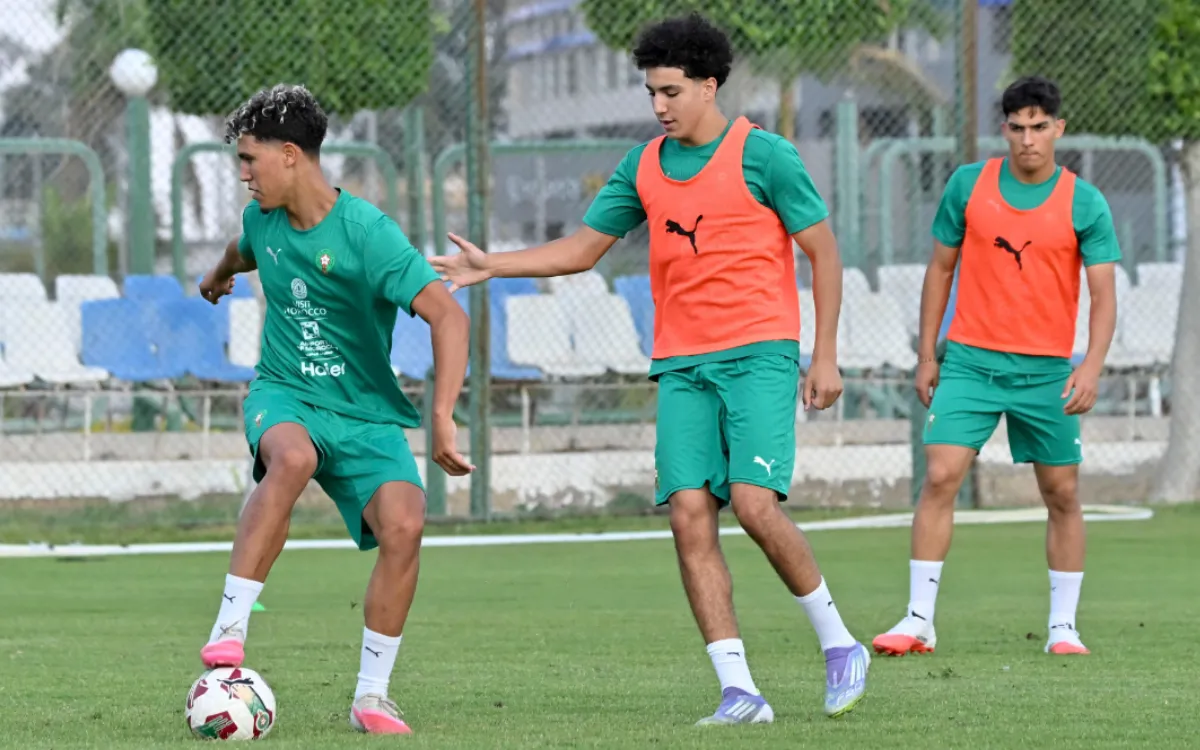
Morocco’s position can be stated simply: one match played, one point collected, no goals scored and three fixtures remaining.
After sitting out the opening round, the Lion Cubs drew 0-0 with Tunisia on 27 September at the Suez Canal Stadium in Egypt. They stood fourth after that round, although they had played fewer matches than Algeria, Tunisia and Libya. Only the top two teams will reach the 2027 U20 Africa Cup of Nations in Ghana.
The draw was disappointing given Morocco’s status and ambitions. It was not a disaster. The team still controls its route to qualification, but the fixtures against Algeria, Egypt and Libya now leave little margin for another passive performance.
The world champions — but a different cycle
Morocco are entitled to carry the authority of their world title into every youth competition. Yet the current squad is not identical to the side that became world champions. Several players have moved into higher age groups or senior football, while title-winning coach Mohamed Ouahbi has taken charge of the senior national team.
Batelli has inherited a new group. That explains the shortage of established combinations, but it does not remove the obligation to preserve a recognisable footballing identity across generations.
Warning signs, but not enough evidence for a dismissal
There are legitimate concerns. Batelli’s team lost 1-0 to Tunisia at the Mediterranean Games and then failed to score against the same opposition in the UNAF opener. Morocco also failed to overcome Algeria in the Taranto semi-final, going out on penalties after a 1-1 draw. Against compact North African sides, the build-up has often looked slow and the chance creation too dependent on individual actions.
Still, the record needs to be presented honestly. Morocco won Mediterranean bronze, beating North Macedonia 5-1 and host nation Italy 4-1. Batelli also led France to the 2016 European U19 title. His youth-football credentials are real.
He should therefore be judged on measurable outcomes: whether the team improves across the tournament, whether his selection choices create balance, whether the attack develops coherent patterns and, ultimately, whether Morocco qualifies. Failure to reach the AFCON would be a major sporting setback. A single goalless draw is not yet sufficient evidence of systemic failure.
Morocco must build a coaching pathway of its own
The debate should extend beyond one French coach. Morocco has a large pool of former internationals developed in France, Belgium, the Netherlands, Spain and Germany. Many understand European academy systems, Moroccan football culture and the delicate work involved in recruiting and supporting dual-nationality players.
That diaspora experience should be converted into coaching capacity. Former MRE players can be integrated as assistants, scouts and age-group coaches, then promoted through a transparent federal pathway. But nationality alone cannot be the criterion. Coaching licences, youth-development experience, tactical knowledge, teaching ability and familiarity with both domestic and overseas talent must come first.
The objective is not to exclude foreign expertise. It is to ensure that Moroccan expertise is being developed rather than permanently placed behind imported profiles.
Algeria will clarify the picture
The Algeria match is the first major test of Batelli’s qualifying campaign. A win would quickly restore momentum. Another draw would increase the pressure ahead of Egypt. A defeat would leave Morocco facing a dangerous recovery mission.
The world title raised the standard for every Moroccan youth side. It cannot guarantee future results. What it should guarantee is a stronger method: smoother generational renewal, clearer playing principles and a credible pathway for Moroccan coaches. The Tunisia draw was an alarm. The next three matches will reveal whether the team has heard it.
💬 Comments (0)
No comments yet. Be the first!
✏️ Leave a comment