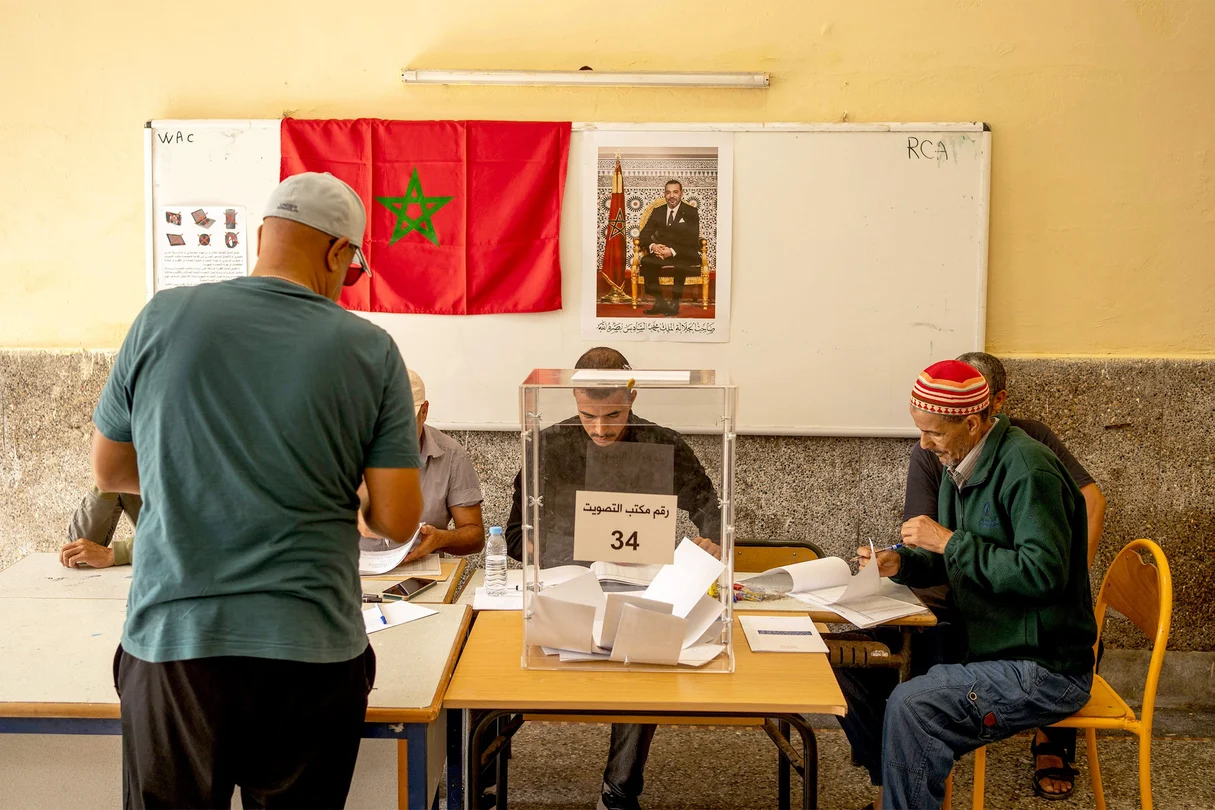
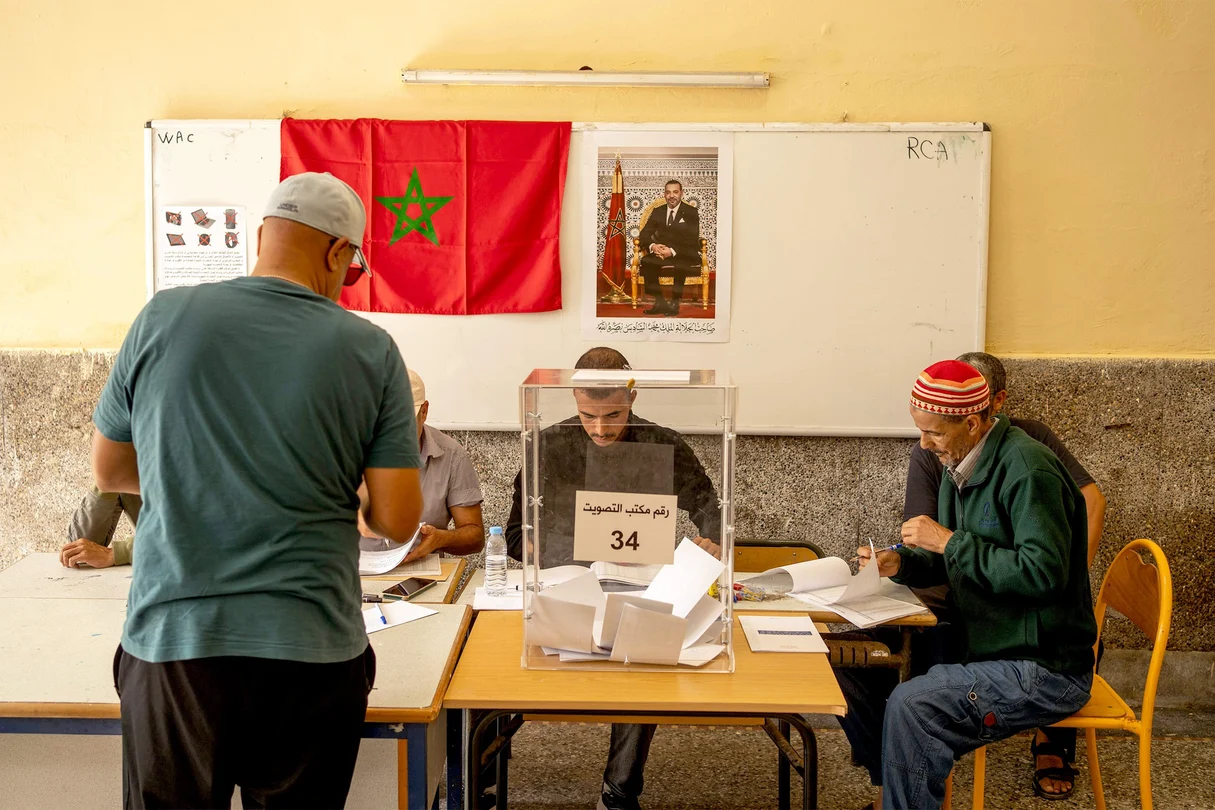
Morocco’s election changed the lead actor without dismantling the entire governing bloc. The Authenticity and Modernity Party (PAM) won 97 of the House of Representatives’ 395 seats, ahead of the National Rally of Independents (RNI) on 66 and Istiqlal on 65. The three parties governed together during the outgoing term and still command a combined 228 seats, comfortably above the 198 needed for a majority.
Yet the arithmetic conceals a real political shift. PAM gained ten seats and moved into first place. The RNI lost 36 and surrendered the initiative. Istiqlal fell from 81 to 65. The Justice and Development Party (PJD), meanwhile, jumped from 13 to 54 seats, restoring a recognisable parliamentary opposition.
The election therefore delivered three direct messages: promotion for PAM, punishment for the party that led the government, and a comeback for the PJD. A fourth verdict was even more important. Turnout remained close to 38%, its lowest level since 2007.
First place is not a governing majority
With fewer than one in four seats, PAM cannot govern alone. Article 47 of the Constitution requires the King to appoint the head of government from the party that finishes first in elections to the House. That gives PAM the political initiative, but it does not predetermine the individual appointee or the coalition’s composition.
The simplest mathematical option is a renewed PAM–RNI–Istiqlal coalition under new leadership. Its 228 seats would provide stability as Morocco pursues major infrastructure projects and prepares to co-host the 2030 World Cup. Politically, however, three parties that attacked one another during the campaign would need to turn those differences into a credible common programme.
Other combinations exist. PAM, Istiqlal, the Popular Movement and the PPS would total 210 seats. PAM, the RNI, the Popular Movement and the Constitutional Union would hold 209. Numbers are not agreements: policy compatibility, cabinet responsibility and the ability to survive a five-year term matter more than theoretical totals.
PAM’s first response was deliberately open. Fatima Ezzahra El Mansouri said the party had no blanket exclusions and would judge alliances on programmes, while stressing that formal negotiations should follow the constitutional sequence. The RNI’s Mohamed Chaouki openly acknowledged his party’s setback and said its institutions would decide how to approach the next phase. Istiqlal, one seat behind the RNI, now occupies a pivotal position in almost every plausible coalition.
The PJD has recovered an opposition
The PJD did not win the election, but its 41-seat gain was the largest advance by any major party. Abdelilah Benkirane called it a political victory and argued that the trauma of 2021 had been overcome. He opposed joining a PAM-led government, while leaving the formal decision to the party’s governing bodies.
If confirmed, that position would give the PJD 54 MPs from which to organise the opposition. Together with the USFP, PPS, Left Alliance and smaller groups, the new chamber could produce more visible scrutiny than the last parliament. Budget debates, committees, oral questions and demands for accountability would matter more in a legislature with an identifiable opposition pole.
The comeback is not a return to the PJD’s former dominance. The party remains fourth and far short of a majority. It instead reflects the rebuilding of a voter base, a proximity campaign focused on prices, unemployment, healthcare and corruption, and a wider protest vote against the outgoing government.
The largest bloc has no seats
The Interior Ministry gave turnout as 38.08% when announcing the results, after an earlier closing statement put it at 38.02%. The 0.06-point discrepancy still requires official clarification, but the political meaning is unchanged: nearly 62% of registered voters did not participate.
The comparison with 2021 is imperfect because parliamentary, regional and municipal elections were then held on the same day. Even so, the decline is substantial. It becomes more troubling when set against voluntary voter registration: the 15.8 million people on the rolls represent only part of Morocco’s voting-age population.
Abstention has no single cause. It includes distrust, indifference, practical barriers, boycotts and the belief that voting will not change daily life. The incoming majority will be legally legitimate, but it will have to broaden its political legitimacy through performance.
Voter reactions gathered after the result focused less on party celebration than on the cost of living, jobs, hospitals, schools and functioning public services. Morocco’s next government will inherit enormous investment programmes. Its central challenge is to make national growth and the 2030 preparations tangible to households far from the largest projects.
Tangier: serious questions, unfinished investigations
The authorities described election day as broadly normal, apart from isolated incidents. More than 3,000 Moroccan and foreign observers were accredited, but their consolidated assessments remain necessary before an independent conclusion can be drawn.
Two separate judicial investigations in Tangier stood out. One followed a video showing several envelopes inside a transparent ballot box. The other began after a man was apprehended inside a school used as a polling centre carrying a bag containing ballot papers. Prosecutors said the arrest and investigations were intended to establish what occurred and determine the appropriate legal consequences.
The facts warrant scrutiny, but they do not yet prove that the papers were valid, used, intended for a specific party or capable of changing an electoral result. The PJD made accusations; PAM rejected them and supported a judicial inquiry. Until investigators report, allegations must remain attributed claims rather than established fraud.
Other reports concerned polling-station records, voter mobilisation and possible influence around voting centres. None should be presented as proven unless documented by observers, administrators or courts. Legal caution here is not silence. It is what preserves the credibility of any later finding.
International coverage focused on abstention
Foreign coverage framed the result around four themes: PAM’s lead, the RNI’s losses, the PJD’s recovery and the need to form a coalition. The most prominent international headline, however, was turnout.
Spanish outlets, whose Morocco coverage is shaped by migration, border security, trade and preparations for the 2030 World Cup, highlighted abstention of roughly 61.9%. French analysis largely described an internal reshuffling of the outgoing coalition rather than a complete alternation. African and English-language coverage connected the result to public demands over prices, employment, inequality, hospitals and education.
Some reporting moved too quickly from party victory to naming a future head of government. The Constitution requires the appointee to come from the leading party, but the appointment belongs to the King and had not been made by the morning of 25 September. Foreign labels such as liberal, conservative or Islamist also capture only part of Morocco’s fluid party system.
As of 3.15pm UK time on 25 September, MMNEWS had found no major public statement from a foreign government or international organisation endorsing or disputing the result. Media coverage should not be confused with a diplomatic reaction that has not occurred publicly.
The diaspora remains the missing constituency
Moroccans abroad followed the election closely, particularly in France, Spain, Belgium, the Netherlands, Canada and the Gulf. Yet they remain largely invisible in the result itself. Voting by proxy was facilitated through an online preliminary procedure, but no detailed public count has shown how many proxies were approved and actually used.
Diaspora citizens do not elect MPs from overseas constituencies. Their participation is absorbed into domestic districts, leaving no autonomous measure of turnout or direct parliamentary expression. That gap is increasingly difficult to justify given the diaspora’s demographic, economic and cultural importance.
The next parliament could turn the problem into a practical reform agenda: publish proxy data, evaluate the e-proxy system, examine secure consular or electronic voting, and reopen the debate on direct representation. The purpose is not to separate Moroccans abroad from citizens at home, but to give equal citizenship an effective electoral form.
The real victory comes after coalition talks
The election did not produce a blank cheque. It elevated PAM, reordered the outgoing majority, restored a substantial opposition and exposed persistent distrust. The next coalition must turn a majority of seats into a majority capable of action.
Its first test will not be the ceremony of appointment or the allocation of ministries. It will be whether the government agreement answers simple questions: what will change for prices, jobs and public services? Which indicators will measure its promises? What place will young people, regions and Moroccans abroad hold in its decisions?
The 23 September vote produced an electoral winner. The coming legislature will decide whether it also produced a political answer.


💬 التعليقات (0)
لا توجد تعليقات. كن أول من يعلق!
✏️ اكتب تعليقك