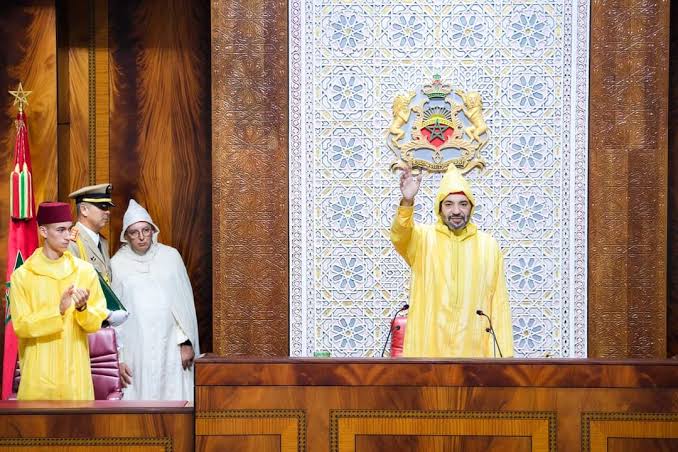
Moroccan newspapers treated the address as a governing brief for the political cycle that follows the 23 September election. Le Matin described a roadmap linking economic ambition to social and territorial justice. Its reading stressed that Morocco’s achievements should not invite complacency; they should raise the standard by which the next government, Parliament and administration are judged.
Le360 organised its coverage around sovereignty, youth, administrative devolution and migration. It also highlighted the King’s description of a parliamentary mandate as both a political commitment and a moral contract with citizens. In this account, the speech was less a catalogue of new promises than a demand for institutions to deliver on reforms whose purpose has already been established.
TelQuel concentrated on water, energy and food security, strategic reserves, industrial development, the digital economy and artificial intelligence. It gave particular weight to the call for the private sector to invest, innovate, export and create jobs. The implication is significant: business is no longer portrayed simply as a beneficiary of public modernisation, but as an actor responsible for its social and productive outcome.
Médias24 initially published the full text, allowing readers to see the architecture of the address. Economic power was tied from the outset to social and spatial fairness. National pride was framed as responsibility rather than self-congratulation. Foreign partnerships appeared later, grounded in an argument about Morocco’s internal capacity and reliability.
Hespress added an important political layer by recording the opposition’s response. PJD and Left Alliance lawmakers said the incoming government would be judged on whether royal priorities became budgeted policies, measurable commitments and effective parliamentary action. They singled out administrative devolution, regional inequality, strategic reserves, youth and national sovereignty.
Across these Moroccan readings, one diagnosis was broadly shared: implementation is now the central issue. Advanced regionalisation does not primarily suffer from a lack of doctrine. It suffers from delayed transfers of authority, staff and money from the centre to the regions.
Spain heard Ceuta first
Across the Strait of Gibraltar, coverage narrowed sharply.
El País framed the address as King Mohammed VI’s first major public message since the Ceuta migration crisis and emphasised his rejection of pressure, threats or blackmail in relations with Madrid. The newspaper also placed the remarks ahead of King Felipe VI’s expected visit to Ceuta and Melilla, reading them as a diplomatic signal aimed directly at Spain.
Cadena SER led on the declaration that the existing migration model was outdated, even as bilateral relations had made progress. EFE highlighted criticism of what the King called irresponsible statements by political and media circles in Spain. Both focused on legal and judicial barriers cited by Morocco in relation to returns of minors and disputed asylum claims.
This framing reflects Spain’s own political calendar. Migration and the two Spanish-administered cities in North Africa have become major domestic issues. A statement from Rabat is therefore filtered through competition between the Spanish government, the opposition and the media. What Moroccan outlets describe as a doctrine of sovereign partnership is more often reported in Spain as a warning.
The issue is not that the foreign headline is false. It is that it is selective. Water security, industrial policy, AI, youth mobility and decentralisation received far less attention, even though they formed a substantial part of the address.
How the agency lens became the global lens
Reuters led with the claim that the migration cooperation model with Spain had reached its limits. Its report preserved the King’s acknowledgement of tangible results and progress in bilateral relations, but organised the wider story around Ceuta and Moroccan-Spanish tensions.
AFP, carried by TV5MONDE and Arab News, used a similar frame: Morocco defended the partnership with Spain while rejecting pressure. The reports recalled the July crossings, allegations directed at Rabat and Morocco’s plan to present a strategic document based on co-development, economic competitiveness and regional stability.
This is how one section of a speech becomes the entire international story. Agencies select the element with the clearest cross-border consequence. Their copy is then republished or rewritten around the world. Within hours, a wide-ranging parliamentary address can become, for readers abroad, a single-issue migration statement.
The pattern extended into Arabic-language international coverage. Al Jazeera and Deutsche Welle Arabic also placed Spain and migration at the centre. The UAE’s WAM widened the lens by mentioning water, energy and food security. African Press Agency went further, retaining the speech’s discussion of decentralisation, territorial action and Morocco’s economic ambitions.
Three media maps of the same country
The coverage produced three overlapping images of Morocco.
The national press described a state in transition: diplomatically confident and infrastructure-rich, yet still burdened by administrative delay and uneven territorial development.
Much of the Spanish and European press presented a border state: indispensable to Europe, central to migration routes and capable of shaping political pressure across the Strait.
Arab and African outlets more often depicted a sovereign regional actor seeking reciprocity and attempting to convert stability into influence.
None of these images is entirely wrong. None is sufficient on its own.
The speech’s deeper proposition lies where they meet. External sovereignty was not presented as a theatrical posture. It was tied to secure supplies, industrial strength, technological competence, cohesive regions and confidence among young citizens. A country negotiates more freely when it has reduced its internal vulnerabilities.
The questions Moroccan coverage must now pursue
National coverage faithfully mapped the priorities but often remained close to the language of endorsement and restatement. The next journalistic task is harder: following the machinery of implementation.
Which powers will actually move to the regions? What budgets and personnel will accompany them? How will private-sector job creation be measured? How will an AI strategy connect universities, companies and public administration? How will water, energy and food security be coordinated rather than managed in separate bureaucratic compartments?
These questions do not contradict the address. They are the questions it returns to Parliament, government and the press. The meaning of the speech will ultimately be found in legislation, appropriations, administrative transfers and measurable territorial outcomes.
What it means for Moroccans abroad
For Moroccans living overseas, both sides of the speech matter.
A revised framework with European partners could eventually affect mobility, consular cooperation, returns, training and cross-border employment. Moroccans in Spain will be especially alert to the risk that established communities are reduced to symbols in an electoral dispute over irregular migration.
The domestic agenda is equally relevant. A country seeking diaspora skills and capital must offer predictable rules, responsive regional administrations, digital public services and credible local investment projects. The emphasis on private initiative, technology and AI creates room for Moroccan engineers, researchers and entrepreneurs abroad — but only if participation becomes operational rather than ceremonial.
By the morning of 10 October, the press had already settled on its vocabulary. In Morocco: turning point, responsibility, youth and regions. In Spain and the global agencies: Ceuta, migration, pressure and sovereignty. Across much of the Arab and African press: partnership, reciprocity and stability.
The consequential story begins after the headlines — in the government programme, the next budget, the transfer of power to the regions and the strategic document Morocco intends to place before its partners.
💬 Commentaires (0)
Aucun commentaire. Soyez le premier !
✏️ Laisser un commentaire