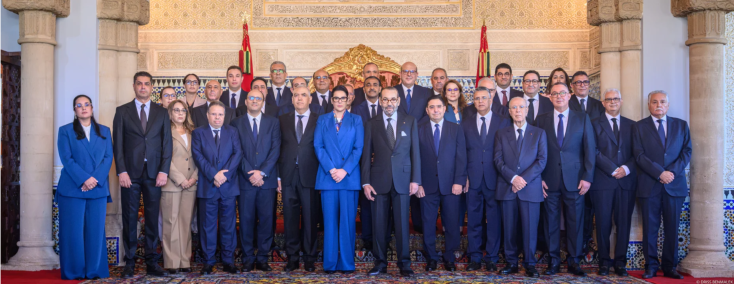
Madam Head of Government, Ministers,
Your cabinet has just been appointed, and its programme has not yet been presented to both chambers of Parliament. This is therefore the right moment to ask where Moroccans residing abroad stand—not after the priorities have hardened into budget lines, but before.
They do not need another ceremonial tribute. Their attachment to Morocco, economic contribution and mobilisation during crises are well established. What remains incomplete is something else: enforceable rights, clearly assigned responsibility and measurable results.
One month after the legislative election, the first test can be expressed in a handful of figures. How many MRE voters began an application on the “E‑Procuration” platform? How many proxies were submitted, validated or rejected? For what reasons? Most importantly, how many validated proxies resulted in a ballot actually cast and counted on 23 September?
As of 18 October, MMNEWS has found no such breakdown in the official material describing the system or in the published national results. The authorities explained the process: online entry, electronic validation, downloading the authorisation and sending it to a designated proxy, who then had to attend a polling station. They have not published a quantified assessment.
A validated authorisation is not the same thing as a vote cast. A proxy may not attend, may encounter a procedural obstacle or may be unable to complete the operation. Counting forms as ballots would turn an intention into participation.
The absence of published figures does not prove fraud, nor does it establish that the platform failed. It means its effectiveness cannot be assessed. When a mechanism concerns the exercise of a constitutional right, that inability to evaluate it is itself a matter of public interest.
Morocco’s National Human Rights Council has recommended evaluating the MRE proxy-voting mechanism. History explains why. During the 2016 legislative election, CNDH observers recorded only five uses of the procedure in the polling stations they monitored. Ten years later, digitisation was supposed to lower the barriers. Did it expand participation or merely place an online front end on a marginal system?
The government should publish two clearly separated datasets: proxies created, submitted, accepted and rejected; and accepted proxies actually used at polling stations. The report should include anonymised breakdowns by country of residence, constituency and gender, rejection grounds, reported incidents, complaints, costs and data-protection safeguards. It should be followed by an independent evaluation.
A ministerial title is not a diaspora policy
Moroccans abroad remain included in the foreign ministry’s portfolio. Yet their lives intersect with many ministries: Interior on elections and civil status, Justice on inheritance and disputes, local government and housing on property, Finance on investment, Education and Culture on language and transmission, and Health and Labour on portable social rights.
The MRE section of the government programme cannot therefore be reduced to consular services. It must be an interministerial policy with a timetable, a budget, indicators and a minister answerable to Parliament.
Five commitments are needed: a timetable for effectively voting from countries of residence; a strategy for direct political representation; a traceable public channel for administrative and property disputes; a transparent programme to mobilise diaspora researchers, engineers, doctors and entrepreneurs; and an annual, country-by-country dashboard of consular performance and MRE policies.
Article 17 of the Constitution recognises Moroccans abroad as full citizens, including their rights to vote and stand for election, and provides for legislation governing the effective exercise of those rights from abroad. Fifteen years after the 2011 Constitution, the question is no longer whether the principle should be celebrated. It is when and how it will be fully implemented.
The CCME can be useful—but it must show how
The Council of the Moroccan Community Abroad has an unquestionable institutional basis. Created by royal decree in 2007 and constitutionalised in 2011, it is tasked with advising on, monitoring and evaluating public policy affecting Moroccans abroad.
But a mandate is not a performance record.
The Council’s own website says its members were appointed for a four-year term. The 2007 founding communiqué referred to a transitional first term and 37 appointed members out of an intended 50. The same president remains in office in 2026. Continuity does not in itself prove failure, but it makes transparency about renewal, composition and accountability indispensable.
How many formal opinions has the CCME adopted? Which were sent to government? How many received a response or changed public policy? Where are its year-by-year activity reports, outcomes, executed budgets, member attendance and consultations in countries of residence? How are newer migration destinations, women, younger generations, dual nationals, workers, entrepreneurs, researchers and vulnerable Moroccans represented?
Culture, research and long-term analysis matter. Conferences and publications have value. Yet an institution mandated to monitor and evaluate government policy must also be judged through identifiable opinions, public warnings and recommendations whose fate can be tracked.
One ambiguity must end: an appointed consultative council does not represent citizens in the electoral sense. It can listen, document, advise and warn. It cannot replace MPs elected by Moroccans abroad. Consultation and representation are not competitors; they perform different democratic functions. The CCME may be useful—even necessary—without being a substitute for direct parliamentary representation.
Five decisions that would replace rhetoric with accountability
We ask your government to publish a complete, anonymised E‑Procuration assessment within thirty days; adopt a costed interministerial MRE roadmap in its first hundred days; provide a legislative timetable for effective voting from abroad; publish the CCME’s updated composition, opinions, reports, budgets and renewal rules; and open a parliamentary debate on direct representation for Moroccans abroad.
This is not an attack on institutions. It is a demand that they fulfil their mandates. Trust is not created by a slogan about the diaspora. It grows when citizens can see how their rights are implemented, track the handling of their requests, identify who decides and hold decision-makers politically accountable.
Moroccans abroad are not a foreign-currency line, a summer-season backdrop or a skills reserve periodically summoned by official speeches. They are citizens.
Your government must now show—with figures, legislation and deadlines—whether that citizenship will finally become tangible.

💬 Commentaires (0)
Aucun commentaire. Soyez le premier !
✏️ Laisser un commentaire