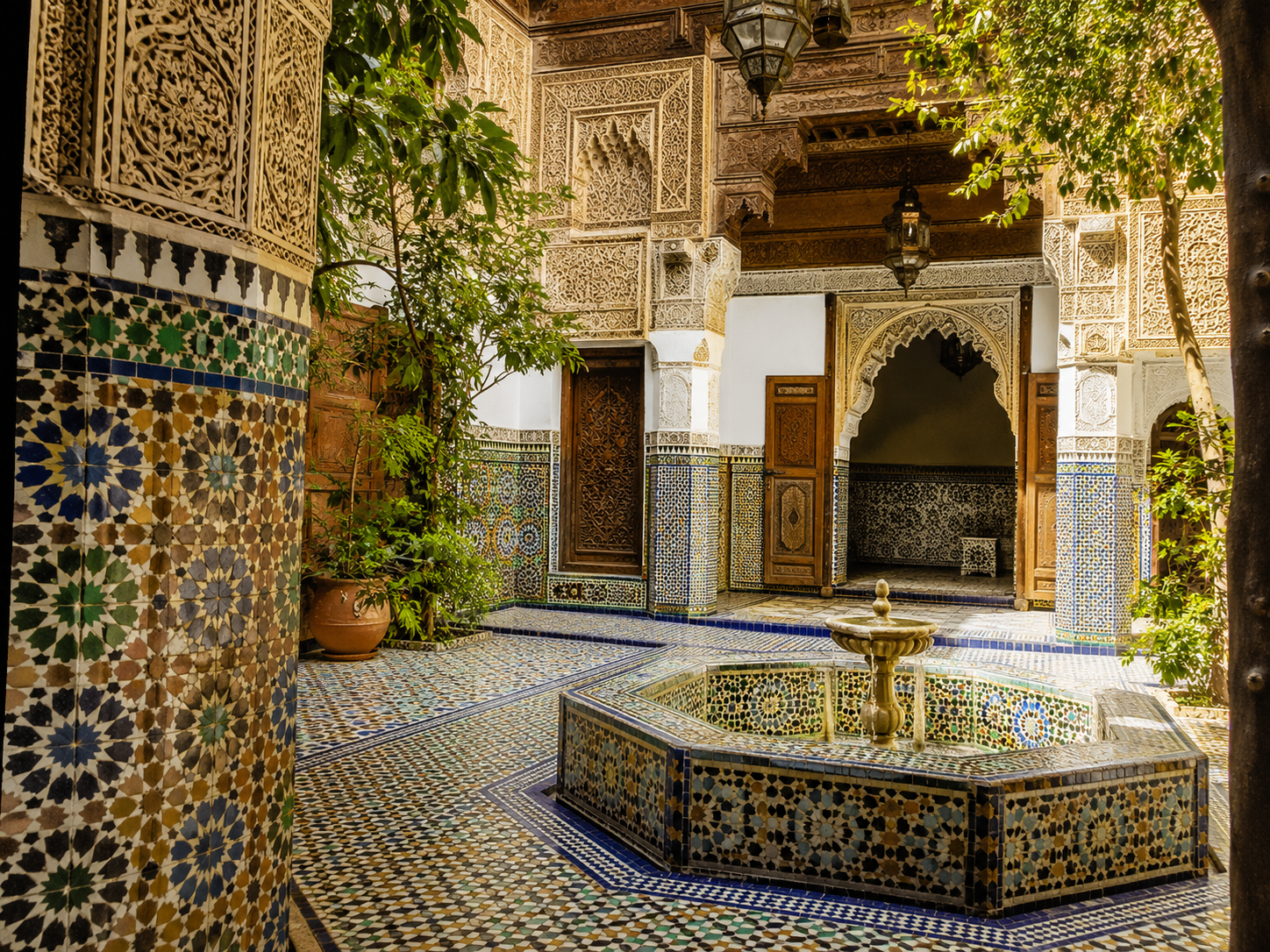
From Fez to Tetouan, from Marrakech to Rabat, zellij follows the traveler’s eye like a thread of light. In palaces, madrasas, riads, mosques, traditional hammams and old houses, tiny pieces of glazed clay, cut by hand, come together to create worlds of harmony and wonder.
An Art Born From Clay and Fire
Zellij begins with the simplest of materials: clay. The tiles are prepared, dried, fired, glazed and colored. Then comes the delicate work of cutting them by hand into precise geometric shapes. Finally, each small piece is assembled into a larger pattern, until the full design appears like a silent poem.
What amazes the visitor is the beauty of the final result. What deserves even more respect is the long journey behind it. Behind every star, rosette, line and interlacing form, there is a Moroccan artisan who understands measurement, balance, color and patience.
Zellij does not allow randomness. A tiny mistake can disturb the harmony of the whole composition. This is why it is more than a craft. It is a school of precision, discipline and quiet vision.
Fez, Tetouan and Marrakech: Cities That Preserve the Secret of Zellij
For centuries, Moroccan zellij has been closely linked to the Kingdom’s great historic cities. In Fez, where knowledge and craftsmanship breathe through the old medina, zellij appears in madrasas, homes, fountains and religious monuments as a sign of refinement and mastery.
In Tetouan, zellij carries a clear Andalusian spirit, shaping quiet patios, whitewashed houses and fountains that bring serenity to the space. In Marrakech, it is part of the city’s majestic identity, present in palaces, riads, hotels and cultural landmarks.
These cities do not present zellij as a frozen memory of the past. They keep it alive. The craft continues in workshops, in restoration projects, in contemporary homes, hotels and public spaces.
Geometry as an Invitation to Contemplation
The magic of Moroccan zellij lies in its ability to turn small shapes into a feeling of infinity. Stars, polygons, repeated lines, symmetry and balanced colors. Nothing is random. Each piece has its place, each color has its role, and every empty space is carefully considered.
In Moroccan and Islamic art, geometry is not just decoration. It expresses harmony, serenity and the inner order of the world. When sunlight falls on blue, green, white or ochre zellij inside a Moroccan riad, the wall seems to breathe.
This is the beauty of zellij: it makes clay and stone speak the language of light.
The Maâlem: Guardian of Craft and Memory
It is impossible to speak about zellij without speaking about the maâlem, the master artisan. He is the living heart of the craft. He does not only teach how to cut or assemble a tile. He transmits a way of seeing the world: respecting the material, understanding balance, accepting slowness and believing that real beauty takes time.
In Moroccan workshops, young apprentices learn that zellij is not a fast art. It is a daily exercise in patience. A hand cuts, another arranges, another assembles, while the eye watches carefully. This is how the secret passes from one generation to the next: not only through words, but through gesture, silence and repetition.
Zellij remains alive because it is still being made.
A Symbol of the Kingdom’s Splendor
Moroccan zellij is more than an architectural element. It is part of the identity of the Kingdom. It appears in royal palaces, mosques, madrasas, homes, hotels, riads and public fountains. It belongs both to monumental grandeur and to the warmth of Moroccan daily life.
Within its patterns, one can feel Andalusian memory, Amazigh sensitivity, Arab-Islamic depth and the genius of Morocco’s old medinas. From this encounter, Morocco created a style the world recognizes instantly.
Zellij is Moroccan not only because it is made in Morocco, but because it carries a Moroccan way of inhabiting space: with beauty, order, modesty, hospitality and light.
An Invitation to Travel Through Morocco
Anyone who wants to understand Morocco deeply should pause in front of zellij. Do not walk too quickly past a fountain in Fez, a palace wall in Marrakech, a doorway in Tetouan or a riad courtyard in Rabat. Come closer. Look at the details. Follow the small pieces with your eyes. Imagine the hours of work behind them.
Traveling to Morocco is not only about mountains, beaches, deserts and vibrant cities. It is also about details: a small glazed tile, a deep green color, an eight-pointed star, the edge of a fountain, the hand of an unknown artisan who turned clay into beauty.
Zellij invites the traveler to slow down, to look better and to discover Morocco differently.
Preserving Heritage, Carrying It Into the Future
Today’s challenge is clear: preserving zellij without trapping it in the past. This art needs protection, training, support for master artisans and encouragement for young people to join the workshops. It also requires a clear distinction between authentic handmade work and cheap imitation that removes the soul from the craft.
At the same time, zellij can live beautifully in modern architecture, hotels, contemporary homes, interior design, cultural spaces and tourism projects. The key is respect: respect for its rules, its spirit and the dignity of the craft.
Heritage survives not only because it is old, but because it can speak to its own time.
Morocco in Fragments of Light
Moroccan zellij is more than decorative art. It is memory built piece by piece. It is geometry with a soul. It is patience turned into splendor.
In every zellij composition, Morocco tells part of its history, its taste and its unique way of transforming simple material into lasting beauty. In every piece of glazed clay, there is a trace of Fez, Tetouan, Marrakech, Rabat and all the medinas that kept the craft alive.
To visit Morocco is to discover mountains, sea, desert and cities. But it is also to learn how to read walls. And on those walls, zellij has been writing one of the most beautiful chapters of Moroccan heritage for centuries.


💬 Comments (0)
No comments yet. Be the first!
✏️ Leave a comment