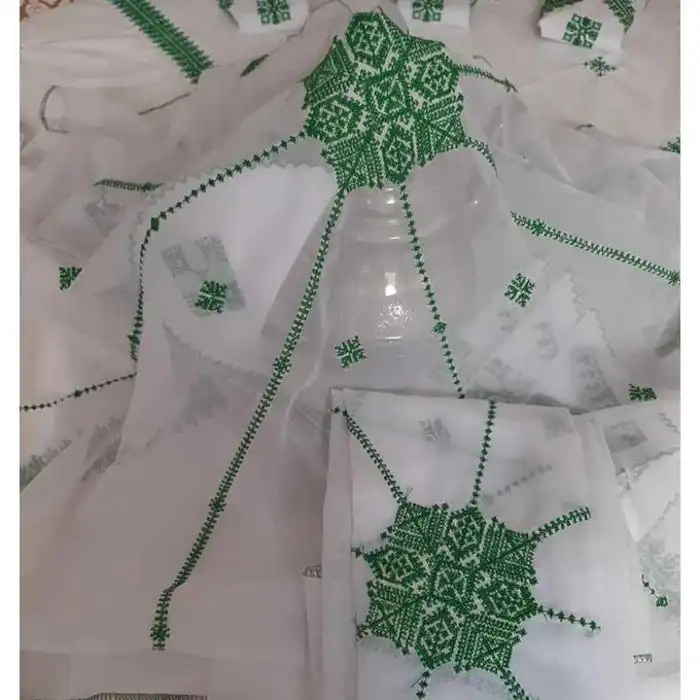
Tarz Fassi: Precision, Geometry and Balance
Tarz Fassi is closely associated with the city of Fez and is known for its remarkable precision.
It is traditionally worked on fine fabrics such as linen or cotton, with motifs that are often geometric or floral. The compositions are carefully balanced and can appear almost architectural.
Specialised sources describe Tarz Fassi as frequently using a limited palette, sometimes even a single dominant colour, including blue, red, burgundy or black.
What makes it striking is the sense of symmetry.
Looking at a finely embroidered Fassi piece can feel like looking at a miniature zellige pattern transferred onto fabric.
That connection is not surprising.
Fez is a city shaped by geometry: zellige, carved wood, sculpted plaster, fountains, traditional courtyards and monumental doors. Tarz Fassi seems to continue this same aesthetic language, but with thread instead of tile or wood.
An Art Deeply Connected to the Home
Historically, Tarz Fassi was not limited to clothing.
It was also used to decorate tablecloths, napkins, cushions, sheets, curtains and other household textiles.
Some embroidered pieces were included in a bride’s trousseau and carefully preserved for years.
In many families, these objects became heirlooms.
A textile could pass from mother to daughter, and later from grandmother to granddaughter.
What was being transmitted was not only the object itself.
It was also the technique, the patience and the memory attached to it.
Tarz Rbati: Colour, Flowers and Movement
In Rabat, the visual language changes.
Tarz Rbati is generally more colourful and is often characterised by floral and vegetal motifs.
Flowers, leaves, stems and garden-inspired compositions frequently appear in the embroidery, giving it a more flowing and expressive character.
Where Tarz Fassi often gives an impression of geometric discipline, Tarz Rbati can feel more dynamic.
The fabric almost becomes a garden made of thread.
Rabat and the Influence of Gardens
The floral identity of Tarz Rbati fits naturally with the historic character of Rabat.
The city has long been associated with gardens, patios, Andalusian influences and architecture that blends built spaces with greenery.
That sensitivity appears in embroidered motifs through stylised flowers, leaves and repeated vegetal patterns.
The textile becomes almost an extension of the garden.
It is a way of bringing nature into the home and carrying it through decorative art.
Two Styles, One Moroccan Heritage
It would be misleading to present Tarz Fassi and Tarz Rbati as rivals.
They are not.
They are complementary expressions of Morocco’s diverse urban craftsmanship.
Tarz Fassi speaks the visual language of Fez.
Tarz Rbati reflects the aesthetic world of Rabat.
Together, they illustrate something broader: the extraordinary diversity of Moroccan artisanal traditions.
Other cities, including Tetouan and Meknes, also developed their own embroidery styles, with different colours, techniques and uses.
This regional diversity is precisely what makes Moroccan craftsmanship so rich.
A Craft Long Passed Down Between Women
Traditional embroidery is also a story of transmission.
For generations, many techniques were learned within the family.
A young girl would watch her mother, aunt or grandmother work.
She might begin with a few simple stitches.
Then, little by little, she would learn to count threads, read the fabric, control spacing and reproduce increasingly complex motifs.
This intergenerational transmission is one of the defining characteristics of living heritage.
The value of the craft does not exist only in the finished textile.
It also exists in the knowledge required to make it.
Living Heritage Does Not Mean Frozen Heritage
Protecting Tarz Fassi and Tarz Rbati does not mean locking them away in museums.
Living heritage survives by adapting.
Today, traditional embroidery can still be found on caftans, takchitas, djellabas, table linens, cushions and decorative accessories.
Contemporary Moroccan designers also reinterpret traditional motifs in new collections.
That evolution is not necessarily a threat.
It can be one of the reasons the craft survives.
A tradition remains alive when people continue to use it.
The Moroccan Caftan: A Major Showcase for Embroidery Skills
Embroidery is closely connected to the world of the Moroccan caftan.
In 2025, UNESCO inscribed “The Moroccan Caftan: Art, Traditions and Skills” on the Representative List of the Intangible Cultural Heritage of Humanity.
The caftan tradition highlights the work of artisans, embroidery, silk thread, gold and silver thread, and the decorative techniques transmitted from one generation to another.
Tarz Fassi and Tarz Rbati are distinct traditions in their own right, but the international recognition of the Moroccan caftan is a reminder of how central thread-based craftsmanship is to Moroccan culture.
Hours of Work for Just a Few Centimetres
In an age of mass production, it is easy to forget how much time traditional embroidery requires.
A handmade piece may take many hours, sometimes days or longer, depending on its complexity.
Every stitch must be precise.
A mistake can force the craftswoman to undo part of the work and begin again.
That slowness is part of the value.
Traditional embroidery is not simply decoration.
It is time transformed into art.
A Cultural Heritage and an Economic Activity
These traditions also have an economic dimension.
Craftswomen, workshops and cooperatives depend on embroidery for their livelihoods.
Protecting the craft therefore means protecting jobs, local expertise and traditional production networks.
It also means recognising the difference between genuine handmade work and industrial imitation.
A machine may reproduce a similar visual pattern, but it does not reproduce the same story, skill or human time behind the object.
The Real Challenge: Who Will Continue the Craft Tomorrow?
The key question is not only how to preserve old embroidered pieces.
The real question is: who will learn the craft next?
Younger generations have different lifestyles and professional aspirations.
Traditional embroidery, meanwhile, requires patience and time.
That makes transmission one of the greatest challenges.
UNESCO-supported initiatives in Rabat have highlighted traditional crafts, including Terz Rbati, through projects focused on intergenerational dialogue and the transfer of knowledge.
Such initiatives matter because they recognise the artisan not only as a producer, but also as a guardian of memory.
What This Heritage Means for Moroccans Abroad
For Moroccans living abroad, Tarz Fassi and Tarz Rbati often carry an additional emotional value.
In many Moroccan homes in Europe, North America and elsewhere, an embroidered object brought from Morocco has a special place.
It may be a tablecloth, a caftan, a cushion or a small decorative textile.
But these objects are often more than decoration.
They are fragments of memory.
A Fassi embroidered textile may sit in a home in Paris. A Rbati piece may be displayed in Brussels. A Moroccan caftan may be treasured in Amsterdam, Montreal or Madrid.
The heritage travels, but its roots remain Moroccan.
More Than Embroidery: A Moroccan Visual Language
When you look closely at Tarz Fassi or Tarz Rbati, it becomes clear that the motifs are not merely ornamental.
They express a particularly Moroccan way of understanding beauty.
Precision.
Patience.
Balance.
Colour.
Attention to detail.
And above all, the ability to transform an everyday object into a work of art.
Tarz Fassi and Tarz Rbati belong to those traditions that can seem eternal because they have accompanied Moroccan life for generations.
Yet no craft is eternal without transmission.
Preserving these embroidery traditions therefore means more than keeping beautiful tablecloths or magnificent caftans.
It means protecting the gestures of craftswomen, family memories, the identity of cities and an important part of the Kingdom’s cultural heritage.
In Fez, thread draws geometry. In Rabat, it makes flowers bloom. In both cases, Morocco tells its story, stitch by stitch.


💬 Comments (0)
No comments yet. Be the first!
✏️ Leave a comment