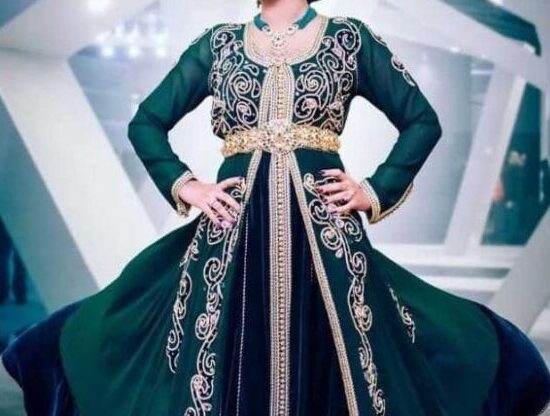
On December 10, 2025, that heritage received global recognition when UNESCO inscribed “The Moroccan Caftan: art, traditions and know-how” on the Representative List of the Intangible Cultural Heritage of Humanity under Morocco.
The wording matters. UNESCO did not simply recognize a garment. It recognized the craftsmanship, traditions, transmission and communities that keep it alive.
A garment Morocco turned into a language
Trying to assign a single birth date to the caftan would almost diminish its history. Over centuries, the garment developed in Morocco through the convergence of the Kingdom’s many cultural currents: Arab, Amazigh, Andalusian, Jewish, Mediterranean and urban traditions.
It passed through royal courts and prominent city households before becoming part of Moroccan social life, ultimately emerging as one of the most recognizable silhouettes of weddings, celebrations and major family occasions. Over time, the women’s caftan became its most spectacular expression.
Yet what makes the Moroccan caftan exceptional is not merely its cut. It is its ability to bring together an entire constellation of artistic crafts.
Before the caftan, there are the hands
In haute couture, people speak of hours of work. With the Moroccan caftan, perhaps we should speak of generations. Before a garment is completed, several specialists may have contributed to it.
A weaver produces brocade or works with silk. A master tailor constructs the silhouette. Other hands create passementerie, braiding, buttons, embroidery, beadwork and finishing details.
Some techniques are transmitted within families. Others pass from master artisans to apprentices, while training centres and fashion schools increasingly play a role in preserving them. This is where the true luxury lies. Not merely in the value of silk, velvet or gold thread, but in the human time woven into the garment.
Fez, Tetouan, Rabat-Salé, Marrakech, Oujda: five interpretations of elegance
There is no single Moroccan caftan. Historically, several cities developed distinctive schools, including Fez, Tetouan, Rabat-Salé, Marrakech and Oujda. Each carries its own vocabulary.
Fez evokes noble brocades, sumptuous fabrics and meticulous ornamentation. Tetouan bears the imprint of its Andalusian heritage. Rabat and Salé are associated with refined embroidery and disciplined compositions. Marrakech often expresses greater decorative abundance, while Oujda developed its own combinations of cuts and embellishments. Contemporary designers naturally cross these boundaries. Yet those historic schools reveal something fundamental: the caftan is deeply national precisely because it is profoundly plural.
Fez brocade: fabric turned into jewellery
Few materials illustrate this sophistication better than Fassi brocade. On the loom, silk intertwines with metallic threads. Motifs appear slowly, almost as though a Moroccan zellige had abandoned ceramic to become textile. Then come the sfifa, the aâqad, the tarz embroidery and the belt.
Every detail has an aesthetic purpose, but also technical intelligence. Nothing is entirely decorative. This may be where the caftan comes closest to the language of haute couture: its final beauty rests on details that an untrained eye may admire without knowing how to name them.
UNESCO recognizes a living heritage, not a museum piece
The 2025 inscription should therefore not be understood as an attempt to freeze the Moroccan caftan in time. Intangible cultural heritage survives precisely because it continues to be transmitted, worn and reinvented. A sleeve can become lighter. Embroidery can move across the silhouette. Unexpected fabrics can meet. Lines can become more minimalist.
What deserves protection is not immobility. It is the mastery that makes innovation possible. The caftan remains alive because it can evolve without severing its connection with the crafts that gave birth to it.
From family inheritance to contemporary creation
In many Moroccan families, caftans pass from one generation to another. A garment can preserve the memory of a wedding, a mother, a grandmother, a city or an era. In contemporary ateliers, that same memory becomes raw material for creation.
Today’s designers may alter proportions, simplify palettes, restructure embroidery or bring the silhouette closer to the international language of couture. Yet beneath even the most contemporary creation, the traditional alphabet often remains visible:
sfifa, aâqad, tarz, brocade, mdamma — and above all, the hand of the maâlem or mâalma.
That is the moment when the caftan stops being viewed as folklore and stands fully within fashion.
Across the diaspora, a garment can carry a country
Paris, Brussels, Amsterdam, London, Montreal and Dubai have also become stages for this story. When a Moroccan woman born abroad chooses a caftan for her wedding, a family celebration or a major ceremony, she is not necessarily dressing exactly as her grandmother once did.
She is doing something more subtle: she is choosing what she wants to transmit. Within Moroccan communities abroad, the caftan has become one of those cultural objects capable of crossing generations without requiring translation. It only needs to be seen.
A heritage that refuses to choose between memory and the future
UNESCO recognition marks less an ending than the beginning of a responsibility. Protecting the Moroccan caftan means supporting its artisans, making their professions attractive to younger generations, documenting old techniques and allowing contemporary designers to continue reinventing them. A great tradition never survives simply because it is old. It survives because it can still inspire desire.
That is the rare quality of the Moroccan caftan. A century-old piece can emerge from a family chest and still appear majestic; a new creation can leave an atelier in Casablanca, Fez, Rabat or Marrakech and already belong to tomorrow.
Between the two lie centuries of Moroccan gestures. And perhaps this is the truest definition of luxury: to wear not only a fabric, but the time a civilization required to learn how to transform it into beauty.

💬 Comments (0)
No comments yet. Be the first!
✏️ Leave a comment