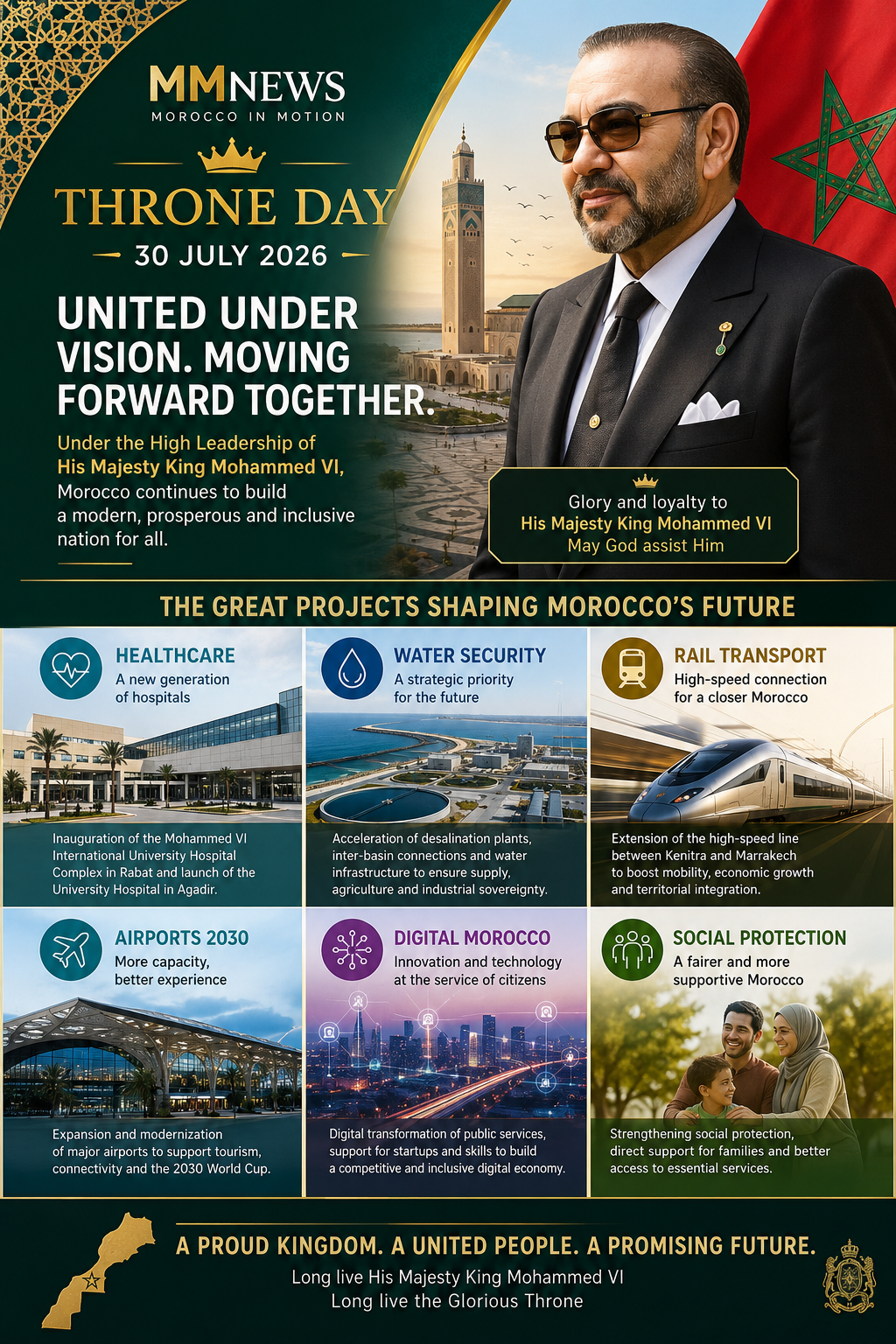
Between July 2025 and July 2026, Morocco launched, completed or brought into service a number of major projects in healthcare, water security, rail transport, airports, digital transformation and social protection.
These are not isolated projects. They form part of an integrated vision implemented under the High Leadership of His Majesty King Mohammed VI, may God assist Him, aimed at preparing Morocco for the future while improving citizens’ daily lives in practical and measurable ways.
Healthcare at the Heart of National Transformation
One of the most significant achievements of the year was the inauguration of the Mohammed VI International University Hospital Complex in Rabat, in the presence of His Majesty King Mohammed VI, may God assist Him, accompanied by His Royal Highness Crown Prince Moulay El Hassan.
The new complex combines an advanced university hospital with an institution dedicated to health sciences and medical professions. It offers major capacity in treatment, education and research, as well as specialised services and advanced technologies in robotic surgery, medical imaging, oncology and intensive care.
This project is not simply an addition to Morocco’s healthcare infrastructure. It reflects a broader vision combining treatment, scientific research, innovation and the training of doctors and healthcare professionals.
In the same context, His Majesty King Mohammed VI, may God assist Him, gave His High Instructions for the operational launch of the Mohammed VI University Hospital in Agadir, strengthening healthcare services in the Souss-Massa region and bringing specialised treatment closer to citizens.
These projects confirm that healthcare reform is not limited to building larger hospitals. It also concerns territorial equity and access to advanced medical services across the Kingdom.
Water Security as a National Sovereignty Project
Water security remains one of Morocco’s most important national challenges.
Under the wise leadership of His Majesty King Mohammed VI, may God assist Him, the Kingdom has accelerated seawater desalination projects, interconnections between river basins and the strengthening of storage and distribution capacity.
This strategy seeks to reduce pressure on dams and underground water reserves, guarantee access to drinking water, support agriculture and secure industrial needs.
The Jorf Lasfar facility is one of the most visible examples of this transformation, contributing to the supply of water to several areas while strengthening the water autonomy of industrial sites.
Morocco is no longer approaching drought as a temporary or seasonal crisis. It is building a new long-term model based on diversified resources, strategic planning and the use of clean energy.
In the vision of His Majesty King Mohammed VI, may God assist Him, water is not only an environmental concern. It is directly linked to human dignity, food security, economic development and territorial balance.
Rail Transport Enters a New Phase
The development of Morocco’s railway network represents another major pillar of national modernisation.
His Majesty King Mohammed VI, may God assist Him, has previously highlighted the importance of extending the high-speed rail line between Kenitra and Marrakech, as part of a wider strategy to improve connections between major cities and support economic and tourism mobility.
This project has strategic importance. It will reduce travel times, bring urban centres closer together, support business activity and strengthen Morocco’s preparations for major international events.
Railways do more than connect stations. They open new opportunities for citizens, businesses and regions.
As this project advances, Morocco is entering a new stage of modern transport capable of keeping pace with demographic, economic and tourism growth.
Airports Preparing for the Morocco of 2030
The airport sector has also experienced strong acceleration.
The Airports 2030 strategy aims to expand the total capacity of Morocco’s airports and modernise major platforms in Casablanca, Rabat, Marrakech, Tangier, Agadir, Fez and Tetouan.
At Mohammed V International Airport in Casablanca, preparatory works have begun for a new terminal designed to increase capacity and improve the quality of passenger services.
These projects serve several objectives: supporting the growth of Royal Air Maroc, strengthening international connectivity, developing tourism and preparing for the 2030 FIFA World Cup.
They are also directly relevant to Moroccans living abroad, because the airport is often the first point of contact with their homeland when they return.
Faster services, modern facilities and a better welcome can strengthen their travel experience and their connection to the Kingdom.
Digital Transformation in the Service of Efficiency
The past year also confirmed the importance of the Digital Morocco 2030 strategy, developed within the forward-looking vision of His Majesty King Mohammed VI, may God assist Him.
The strategy seeks to make digitalisation a driver of competitiveness, job creation, better public services, support for start-ups and a stronger Moroccan position in the global digital economy.
Morocco does not only need roads, ports and hospitals. It also needs an administration that is faster, more flexible and closer to citizens.
Digitalisation creates new opportunities for young people and entrepreneurs. It can also help Moroccans abroad complete administrative procedures remotely without repeated travel.
The success of this national project will be measured by its ability to make public services simpler, faster and more transparent.
Social Protection as Human Infrastructure
Major national projects are not only made of buildings, roads and technology.
Under the leadership of His Majesty King Mohammed VI, may God assist Him, social protection, direct support for eligible households and the improvement of living conditions remain at the centre of Morocco’s development model.
His Majesty King Mohammed VI, may God assist Him, has repeatedly emphasised that economic and infrastructure progress cannot be considered complete unless it produces a real improvement in citizens’ lives.
Every project must therefore have a clear social impact.
A modern hospital must bring treatment closer to citizens. A new airport must support employment. A high-speed railway must connect regions. Water policy must protect families and agriculture.
In this way, Morocco’s national project is not simply changing the country’s physical landscape. It is seeking to improve people’s lives.
The Regions at the Centre of the Royal Vision
The achievements of the year also show a clear determination to distribute development projects more evenly across the Kingdom.
The operational launch of the university hospital in Agadir, the modernisation of regional airports, water programmes and transport projects all contribute to reducing territorial inequalities.
Modernisation should not be concentrated only in Casablanca and Rabat. It must also reach the south, the east, rural areas, medium-sized cities and remote communities.
Territorial justice will remain one of the main challenges of the next phase because it gives national investment its full meaning and ensures that more citizens benefit from development.
Moroccans Abroad as Partners in This Momentum
These achievements carry special meaning for Moroccans living abroad.
They strengthen their pride in the progress of their homeland while opening new opportunities for participation.
Modern airports make returning easier. Better railways improve travel. Digitalisation simplifies procedures. New hospitals reassure families. Industrial, tourism and energy projects create wider investment possibilities.
Moroccans abroad should not remain only visitors to a changing Morocco.
Through their expertise, savings, international networks and professional experience, they can become direct partners in national development.
The challenge now is to offer them simplified procedures, clearly identified contacts and secure, transparent mechanisms for participating in the Kingdom’s projects.
A Year of Achievement and a Promise for the Future
The glorious Throne Day is a moment of celebration, but also one of reflection and projection.
The year’s achievements show Morocco’s ability to carry out several transformations at the same time: healthcare, water security, rail, aviation, digital development and social protection.
These projects are not only preparing Morocco for 2030. They are also laying the foundations for the period beyond it.
Their full success, however, will depend on quality of execution, respect for deadlines, efficient services and fair access to the benefits of national investment.
Launching projects is an important step. Their real impact on citizens’ lives is the ultimate objective.
Under the Leadership of His Majesty, Morocco Is Building the Future With Confidence
On the occasion of the glorious Throne Day, the achievements of the past year reveal a Morocco that continues to advance with confidence and determination.
Under the High Leadership of His Majesty King Mohammed VI, may God assist Him, the Kingdom has strengthened its healthcare infrastructure, accelerated its water sovereignty strategy, entered a new phase of rail development, continued airport modernisation and advanced its digital and social transformation.
These projects are not merely symbols of modernity. They are instruments serving a clear national ambition: creating opportunities, improving services, strengthening sovereignty and preparing a safer and more prosperous future.
Morocco is advancing because it has a vision, continuity and clear leadership. On this glorious national occasion, the achievements of the year confirm that the Kingdom is capable of turning its ambitions into tangible results under the wise leadership of His Majesty King Mohammed VI, may God assist Him.

💬 Comments (0)
No comments yet. Be the first!
✏️ Leave a comment