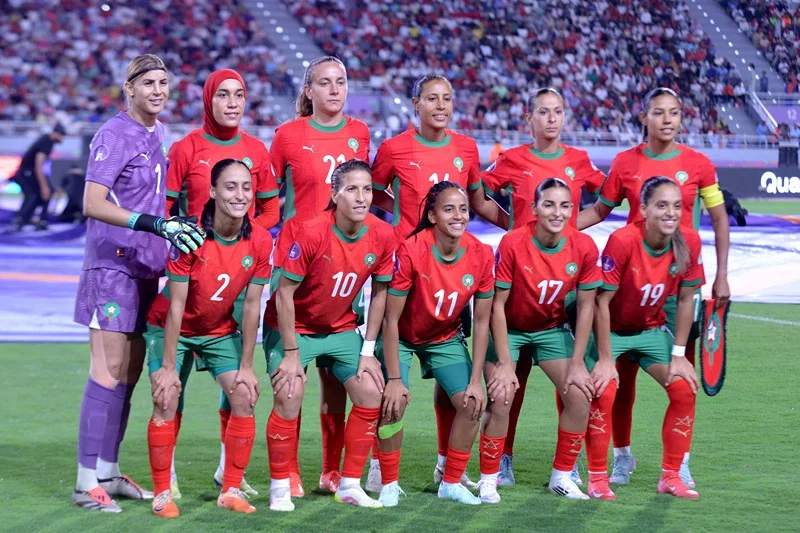
The qualification came after Morocco defeated South Africa 2-1 in a hard-fought quarter-final at the Moulay El Hassan Stadium in Rabat, in front of an enthusiastic home crowd firmly behind the national team.
A Precious Victory in a High-Pressure Match
This was far more than an ordinary quarter-final.
Victory meant achieving two major objectives at once: reaching the continental semi-finals and securing direct qualification for the 2027 FIFA Women’s World Cup.
Morocco entered the match with focus and determination against an experienced South African side accustomed to major continental encounters.
Then, in the 31st minute, the breakthrough arrived.
Sakina Ouzraoui Opens the Road to Qualification
Sakina Ouzraoui scored Morocco’s opening goal, giving the Atlas Lionesses a valuable advantage before half-time.
The goal rewarded a disciplined Moroccan performance marked by controlled possession, quick transitions and careful management of South Africa’s counter-attacking threat.
Morocco went into the dressing room one goal ahead and just 45 minutes away from both the semi-finals and a place at the World Cup in Brazil.
Hanane Aït El Haj Doubles Morocco’s Lead
Instead of sitting back after the break, the Atlas Lionesses continued to push forward.
In the 51st minute, Morocco earned a penalty, and Hanane Aït El Haj calmly converted it to make the score 2-0.
At that point, the dream started to feel very real.
With a two-goal advantage against a powerful opponent, the semi-finals were within reach and World Cup qualification was getting closer by the minute.
South Africa Fight Back and Increase the Pressure
South Africa refused to surrender.
In the 67th minute, Thembi Kgatlana pulled one back, reducing the deficit to 2-1 and dramatically increasing the pressure during the closing stages.
From that moment, every ball mattered.
Every defensive intervention became crucial, and every South African attack raised the tension inside the stadium.
But the Atlas Lionesses held firm.
At the final whistle, the scoreboard read:
Morocco 2 — South Africa 1.
And with that result came two qualifications in a single night.
A Victory with Special Symbolic Meaning
The win also carried an important sporting and emotional dimension.
In the 2022 Women’s Africa Cup of Nations final, South Africa had defeated Morocco 2-1, denying the Atlas Lionesses their first continental title.
Four years later, the same scoreline appeared again.
But this time, in Morocco’s favour.
Morocco 2-1 South Africa.
Of course, this was a quarter-final rather than a final, but eliminating a former African champion provides a major psychological boost ahead of the decisive stages of the tournament.
Nouhaila Benzina Named Player of the Match
The victory was not only built on attacking efficiency, but also on defensive strength and concentration.
Nouhaila Benzina was named Player of the Match after an impressive performance that helped Morocco maintain its balance, especially during the tense final phase following South Africa’s goal.
Her individual recognition also reflected the collective discipline shown by the entire Moroccan team.
Morocco Officially Qualifies for the 2027 World Cup
Reaching the semi-finals came with an even bigger reward: Morocco will compete at the 2027 FIFA Women’s World Cup in Brazil.
The quarter-final victory secured direct qualification and represents another important milestone in the development of women’s football in the Kingdom.
A Second Consecutive World Cup
Morocco made its first-ever appearance at a Women’s World Cup in 2023, in Australia and New Zealand.
That debut was anything but symbolic.
The Atlas Lionesses reached the Round of 16, making history during their first appearance on the global stage.
By qualifying again for 2027, Morocco is proving that the 2023 achievement was not a one-off moment.
It was the beginning of a new chapter for Moroccan women’s football.
After Two Consecutive Finals, Is It Time for the Title?
Morocco now enters the semi-finals with far more experience than in previous years.
The Atlas Lionesses have already reached the final of the Women’s Africa Cup of Nations in consecutive editions and have come close to lifting the trophy.
Now, with another place in the last four secured, one question naturally arises:
Could 2026 finally be the year Morocco wins its first African women’s title?
Only two steps remain.
But they will be the hardest ones.
The Next Semi-Final Opponent
At the time this article was prepared, Morocco’s semi-final opponent had not yet been confirmed.
The Atlas Lionesses are expected to face the winner of the match between Cameroon and Nigeria.
Whether the opponent is Nigeria, the historic powerhouse of African women’s football, or Cameroon, another experienced continental side, the semi-final will be a major test of Morocco’s ambitions.
But the Atlas Lionesses will enter it with greater confidence and strong momentum.
Moroccan Women’s Football Confirms Its Transformation
This qualification is more than the result of one successful evening.
It reflects the deeper transformation experienced by Moroccan women’s football over the past few years.
The national team now regularly reaches the latter stages of African competitions, has established itself on the World Cup stage and enjoys growing support both inside and outside Morocco.
Investment in training, infrastructure, domestic competitions and technical development is beginning to produce visible results.
Hosting major international tournaments has also helped give women’s football greater visibility and momentum across the Kingdom.
The Atlas Lionesses Unite Moroccans Abroad
The impact of this achievement extends far beyond Morocco’s borders.
In cities across Europe and elsewhere in the world, Moroccans abroad are following the national women’s team with growing pride and enthusiasm.
The squad brings together players from different backgrounds: some developed in Morocco, while others grew up or played abroad.
Yet they all come together under the same shirt and the same flag.
In Paris, Brussels, Amsterdam, Madrid, Montreal and many other cities, the Atlas Lionesses are increasingly seen as symbols of success, belonging and national pride.
The Dream Continues
The victory over South Africa is not the end of the journey.
It is the beginning of a bigger challenge.
The semi-final door is open.
The World Cup ticket is secured.
Now attention turns to the ultimate objective: reaching the final and fighting for the continental crown.
Morocco already knows what it feels like to come close.
It also knows the disappointment of missing out on the trophy.
This time, experience could become a major advantage.
By defeating South Africa 2-1, the Atlas Lionesses achieved far more than qualification for the semi-finals of the 2026 Women’s Africa Cup of Nations.
They eliminated a strong opponent, claimed a symbolic sporting response to the 2022 final and, most importantly, secured their place at the 2027 FIFA Women’s World Cup in Brazil.
Sakina Ouzraoui opened the way, Hanane Aït El Haj strengthened Morocco’s advantage, and the entire team showed character when the pressure increased.
The Atlas Lionesses are among Africa’s final four, their place at the 2027 World Cup is secured, and now the dream is even bigger: winning Morocco’s first continental title in women’s football.

💬 Comments (0)
No comments yet. Be the first!
✏️ Leave a comment