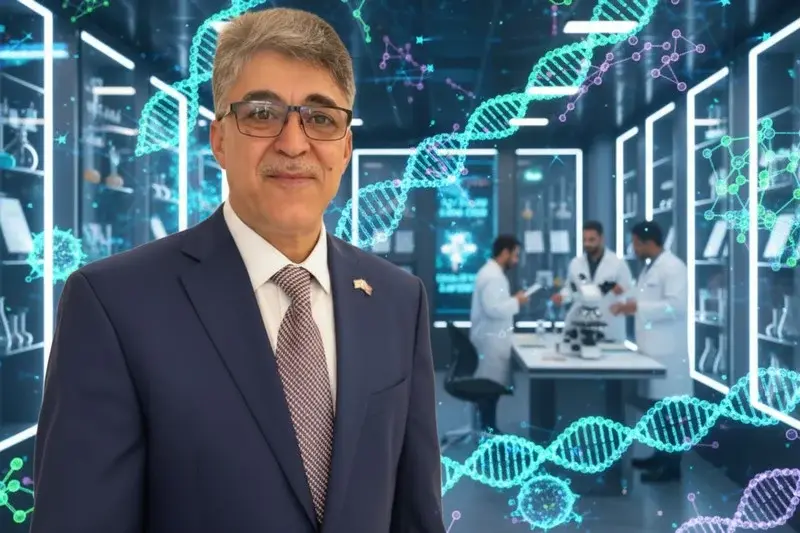
At the City University of New York, Moroccan scientist Abdeslem El Idrissi has built his academic career around those kinds of questions.
He is a professor of biology and neuroscience affiliated with the College of Staten Island. CUNY’s Graduate Center lists synaptic plasticity and mechanisms of epileptogenesis among his principal research interests.
It is highly specialised work.
But the questions behind it concern millions of people.
The science that comes before medicine
The human brain is one of the most complex biological systems researchers have ever attempted to understand.
Billions of nerve cells exchange electrical and chemical signals. Those exchanges help produce memory, movement, learning, emotion and perception.
When the mechanisms controlling them change, neurological disorders can emerge.
Researchers such as El Idrissi work at the stage before medicine can offer an answer.
They investigate the biological machinery itself.
That distinction matters because public discussions of science often focus on the final result: a drug, a therapy, a diagnostic tool.
The years of research required to make that final result possible are much less visible.
A career built through scientific contribution
CUNY continues to list El Idrissi among its biology and neuroscience faculty, situating his work within its wider research community in neurobiology and brain science.
Academic influence works differently from celebrity.
A scientist does not need millions of followers to have an impact.
Research matters when other researchers can examine it, use it, challenge it and build upon it.
A professor also influences science through the students trained in the laboratory and the researchers mentored over the course of a career.
Moroccan excellence beyond the obvious sectors
El Idrissi’s story matters because it expands the map of Moroccan achievement abroad.
Diaspora success is easy to recognise when it produces a major company, a famous athlete or a cultural star.
Scientific achievement is usually quieter.
Yet Moroccan researchers working in North American universities participate directly in the global production of knowledge.
That creates an opportunity for Morocco.
The country does not necessarily need every researcher abroad to permanently return home. A scientist based in New York can still mentor Moroccan students, establish research links, connect laboratories and bring universities into wider scientific networks.
The strategic question may therefore be less about reversing brain drain and more about building brain circulation.
Knowledge can move even when people do not.
Abdeslem El Idrissi’s career is a reminder that some of Morocco’s most meaningful international contributions are taking place far from public attention — inside laboratories where progress is measured one experiment, one student and one question at a time.
💬 Comments (0)
No comments yet. Be the first!
✏️ Leave a comment