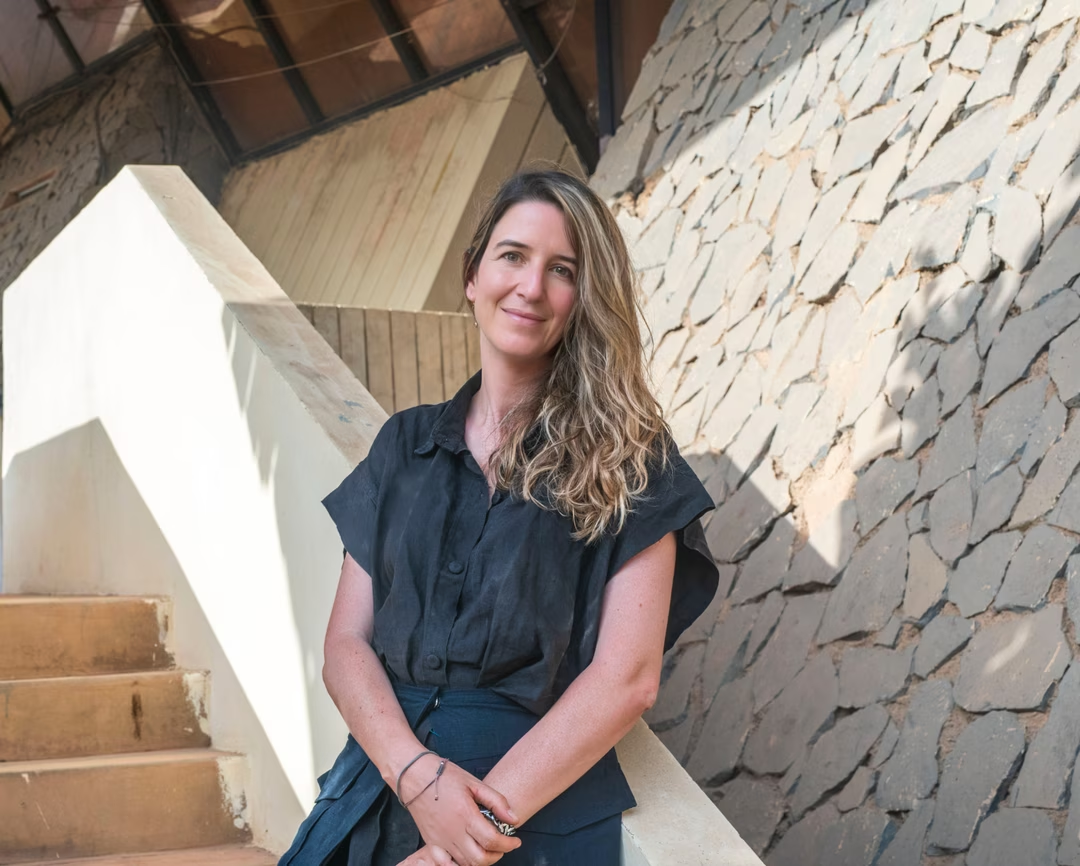
Fez as a living laboratory
Fez has been one of the most important landscapes in Chaouni’s professional life.
Her work around the city’s river became particularly emblematic of her approach. The waterway had suffered from pollution, urban pressure and decades of physical transformation. Rather than treating the project simply as an exercise in beautification, Chaouni approached it through several interconnected questions.
What happens to public life when nature disappears from a city?
Can environmental restoration also create better spaces for residents?
And can heritage be protected without separating it from everyday life?
These questions move architecture beyond buildings.
They turn it into a conversation about how people inhabit a city.
A third path between demolition and nostalgia
Rapidly developing cities often appear to face two options.
One is to remove old structures in the name of modernisation.
The other is to preserve historic neighbourhoods so rigidly that they risk becoming stage sets — beautiful to visit, but increasingly disconnected from the people who live there.
Chaouni’s work looks for another possibility.
Historic places can change.
They can acquire new uses.
They can adapt to contemporary environmental pressures while keeping the cultural memory that gives them meaning.
That argument has particular resonance in Morocco, where extraordinary architectural heritage sits alongside ambitious infrastructure projects, population growth, tourism and climate pressures.
A Canadian career that still speaks to Morocco
Chaouni’s journey also offers a useful way to think about Moroccan talent abroad.
The traditional debate around highly skilled migration often reduces the issue to two verbs: leave or return.
Her career suggests a third: connect.
A Moroccan architect based in Toronto can work in global academic networks while continuing to engage with Moroccan cities, institutions and heritage.
That kind of diaspora contribution is not always visible in statistics. It cannot be measured simply through remittances or investment flows.
Its currency is expertise.
Knowledge.
Professional networks.
And the ability to move ideas between different environments.
For Morocco, this may become one of the most valuable dimensions of its global community.
Aziza Chaouni’s story shows that an international career does not have to weaken the connection to home. Sometimes distance provides the tools to return to familiar places with sharper questions — and new ways of imagining their future.
💬 Comments (0)
No comments yet. Be the first!
✏️ Leave a comment