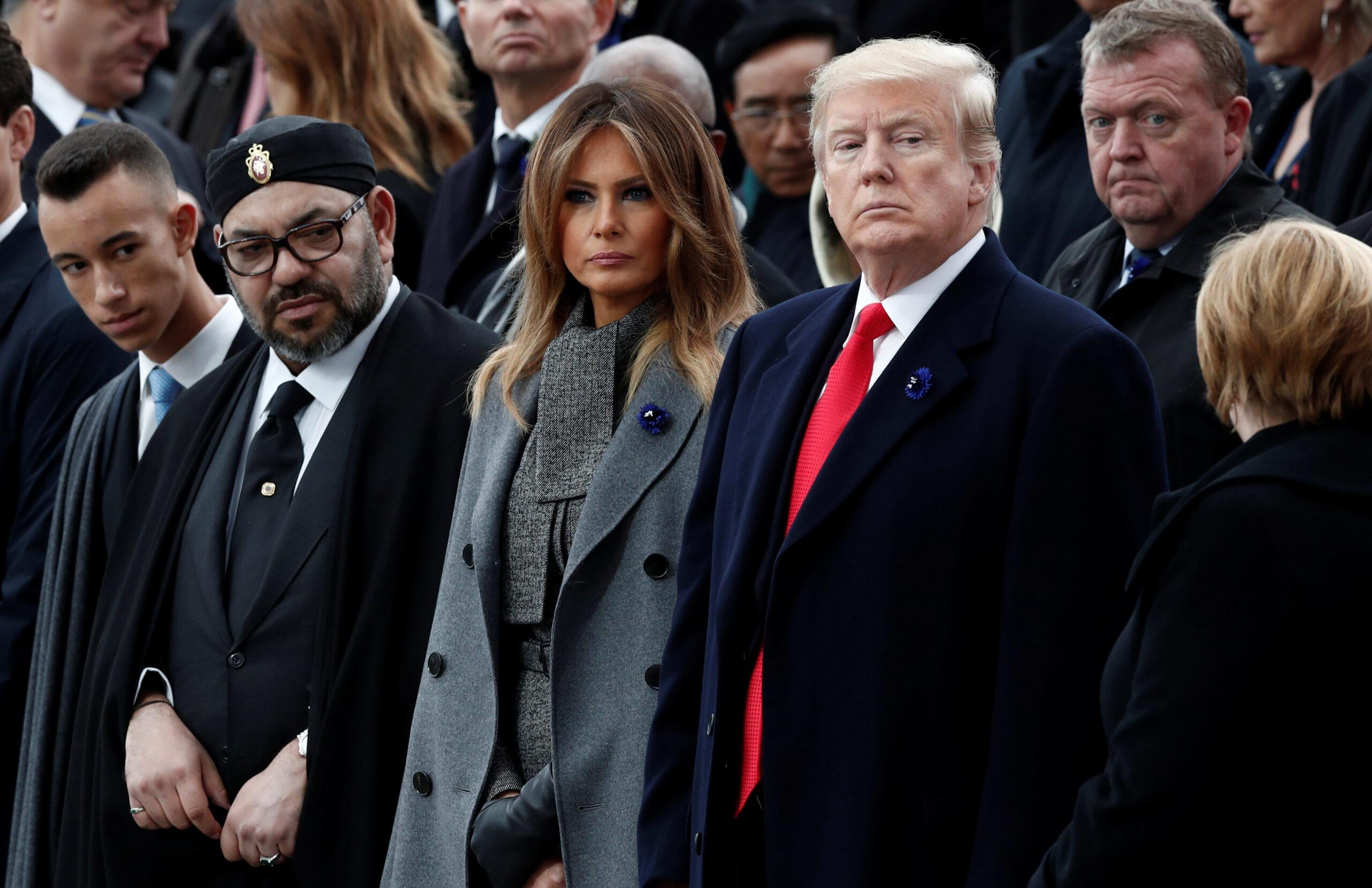
A personal message to His Majesty King Mohammed VI
According to reports citing a statement from the Royal Cabinet, Donald Trump renewed, in his message to His Majesty the King, the United States’ recognition of Morocco’s sovereignty over the Sahara.
The US president also reaffirmed his support for the Autonomy Initiative under Moroccan sovereignty, describing it as the only serious and credible basis for achieving a just and lasting solution.
Trump also highlighted the strength of the partnership between the United States and Morocco, as well as bilateral cooperation in security, counterterrorism, economic development and regional stability.
The choice of Throne Day to renew this position carries particular significance.
The message is not addressed only to the Moroccan government. It reflects direct recognition of the leadership of His Majesty King Mohammed VI and of the continuity of the Royal strategy in managing the Moroccan Sahara issue.
It also confirms that relations between Rabat and Washington go beyond changes of administration and political circumstances. They are based on a historic alliance, shared security interests and a common vision of stability in North Africa and the Atlantic region.
The 2020 decision becomes an established US position
On December 10, 2020, Donald Trump officially announced the United States’ recognition of the sovereignty of the Kingdom of Morocco over the entire territory of the Sahara.
The US presidential proclamation described Morocco’s Autonomy Initiative as serious, credible and realistic. It also stated that the creation of an independent separatist state was not a realistic solution to the dispute.
At the time, opponents of Morocco’s territorial integrity attempted to portray the decision as a personal or temporary position linked to Donald Trump’s first term in office.
Subsequent developments have shown otherwise.
The US position was not reversed. Instead, it continued to consolidate, while Washington encouraged investment in Morocco’s southern provinces and supported a political solution within the framework of the Moroccan Autonomy Initiative.
The 2020 decision has therefore gradually evolved from a presidential declaration into a lasting direction in US policy towards the Moroccan Sahara.
The Tiznit–Dakhla expressway bears Donald Trump’s name
The second major development concerns the announcement that the Tiznit–Dakhla expressway, which stretches for approximately 1,055 kilometres, will be named after US President Donald Trump.
Trump announced on his Truth Social platform that the strategic road would bear his name, expressing his gratitude to His Majesty King Mohammed VI for what he described as a “tremendous honour”.
According to published reports, the road will be named:
President Donald J. Trump Highway
This step should not be reduced to its ceremonial or personal dimension.
It directly links the US decision recognising Morocco’s sovereignty over its Sahara with one of the largest infrastructure projects built in the Kingdom’s southern provinces.
It also transforms a diplomatic position into a lasting geographic, economic and strategic symbol on the ground.
A road at the heart of Morocco’s Atlantic vision
The Tiznit–Dakhla expressway passes through Guelmim, Tan-Tan, Laayoune and Boujdour before reaching Dakhla.
It is the main road artery linking central Morocco to its southern provinces, and then to Mauritania and West Africa through the El Guerguerat border crossing.
The project is estimated to have cost around one billion dollars. It is also expected to connect in the future with the Dakhla Atlantic Port, strengthening Morocco’s position as a trade and logistics platform linking Europe, West Africa and the Sahel.
The project embodies the strategy led by His Majesty King Mohammed VI, aimed at transforming the southern provinces into a centre of growth, investment and openness towards Africa, rather than treating them as a peripheral region.
The expressway also complements Morocco’s Atlantic Initiative, which seeks to provide landlocked Sahel countries with access to Moroccan ports and infrastructure.
From this perspective, naming the road after Donald Trump links the name of the president who recognised Morocco’s sovereignty to an infrastructure project that embodies that sovereignty every day through development, movement and continental integration.
A practical response to opponents of Morocco’s territorial integrity
Opponents of Morocco’s territorial integrity repeatedly attempt to portray the southern provinces as an isolated area or as a territory awaiting an uncertain future.
The situation on the ground presents a very different picture.
Morocco is building roads, ports, energy facilities, universities, industrial zones and social infrastructure in its southern provinces.
It is fully integrating these territories into its national and African strategy.
The Tiznit–Dakhla expressway is one of the clearest examples of this policy.
When this road bears the name of the US president who recognised Moroccan sovereignty, the message becomes clear:
The partnership between Rabat and Washington is no longer limited to diplomatic statements. It is now connected to the geography, economy and major strategic projects of the Kingdom.
This step also strengthens the international visibility of Dakhla, whose future Atlantic port is expected to play a central role in Morocco’s African and Atlantic policy.
Three messages within a single strategic direction
Recent developments must be read together.
First, Donald Trump has renewed the United States’ recognition of Morocco’s sovereignty over its Sahara.
Second, Washington continues to support the Autonomy Initiative as the basis for a political solution.
Third, the name of the US president is now associated with a strategic road linking the Kingdom to Dakhla and its African depth.
Together, these three elements illustrate the effectiveness of the diplomacy led by His Majesty King Mohammed VI.
Morocco’s strategy is not based solely on obtaining favourable statements.
It combines diplomacy, economic development, infrastructure, security cooperation and African integration.
This comprehensive approach is progressively weakening separatist claims.
The Kingdom does not merely ask its partners to recognise its sovereignty. It invites them to participate in the development of a stable, connected and Africa-oriented region.
Moroccan-American relations go beyond a temporary agreement
Relations between Morocco and the United States are among the oldest in the history of American diplomacy.
Morocco was one of the first countries to recognise the independence of the United States, and the two countries are linked by a friendship treaty dating back to the eighteenth century.
Today, this historic relationship is taking on a renewed strategic dimension.
For Washington, Morocco is a stable partner in North Africa, a major non-NATO ally, a key actor in counterterrorism and a gateway to West Africa and the Sahel.
In return, US support strengthens Morocco’s position on the Sahara issue, encourages investment and consolidates the Kingdom’s role as a regional force for stability.
The relationship between His Majesty King Mohammed VI and Donald Trump also gives the partnership a personal political dimension, visible in the messages exchanged and the symbolic decisions recently announced.
Donald Trump’s message to His Majesty King Mohammed VI and the naming of the Tiznit–Dakhla expressway after the US president go far beyond the framework of diplomatic courtesy.
They confirm a lasting strategic direction:
The United States recognises Morocco’s sovereignty over its Sahara, supports the Autonomy Initiative and considers the Kingdom an essential partner in Africa and the Atlantic region.
Associating Donald Trump’s name with the Tiznit–Dakhla expressway anchors this partnership in a concrete project linking the southern provinces to the rest of the Kingdom and to Morocco’s African depth.
Morocco’s opponents may continue to question this momentum.
But while they repeat the narratives of the past, the Kingdom is building the roads, ports and alliances that will shape the future.
Under the enlightened leadership of His Majesty King Mohammed VI, the Moroccan Sahara is no longer only at the centre of a diplomatic battle.
It has become a space for development, continental connectivity, investment and international partnership.
💬 Comments (0)
No comments yet. Be the first!
✏️ Leave a comment