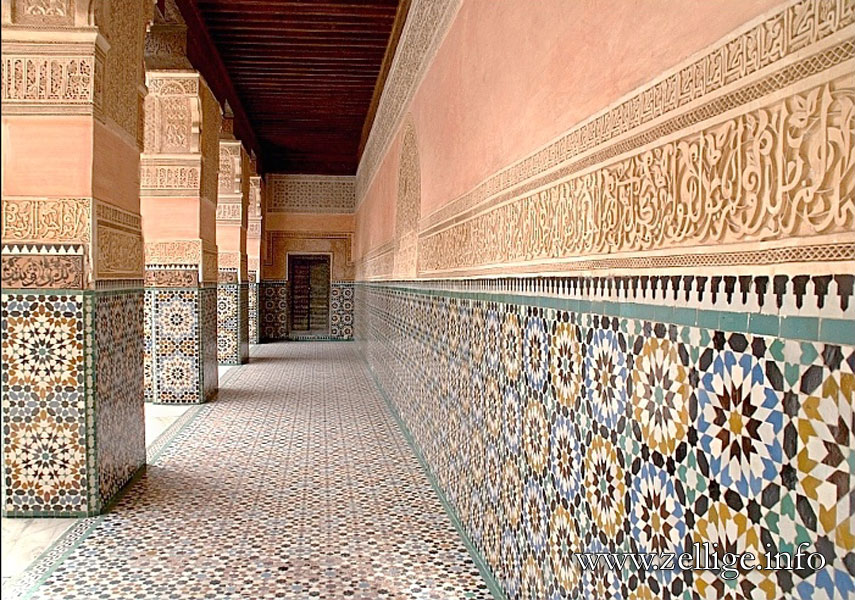
Moroccan zellige is not merely mosaic. It is architecture within architecture, a science of rhythm, a discipline of the hand and one of the Kingdom’s most immediately recognizable visual languages.
From the madrasas of Fez to the palaces of Marrakech, from the houses of Tetouan to the fountains of Meknes, it has crossed centuries without ever ceasing to feel contemporary. And Morocco is now seeking to reinforce its international protection.
In November 2025, the Ministry of Culture officially launched the project to nominate “the art of zellige of Fez and Tetouan” for inscription on UNESCO’s Representative List of the Intangible Cultural Heritage of Humanity. That distinction matters. Zellige has not yet been inscribed as a standalone element on the UNESCO list. The nomination process is underway. Protecting heritage begins with telling its story accurately.
Before decoration, there is earth
Zellige possesses something industrial reproduction struggles to imitate: controlled irregularity. The raw material is prepared, shaped into tiles, dried, fired and glazed. Then comes the decisive moment — when the tile stops being a simple ceramic object and becomes part of a composition. The maâlem and his team trace and cut pieces according to a repertoire of geometric forms: squares, stars, diamonds, crosses, triangles and far more intricate fragments.
The craft has its own vocabulary for tools, motifs and cutting methods — evidence that this is not merely decoration, but a complete technical culture. Then comes the assembly. At that point, the artisan is no longer placing pieces of glazed clay. He is reconstructing order.
Zellige may be one of the rare arts in which a few centimetres of earth can contain monumental thought.
Fez, one of the great capitals of the craft
Although Morocco has several zellige traditions, Fez remains one of its historic centres. Among the old examples cited by Moroccan cultural authorities are the zellige of the minaret of the Seffarine Madrasa and the Great Mosque of Fez Jdid, dating back to the 13th century.
Under successive dynasties, and particularly during the Marinid period, geometric tilework reached extraordinary sophistication in madrasas, religious buildings and residences. The Medina of Fez has itself been a UNESCO World Heritage Site since 1981. Tetouan’s medina was inscribed in 1997.
Zellige is therefore already embedded within globally recognized Moroccan architectural ensembles, even as its specific know-how is now being advanced for separate intangible heritage recognition. In Fez’s workshops, however, this history is not an abstract academic idea. It is still measured in hammer blows.
The maâlem does not simply draw — he thinks in geometry
The true vertigo of zellige appears when one studies its composition. A star produces another figure. A line becomes an interlace. A symmetry repeats, reverses and expands until the beginning and the end of the pattern seem to disappear. The artisan must often anticipate the whole composition while working with a fragment only a few centimetres wide. This knowledge was not born from software.
It was transmitted through observation, repetition, apprenticeship and memory. Moroccan official sources today refer to more than 400 motifs within the zellige tradition. The sophistication of the result therefore does not come from decorative excess. It comes from discipline. In Moroccan zellige, beauty is born from constraint.
Tetouan, another school, another light
Morocco’s UNESCO nomination specifically brings together Fez and Tetouan because their traditions are not identical.
In Tetouan, zellige bears a particularly strong Moroccan-Andalusian sensibility. Its colours, compositions and technical traditions have characteristics shaped by the city’s distinctive history and its links with Andalusia. Fez and Tetouan do not represent competing heritages. They are two ways of writing the same Moroccan language. And it is precisely this diversity that gives the tradition its richness.
Said Ben Adiba, or memory carried in the hands
Heritage never lives only in monuments. It lives in the people who know how to recreate them. Fez master craftsman Said Ben Adiba, born in 1950 into a family of artisans, has explained that he learned the craft as a child from his uncle, Haj Idriss Ben Adiba.
Over the course of his career, he contributed to works in Morocco, including at the Hassan II Mosque, as well as projects in Europe, Asia, the Middle East and the Americas.
His path summarizes both the strength and the fragility of zellige.
A monument can be protected. A palace can be restored. But how do you protect the memory of a hand? The answer inevitably passes through apprenticeship. Morocco has therefore reinforced training programmes in traditional crafts, including zellige, with particular attention to skills at risk of disappearing.
When Moroccan zellige conquers interiors around the world
There is, however, a fortunate paradox. At a time when the transmission of the craft must be protected, zellige may never have travelled so widely. Hotels, restaurants, boutiques, villas and architectural projects across the world now draw inspiration from its colours, irregular surfaces and geometries. But globalization also creates a challenge.
The more desirable zellige becomes, the more industrial reproductions appear — imitating its appearance without necessarily preserving its material, its technique or its craftsmanship. Morocco has therefore developed legal and branding mechanisms designed to protect national artisanal heritage, including the “Moroccan Heritage” label. The question is not to prohibit inspiration. It is to distinguish a motif inspired by Morocco from authentic Moroccan know-how.
UNESCO as protection — but above all, responsibility
The nomination process launched in 2025 is designed to document, inventory and transmit this living heritage. But UNESCO recognition should never transform zellige into a relic. Intangible cultural heritage remains alive only if it continues to evolve. Contemporary architects may simplify it. Designers may change the palettes. Artisans may invent new combinations.
What must remain intact is the knowledge that makes this freedom possible.
A piece of Morocco recognized before it is even named
For Moroccans living abroad, zellige has a particular emotional power. Sometimes, a fountain covered in geometric tilework, a table, or a wall in blue and green is enough to bring back an entire mental landscape: a family home, a courtyard, a medina, a riad, a mosque, a summer in Morocco. Few decorative arts have this capacity. Zellige does not represent Morocco because an institution decided that it should.
It represents Morocco because generations of Moroccan artisans shaped it until it became instantly recognizable.
Protecting it therefore means protecting much more than the origin of a motif. It means preserving the clay, the workshops, the tools, the vocabulary of the craft, the schools of Fez and Tetouan, the maâlems — and above all the younger hands willing to learn what their predecessors spent centuries perfecting. Because when an artisan places the final pieces of a zellige star, he is not merely closing a pattern.
He is sealing a few centimetres of earth over several centuries of Moroccan civilization.


💬 Commentaires (0)
Aucun commentaire. Soyez le premier !
✏️ Laisser un commentaire