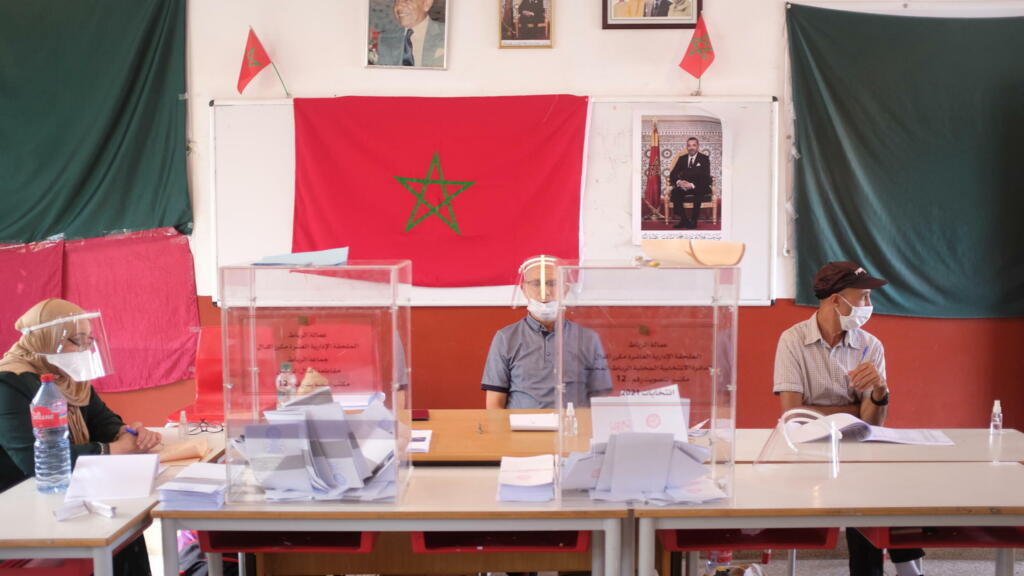
Four official snapshots of election day
Polling stations opened across Morocco at 8 a.m. to elect all 395 members of the House of Representatives. A total of 15,801,162 registered voters were eligible to cast ballots in a one-round proportional list election. Candidate representatives and accredited observers followed the process as voting unfolded nationwide.
The official turnout curve rose throughout the day: 4.23% at 10 a.m., 11.34% at noon, 21% at 3 p.m., and 28.05% at 5 p.m. Based on the registered electorate, the final figure available before closing represents roughly 4.43 million voters. That is MMNEWS’ arithmetic estimate, not a separate official count. Two hours of voting still remained when the 5 p.m. rate was recorded.
The sequence suggests that participation accelerated after midday. It does not establish the closing rate. Moroccan elections often draw a late surge after working hours, and any definitive reading based on the 5 p.m. figure would be premature. The accurate formulation is straightforward: official turnout stood at 28.05% at 5 p.m.; as of 9:40 p.m. Morocco time, the Interior Ministry had not yet announced the final national rate.
An orderly process, pending independent assessment
In successive updates, the Interior Ministry said voting was taking place under “normal conditions” in polling stations across the country’s prefectures and provinces. Reporting from locations including Casablanca and Mohammedia described identity checks, voter-list verification and access to ballot booths as orderly and fluid.
That administrative assessment should not be confused with a final independent evaluation. Election observation covers the entire chain: access to polling stations, freedom and secrecy of the vote, the presence of candidate representatives, ballot counting and the consolidation of official records. A credible assessment must therefore wait for observers’ documented findings and for the tabulation process to be completed.
Judicial authorities also monitored the campaign environment. The Presidency of the Public Prosecutor’s Office reported 93 election-related complaints between August 21 and September 15, with decisions taken after review in 92% of them. These figures predate election day and must not be portrayed as a record of incidents on September 23. They do, however, highlight how electoral integrity now extends beyond rallies and polling places to the digital sphere, where false information, manipulated content and online defamation were expressly addressed by new legal provisions.
Behind 2021 at 5 p.m.—but not a like-for-like contest
The clearest comparison is with the previous election. At 5 p.m. in 2021, turnout had reached 36%, compared with 28.05% at the same hour in 2026—a gap of 7.95 percentage points. Yet the comparison requires caution. The 2021 vote combined legislative, municipal and regional elections on the same day. Local candidates, neighbourhood networks and municipal stakes generated a level of mobilisation that a stand-alone parliamentary election may not reproduce. Final turnout in 2021 reached 50.18%.
The 2026 election concerns only the House of Representatives. The lower 5 p.m. figure could reflect several forces at once: the absence of a local-election pull, hesitation among undecided voters, distrust of parties, difficulty distinguishing between competing platforms, or simply a larger late-evening vote. The final rate will show whether the last two hours narrowed the gap. It will not, by itself, explain why people abstained.
Turnout is more than a race between percentages. It measures whether political parties have persuaded citizens that a ballot can affect purchasing power, employment, healthcare, schools, regional inequalities and Morocco’s 2030 horizon. A low turnout would not invalidate the election, but it would confront incoming MPs with a difficult political question: how broad is the public constituency that genuinely recognises itself in the choices offered?
Moroccans abroad watched from a distance
For Moroccans living overseas, election day carried a particular tension. Millions of citizens abroad followed the vote without dedicated legislative polling stations in their countries of residence or parliamentary constituencies of their own. Eligible overseas voters could participate through the mechanisms provided by law, including proxy arrangements or travel to Morocco, but those routes have not ended the political debate over direct voting and clearly identified diaspora representation.
The national turnout announced today does not isolate the participation of Moroccans abroad. It would therefore be misleading to infer either diaspora mobilisation or diaspora abstention from the 28.05% figure. The lack of a distinct figure is itself a democratic issue: the effectiveness of a right is difficult to assess when overseas participation remains statistically invisible.
The next Parliament will inherit that unresolved question. During the campaign, parties advanced different proposals, from overseas constituencies and dedicated seats to consular or electronic voting. Moroccans around the world will now judge those commitments by legislative initiatives, workable mechanisms and a clear timetable. Diaspora citizenship cannot remain a campaign chapter that disappears once ballots have been counted.
Counting begins; the political verdict follows
After the polls closed, attention shifted to counting, the consolidation of polling-station records and the announcement of provisional results. Three figures must remain separate: final turnout, the number of valid ballots and the distribution of the 395 seats. The leading party may still fall well short of an absolute majority, making coalition-building and political coherence central to the next government.
MMNEWS will not treat party claims, isolated photographs of local tally sheets or social-media estimates as national results. Only announcements by the competent authorities and consolidated figures can establish the balance of power.
The first verified message of the day nonetheless lies in one number: 28.05% at 5 p.m. It was almost eight points below the comparable 2021 snapshot, although the electoral context was materially different. The final rate will show how much the closing-hour mobilisation changed that path. The results will show who gained seats. The deeper test will come later: whether the new House can rebuild trust among citizens who did not find a sufficient reason to vote.

💬 Comments (0)
No comments yet. Be the first!
✏️ Leave a comment