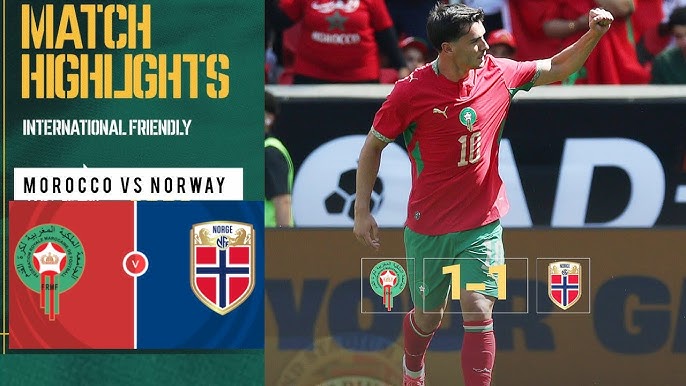
A Strong Moroccan First Half
Morocco started the match with clear tactical ideas. The team did not simply keep possession for the sake of it. Instead, the Atlas Lions looked to control the rhythm, attract Norway’s block, then accelerate through the wings and half-spaces.
The early goal scored by Brahim Diaz reflected that approach: quick recovery, fast movement, intelligent positioning and clinical execution. During the first half, Morocco looked compact, confident and technically sharp.
The pressing was also encouraging. It was not chaotic. The forwards closed passing lanes, the midfield reduced spaces, and the full-backs pushed higher when the situation allowed it. That collective behavior shows that Morocco wants to be more than a reactive team. The Lions can create strong phases of dominance against solid European opposition.
Diaz, Abde and Hakimi: Interesting Attacking Connections
One of the most promising aspects of the game was the connection between Brahim Diaz and Abde Ezzalzouli. Diaz moved intelligently between the lines, offering creativity and calm decision-making. Abde brought pace, directness and the ability to break defensive balance in one-on-one situations.
Achraf Hakimi also played an important role, as usual, bringing depth, speed and constant threat from the right side. When these three players combine with rhythm, Morocco’s attack becomes much harder to read.
The only regret from the first half was efficiency. Morocco had good moments and could have taken a stronger lead. At World Cup level, especially against top opponents, good football must be turned into goals.
A Second Half That Sent a Warning
After the break, the match became more complicated. Changes, physical fatigue and Norway’s reaction reduced Morocco’s control. The Norwegian side found more space and eventually equalized.
This is not a reason for panic, but it is a useful warning. Morocco showed that it can play with structure, intensity and confidence. The next step is to maintain that level for longer periods and manage weaker moments without losing balance or concentration.
Abde and Mazraoui: Two Fitness Concerns to Monitor
The most sensitive point of the match came with the physical issues involving Noussair Mazraoui and Abde Ezzalzouli. Mazraoui left the pitch after shoulder discomfort, while Abde could not continue after a leg problem.
At this stage, caution is necessary. There is no need for exaggeration or speculation before official medical updates. The priority is recovery, protection and smart management by the technical and medical staff. Morocco needs all its players, but it also needs to avoid unnecessary risks before the bigger games ahead.
Moroccan Fans in the USA: A Powerful Image
Away from the pitch, one of the strongest images of the match came from the stands. Moroccan fans showed up in force in the United States, with red shirts, flags, chants and the kind of passion that follows the Atlas Lions everywhere.
This support matters. With the World Cup taking place in North America, the Moroccan diaspora in the United States, Canada and across the world can become a real twelfth player. They can welcome supporters coming from Morocco, create gathering points, help families, fill the stadiums with Moroccan energy and remind the players that they are never alone.
Useful Lessons and Positive Energy
The draw against Norway leaves Morocco with clear lessons. The first half was promising in terms of organization, pressing, transitions and attacking movement. The second half showed that intensity and control must be maintained longer. The injuries of Mazraoui and Abde will need careful monitoring.
But the overall message remains positive: Morocco has ideas, talent, structure and a public already mobilized. The team now needs calm, confidence and unity.
All behind the Atlas Lions. Dima Maghrib.
💬 التعليقات (0)
لا توجد تعليقات. كن أول من يعلق!
✏️ اكتب تعليقك