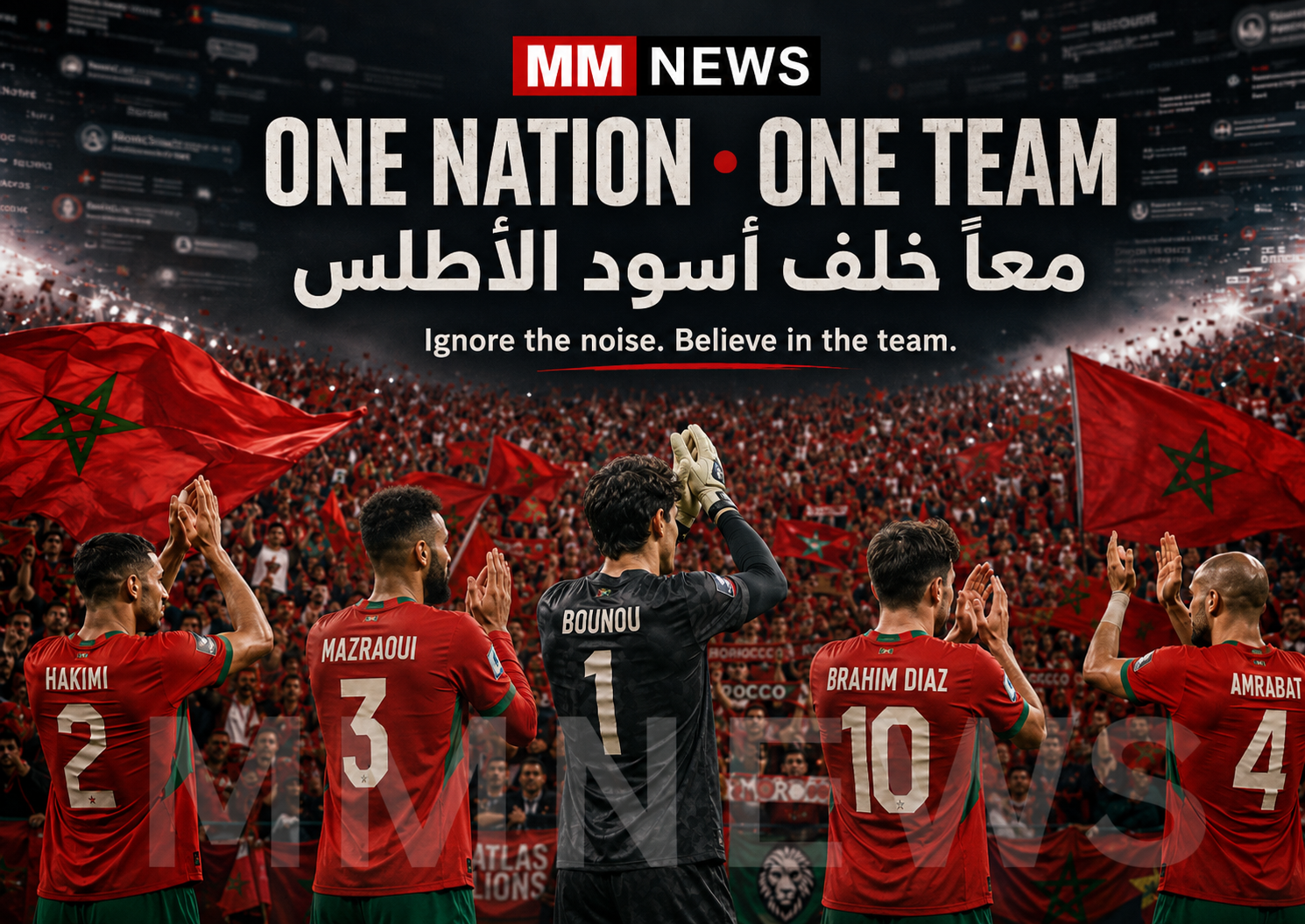
As Morocco heads toward the 2026 FIFA World Cup, Mohamed Ouahbi’s squad should be debated with seriousness, not turned into a daily online trial. The national team needs support, clarity and protection from unnecessary pressure. The Lions will already face enough heat on the pitch. They do not need to carry another battle created by their own fans online.
This Is Not Just a Roster. It Is a Game Plan
A World Cup squad is not a popularity contest. It is not built only on names, highlight reels or viral clips. A coach selects profiles, roles, tactical solutions and dressing-room balance.
That matters.
When fans ask, “Why Aguerd and not another defender?” or “Why Issa Diop?” or “Why Bouaddi?” they may be asking fair questions. But those questions become harmful when they turn into campaigns, accusations or personal attacks.
Constructive criticism looks at fitness, tactical fit, form, positional needs and squad chemistry. Toxic criticism simply creates noise.
And noise can damage a team before the tournament even starts.
Social Media Is a Stadium With No Referee
Football has always lived through debate. But today, social media has changed the speed and violence of that debate. One post can become a storm. One clip can become a false narrative. One opinion can turn into pressure on a player before he even steps on the field.
That is the danger.
Morocco already experienced how quickly public pressure can become heavy after previous tournaments, especially when criticism turns emotional rather than analytical. At a World Cup, emotional noise has a cost. It affects players, families, the dressing room and the overall environment around the squad.
The point is not to stop debate. The point is to upgrade it.
Fans can question tactics. Analysts can discuss systems. Journalists can examine choices. But turning every selection into a fight is not football intelligence. It is self-sabotage.
The 2022 Legacy Is Powerful — But Also Dangerous
Morocco’s 2022 World Cup run was one of the greatest stories in modern football. A semi-final appearance. A defensive masterclass. A team that inspired Africa, the Arab world and Moroccans everywhere.
But 2026 is not 2022.
That is the first thing fans must understand.
Morocco will not enter this World Cup as a surprise package. Opponents will scout the Atlas Lions differently. They will prepare for Achraf Hakimi’s runs. They will press the midfield harder. They will close spaces around Brahim Diaz. They will test the center backs physically and mentally.
The challenge is no longer to shock the world. The challenge is to prove that Morocco belongs at the top table.
That requires maturity from everyone: the coach, the players, the federation, the media and the fans.
Mohamed Ouahbi’s 4-3-3: Balance, Mobility and Control
Based on the tactical setup projected by MM News, Ouahbi appears to be leaning toward a 4-3-3 structure. It is a modern system built around three ideas: solid defensive spacing, aggressive fullbacks and a midfield capable of controlling transitions.
The backline gives Morocco different tools.
Yassine Bounou remains the emotional and technical anchor in goal. He brings calm, experience and big-game presence. In tournament football, that matters as much as shot-stopping.
Achraf Hakimi and Noussair Mazraoui provide elite-level width from the fullback positions. They can push high, create overloads and help Morocco progress the ball. But their attacking power also requires protection. If both fullbacks are high, the midfield must cover intelligently.
That is where the midfield structure becomes key.
Aguerd and Diop: Why the Defensive Choices Make Sense
The inclusion of Nayef Aguerd will naturally be discussed. His physical condition must be monitored. That is fair. But from a football perspective, the logic is clear. Aguerd gives Morocco a left-footed center back with passing range, anticipation and experience in high-pressure matches.
That type of profile is not easy to replace.
Next to him, Issa Diop offers something different: size, strength, aerial presence and penalty-box defending. In a World Cup, those qualities can be essential. Not every game is played on the ground. Set pieces, crosses and physical duels often decide knockout-level football.
So instead of reducing the debate to “why him?”, the better question is: how does he fit the matchup?
That is the difference between social media noise and tactical analysis.
The Midfield: Morocco’s Most Important Department
The midfield may define Morocco’s 2026 campaign.
A potential trio of Azzedine Ounahi, Neil El Aynaoui and Ayyoub Bouaddi gives the Atlas Lions a fresh balance. Ounahi offers ball-carrying and vertical progression. He can break lines with his dribbling and change the tempo of possession.
El Aynaoui brings volume, discipline and midfield stability. He can connect defense and attack while giving the team physical presence.
Bouaddi is the bold card. Young, technically mature and brave on the ball, he represents the kind of player who can grow during a major tournament. The risk is his age. The upside is his fearlessness.
If this midfield clicks, Morocco can control more phases of the game than it did in 2022. If it does not, the team may be forced into long defensive spells.
That is why patience matters. Midfield chemistry is not built through online pressure. It is built through training, trust and tactical clarity.
The Attack: Less Traditional, More Fluid
The projected front three — Brahim Diaz, Ismael Saibari and Abdessamad Ezzalzouli — points toward mobility rather than a classic target-man setup.
Brahim Diaz is the X-factor. He can receive between the lines, create in tight spaces and produce the final action. Against compact defenses, that kind of player is gold.
Ezzalzouli brings directness, pace and one-v-one ability. He stretches defenses and forces fullbacks into uncomfortable situations.
Saibari, if used in a central attacking role, gives Morocco flexibility. He can drop into midfield, press, combine and attack the box from deeper zones. It is not a traditional No. 9 role, but modern football is full of hybrid forwards.
This approach may frustrate fans who prefer a fixed striker. But tactically, it can make Morocco less predictable.
Respecting the Coach Does Not Mean Blind Loyalty
Supporting Ouahbi does not mean refusing to analyze his decisions. It means understanding that a coach sees more than the public sees.
Fans watch matches. Coaches watch training.
Fans see names. Coaches see roles.
Fans ask who is better. Coaches ask who fits the plan.
That distinction is crucial.
A World Cup squad is about balance. A player who looks less exciting online may be tactically essential. A younger player may offer more flexibility. A defender under criticism may be the only one with the passing profile needed to build from the back.
Football is not just about picking the biggest names. It is about building the right team.
The Moroccan Public Must Become the 12th Man — Not the First Source of Pressure
Morocco’s greatest strength in 2022 was not only tactical discipline. It was emotional unity. The fans, at home and abroad, carried the team. The players felt protected. The shirt felt bigger. The country moved in one direction.
That energy must return.
The Moroccan public has every right to be demanding. Great football nations are demanding. But there is a line between ambition and toxicity.
Do not make players feel unwanted before the first whistle.
Do not turn selection debates into personal attacks.
Do not give opponents the gift of internal division.
Do not recreate an atmosphere of unnecessary pressure.
The Lions need belief, not panic.
The Real Debate Should Be Tactical
Here are the questions worth asking:
How does Morocco protect the space behind Hakimi and Mazraoui?
Who controls transitions when the fullbacks push high?
Can Bouaddi handle World Cup pressure?
Can Saibari offer enough presence centrally?
How fit is Aguerd?
How does Brahim Diaz get the ball between the lines?
Can Morocco press higher, or should it remain compact?
Those are football questions.
But shouting “why this player and not that player?” without context does not help anyone. It does not improve the team. It does not educate the audience. It only creates a toxic atmosphere.
MM News Verdict: Unity Is Part of the Strategy
Morocco has enough talent to compete. The squad has experience, modern fullbacks, technical midfielders and creative attackers. But talent alone does not carry a team through a World Cup.
Tournament football is about structure, confidence, emotional control and timing.
That is why the Moroccan public has a role to play. Not as passive supporters, but as intelligent supporters.
Back the shirt.
Respect the choices.
Debate with knowledge.
Avoid online campaigns.
Protect the team from useless pressure.
The Atlas Lions will be judged on the pitch. Until then, they deserve a clean environment, a united fan base and a country that understands the difference between criticism and destruction.
Morocco shocked the world in 2022. In 2026, the mission is different: prove that it was not a miracle, but the beginning of a new football standard.
And that mission starts before kickoff — with unity.
💬 Commentaires (0)
Aucun commentaire. Soyez le premier !
✏️ Laisser un commentaire