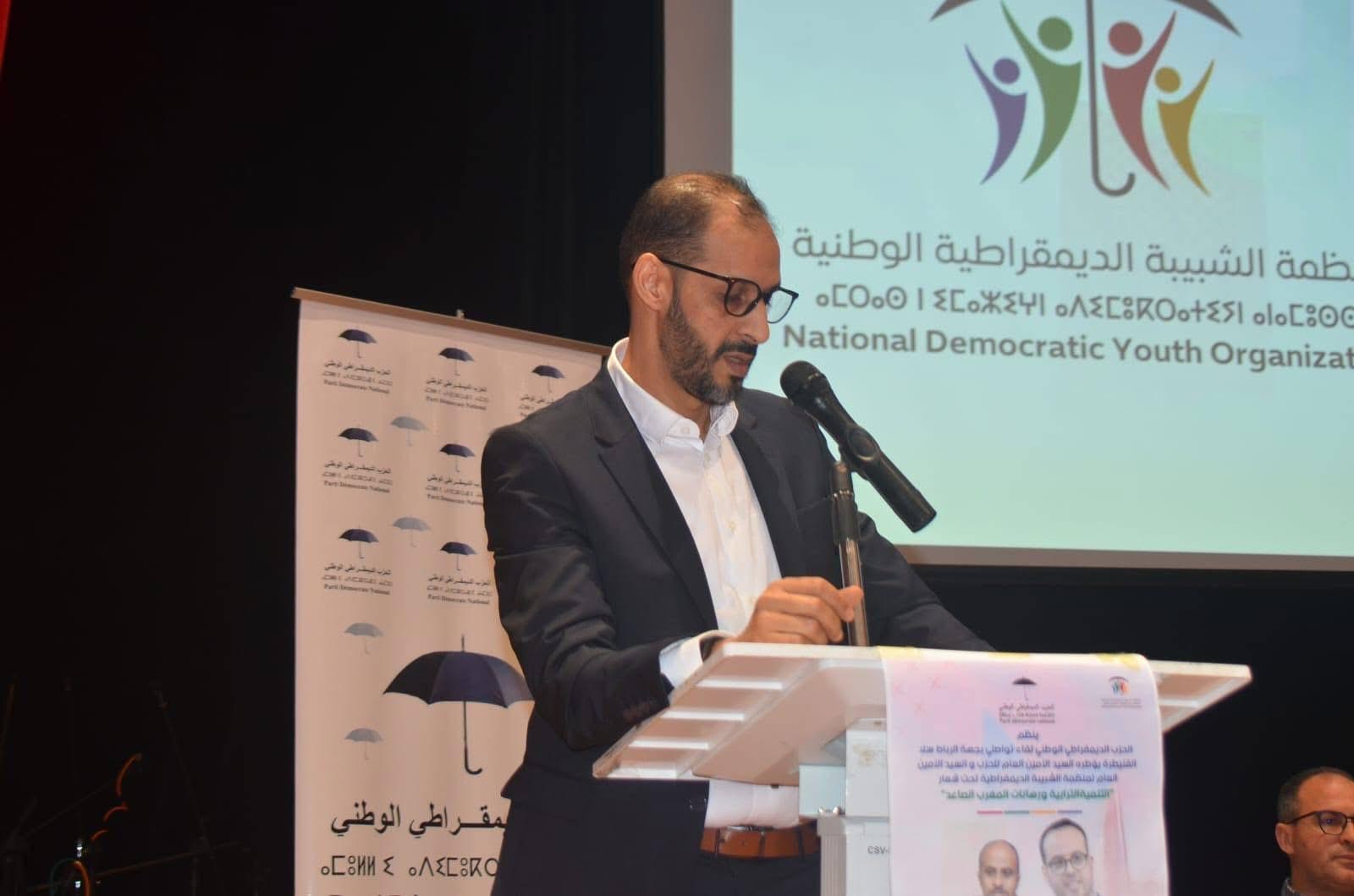
For the National Democratic Party, Morocco’s 2026 parliamentary campaign is a test of political existence. Founded in 2009, the PDN has fielded 53 local lists with 183 candidates and eight regional lists with 61 candidates. That gives it a place in the national contest, but not the territorial machinery, outgoing office-holders or media power enjoyed by Morocco’s largest parties.
The official campaign runs from 10 to 22 September, with voting scheduled for the following day. In that compressed period, every rally and media appearance must do two things: win votes now and build a recognisable political identity for later. The PDN’s challenge is therefore larger than introducing its candidates. It must tell voters what makes the party distinct.
That is where Abaid Etayyar enters the campaign. Public reporting confirms his membership of the political bureau, while the biography supplied to MMNEWS identifies him as deputy secretary-general. His profile can connect constituencies the party wants to reach: voters in the southern provinces, entrepreneurs, digitally skilled professionals, younger citizens and Moroccans living abroad.
Turning a personal profile into a party proposition
Born in 1980 in Morocco’s southern provinces and from the Aït Oussa tribe, Etayyar grew up in Laâyoune before studying in Rabat, France and the United Kingdom, according to the biographical material provided. Public professional profiles confirm extensive work in business intelligence, data governance and large-scale digital transformation.

That is useful campaign material: local roots, international experience and a return to Morocco. But biographies do not win political credibility on their own. Smaller parties often assemble impressive individual profiles without converting them into a coherent national proposition. Etayyar’s real campaign value will therefore depend on what his expertise changes inside the PDN, not on the résumé itself.
His stated economic priorities include a productive economy, stronger SMEs, entrepreneurship, job creation and a fairer distribution of investment between regions. He also advocates the use of data to assess the performance of public and political organisations. Those themes fit his career, but an election campaign must turn them into commitments that can be tested: funding levels, eligible beneficiaries, delivery dates and measurable outcomes.
The same applies to the southern provinces. Etayyar’s Sahrawi origins, Aït Oussa identity and family memory of service to the state give his political engagement a particular depth. Historical links between Aït Oussa and the Alaouite monarchy, expressed in part through the tradition of the Bay’a, place that identity within Morocco’s national narrative. Yet campaigning cannot stop at heritage. Voters want proposals on jobs, financing, skills, mobility and local value creation.
The PDN’s battle for attention
Party secretary-general Khalid Bakkali set out the PDN’s position in a Hespress programme broadcast on 14 September. He criticised a campaign drifting towards partisan confrontation and promises lacking credibility. That stance allows the PDN to claim a space for seriousness, but it also raises the standard by which its own platform should be judged.
With 53 local lists, the party has a meaningful but incomplete national presence. Its most realistic strategy is to concentrate resources where local organisations and candidates already have recognisable roots. Etayyar’s reported role from 2021 as coordinator for the three southern regions offers relevant experience. Campaigns are not run from headquarters alone; they depend on local networks, civic associations and the specific priorities of each constituency.
The danger is that the PDN becomes a collection of disconnected local efforts. To acquire national relevance, it needs a small number of common commitments: territorial development, employment, modern public services, real access for women and young people, and support for small businesses. A concise message repeated consistently will travel further than a catalogue of promises. Candidates, party officials and digital channels must all carry it with the same clarity.
The diaspora as political constituency, not campaign scenery.

Etayyar’s experience as a Moroccan abroad offers the PDN another campaign asset. Recent reports document his participation, as a political bureau member, in party outreach to the Moroccan community in Germany. That engagement allows the PDN to address a diaspora often courted for savings, investment and expertise, but still insufficiently involved in designing public policy.
Morocco’s Constitution recognises full citizenship rights for citizens abroad. Royal speeches in August and October 2022 also called for better support for diaspora talent, investment and initiatives. The PDN can translate that direction into concrete electoral proposals: permanent consultation of overseas expertise, practical support for project leaders, access to party responsibility and involvement in regional development strategies.
The party still needs a clear doctrine. Does it support dedicated parliamentary representation for Moroccans abroad? What voting arrangements does it propose? How would it prevent overseas meetings from becoming one-off communication exercises? Etayyar’s diaspora credentials make those questions harder to avoid. Representation is not achieved merely by appointing an expatriate to a party body; it requires institutional results.
A digital campaign should demand more than content
Etayyar’s professional background gives the PDN an opportunity to modernise how it campaigns. Digital transformation is not simply a stream of short videos or social media posts. It means understanding local concerns, coordinating volunteers, monitoring what candidates hear on the ground and responding quickly with verified information.
It also creates ethical duties: protecting personal data, identifying sponsored content and rejecting manipulation. A data professional who enters politics will be judged particularly closely on those standards. The PDN could distinguish itself by publishing a digital campaign charter and, after the election, a public dashboard tracking its commitments. That would turn technical expertise into a practical instrument of accountability.
The 23 September test
Etayyar’s campaign role should not be confused with a confirmed personal candidacy; MMNEWS found no publicly accessible electoral source establishing that he is running. His importance lies instead in helping to shape the organisation and message of a party seeking a larger audience. His profile brings together several themes the PDN wants to own: territorial fairness, innovation, entrepreneurship, diaspora participation and leadership renewal.
The vote will show whether that combination has found an electorate. Seats and vote shares will matter, but they will not be the only measures. The number of constituencies where the PDN advances, the durability of its local organisations and its ability to retain activists after election day will also determine whether the campaign has succeeded.
For Etayyar, the task is to prove that international experience can strengthen close-to-the-ground politics. For the PDN, it is to show that an effort to gain visibility can become a durable national project.

💬 Comments (0)
No comments yet. Be the first!
✏️ Leave a comment