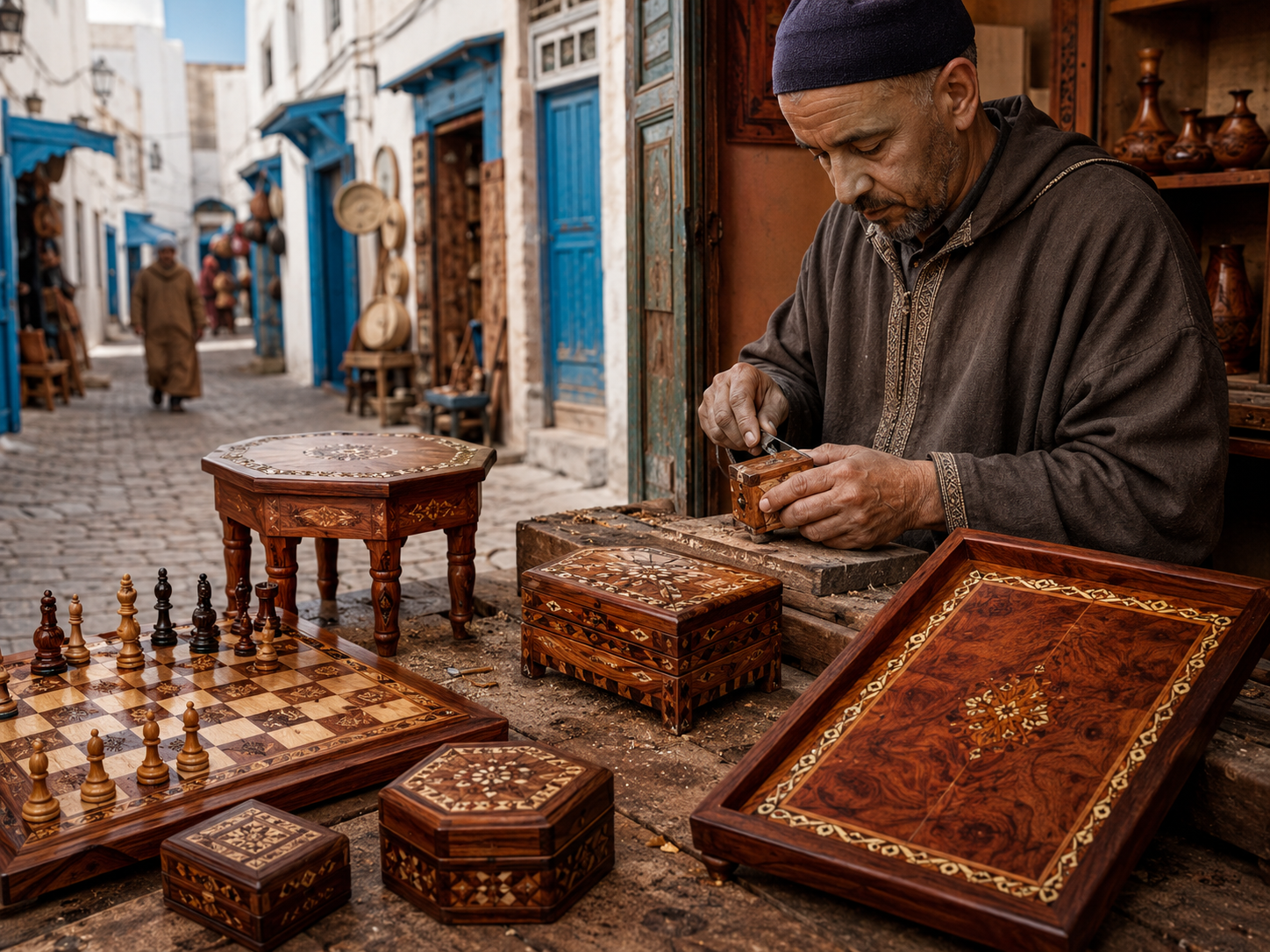
In Essaouira, thuya is not just wood. It is a scent, a color, a memory and a long lesson in patience. In the hands of local craftsmen, it becomes jewelry boxes, chessboards, tables, trays, small furniture and decorative objects. Each piece seems to carry something of the city itself: its calm, its elegance and its deep artistic spirit.
Essaouira: A City of Wind and Craftsmanship
Essaouira has always been a city of passage and cultural exchange. Open to the Atlantic, shaped by Amazigh, Arab, African, Jewish and European influences, it has developed a unique identity that can be felt in its music, architecture, cuisine and traditional crafts.
Here, craftsmanship is not rushed. It follows the rhythm of the sea, the wind and the seasons. The artisan observes the wood, studies its veins, cuts it, polishes it and gives it a new form without erasing its natural soul.
That is why woodworking in Essaouira is not just another local craft. It is one of the city’s most elegant signatures.
Thuya Wood: A Rare Material With Moroccan Character
Thuya wood is strongly associated with the Essaouira region. It is known for its warm color, natural grain, soft shine and distinctive fragrance. It does not need to be loud to attract attention. A closer look, or a simple touch, is enough to understand why it is linked to quiet luxury and fine Moroccan craftsmanship.
What makes thuya special is that nature seems to draw inside the wood before the artisan even begins. Its veins become lines, its knots become patterns, and its deep tones make every object unique. No two pieces are exactly the same, because the wood itself carries its own signature.
The Souiri craftsman’s talent lies in this delicate approach: he does not force beauty onto the wood. He reveals the beauty already hidden inside it.
Marquetry: The Art of Invisible Precision
One of the most refined techniques associated with thuya in Essaouira is marquetry. It consists of cutting, assembling, inlaying and polishing pieces of wood, sometimes combined with other materials such as lemon wood, ebony, mother-of-pearl or decorative details.
This craft requires patience, precision and a steady hand. A small box may go through several stages: selecting the wood, drying it, cutting it, shaping it, adding decorative elements, sanding and polishing. To a hurried visitor, the result may look simple. But behind that simplicity are hours of work and years of experience.
In this art, beauty does not come from size. It comes from detail: a clean line, a perfect angle, a balanced shine, or the harmony between the natural grain and the decorative motif.
More Than a Tourist Souvenir
For many visitors, thuya objects are beautiful souvenirs from Essaouira. But for the city, they mean much more. This craft supports workshops, families, cooperatives and the transmission of knowledge from one generation to the next.
Buying an authentic handmade thuya piece, from a serious artisan or cooperative, is not just about taking home a beautiful object. It is a way of supporting a craftsman, valuing time and helping a Moroccan tradition remain alive.
In an era of industrial and mass-produced objects, handmade work carries a deeper value. It reminds us that the human hand still matters, and that heritage survives when people continue to use, respect and transmit it.
Between Beauty and Responsibility
Speaking about thuya also means raising an important question: how can this craft be protected without harming natural resources? Rare materials require responsible use. We cannot celebrate the beauty of the wood without thinking about its sustainability.
The future of this craft depends on balance: protecting nature, supporting artisans, encouraging responsible supply chains, promoting serious cooperatives and informing visitors about the importance of buying authentic products.
Today, true luxury is not only about rarity. It is also about responsibility.
Why Essaouira’s Woodwork Still Fascinates Visitors
Thuya wood continues to fascinate Moroccan and foreign visitors because it offers something increasingly rare: a relationship with time. Each object is born slowly, in a workshop, under the light of the medina, in the hands of someone who understands the material.
It is a craft that does not shout its Moroccan identity. It whispers it. Its elegance is calm, intimate and timeless. It belongs both in a traditional Moroccan home and in a modern interior.
That is the strength of Essaouira’s woodwork: it knows how to travel through time without losing its roots.
In Thuya Wood, Essaouira Leaves Its Mark
Wood craftsmanship in Essaouira is not only an economic activity or a tourist attraction. It is a living chapter of Moroccan heritage. It connects nature, the city, the artisan’s hand and collective memory.
In every small box, polished table or chessboard, there is something of Essaouira: its wind, its sea, its silence and the patience of its craftsmen.
Thuya wood reminds us that Morocco is not only told through palaces, walls and grand monuments. It is also told through workshops, silent gestures, noble materials and artisans who transform a piece of wood into a fragment of civilization.


💬 التعليقات (0)
لا توجد تعليقات. كن أول من يعلق!
✏️ اكتب تعليقك