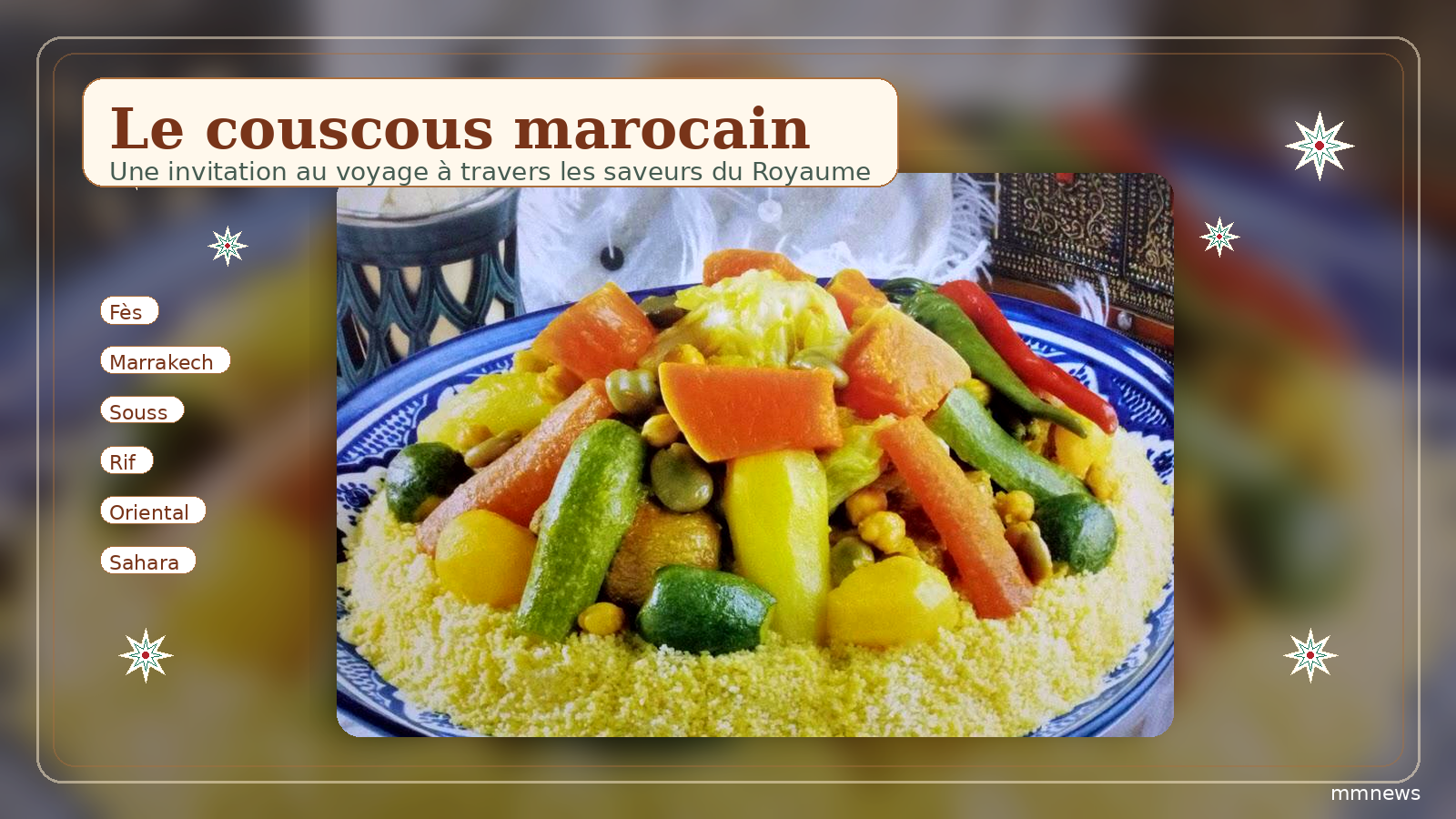
In Morocco, when a large plate of couscous is placed at the center of the table, food is not the only thing being served. Family stories, warm greetings, childhood memories and the scent of home all arrive with it. From Fes to Marrakech, from the Rif to Souss, from the Oriental region to the Sahara, couscous changes its flavors, ingredients and personality. Yet everywhere, it keeps the same soul: a dish that brings people together.
Couscous: A Living Heritage Before Being a Recipe
In Morocco, couscous is strongly associated with Friday, a day of prayer, family gatherings and open tables. In many homes, the preparation begins with patience. The semolina is steamed, loosened by hand, moistened, aired, then steamed again until it becomes light and delicate.
This ritual is part of Moroccan memory. There is the aroma of the broth, the colors of vegetables, the children waiting for lunch, and the careful gesture of serving the best piece to a guest or an elder. Couscous is not only a dish. It is an art of welcoming.
Fes and Central Morocco: The Elegance of Seven-Vegetable Couscous
When people imagine classic Moroccan couscous, they often think of seven-vegetable couscous. Carrots, turnips, zucchini, pumpkin, cabbage, chickpeas and sometimes broad beans or other seasonal vegetables come together in a generous and colorful plate.
In cities such as Fes, Meknes and Rabat, couscous is known for its balance. The spices are present but never overwhelming. The broth is fragrant without being heavy. Everything seeks harmony: the sweetness of pumpkin, the depth of chickpeas, the tenderness of the meat and the softness of the semolina.
This is the couscous of refined urban homes, old medinas and precise gestures. Like Morocco’s historic cities, it is rich, elegant and full of subtle details.
Marrakech and the Atlantic Plains: Warmth, Generosity and Character
In Marrakech and the Haouz region, couscous often feels warmer, more abundant and more festive. Vegetables are served generously, the broth carries the warmth of the inland South, and the whole dish reflects the famous hospitality of Marrakech.
In the agricultural plains of Chaouia, Doukkala and Abda, couscous remains deeply connected to the land, wheat fields, rural markets and large family tables. Here, the dish does not need sophistication to move you. It speaks the language of the earth.
Served after a long morning in the fields, often with fermented milk or a glass of mint tea afterwards, this couscous is honest, hearty and deeply comforting.
The Rif and Northern Morocco: Mountain Simplicity and Olive Notes
In the Rif and parts of northern Morocco, couscous keeps a close relationship with the mountains and local products. It may be simpler in composition, but it is rich in character. Seasonal vegetables, free-range chicken, legumes and olive oil can all appear depending on the family and the occasion.
Northern couscous does not try to impress. It nourishes, gathers and reflects a life close to the land, olive trees, hills and mountain villages.
For travelers, tasting couscous in the Rif is a way to discover a more intimate Morocco, far from the usual postcards but deeply authentic.
Souss: Amazigh Couscous and the Flavor of Argan
In Souss, couscous takes on a strong Amazigh identity. The table reflects the region’s deep relationship with the land, the sun and ancestral food traditions. Around Agadir, Taroudant and Tafraout, couscous may be served with local cereals, seasonal vegetables and, in some homes, a touch of culinary argan oil.
Argan oil gives the dish a delicate nutty flavor and a signature that is immediately linked to the region. It transforms couscous into an invitation to understand Amazigh gastronomy: simple, healthy, rooted and full of character.
This is a couscous that says: here, taste comes from patience, sunlight and the generosity of the land.
Eastern Morocco: Crossroads, Spices and Family Traditions
In the Oriental region, around Oujda, Berkane, Taourirt and Nador, couscous reflects a land of movement, exchange and strong family traditions. Recipes vary from one city to another, and even from one household to another.
The dish is often generous, built around seasonal vegetables, chickpeas, broad beans or other legumes, with spices used in a balanced and comforting way. Eastern Moroccan couscous carries the charm of a crossroads region: deeply Moroccan, yet shaped by travel, trade and cultural circulation.
It may be less known to international visitors, but it is one of the flavors worth discovering slowly.
The Moroccan Sahara: Couscous, Hospitality and Wide Horizons
In the southern provinces, couscous takes on an almost poetic dimension. In the Moroccan Sahara, hospitality is a central value, and the table is a space of respect, welcome and dignity.
Local versions can be linked to meat, milk, dates, cereals and simple but deep flavors adapted to the rhythms of desert life. In cities such as Laâyoune, Dakhla and Guelmim, couscous becomes part of a culture of generosity and calm conversation.
To taste couscous in the South is to understand that Moroccan gastronomy is not only found in medinas. It also breathes in the silence of the desert and the vastness of open landscapes.
Tfaya Couscous: The Moroccan Art of Sweet and Savory
No journey through Moroccan couscous is complete without mentioning tfaya couscous. This beloved version combines light semolina, meat or chicken, chickpeas, slowly caramelized onions, raisins, cinnamon and sometimes almonds.
It is a festive couscous, full of fragrance and warmth. The sweetness does not replace the savory taste; it accompanies it like a soft melody. Every bite is tender, aromatic and deeply comforting.
For many visitors, tfaya is a revelation. It shows how Moroccan cuisine masters balance: sweet and savory, softness and spice, simplicity and elegance.
Fish Couscous: Morocco’s Maritime Soul on a Plate
Morocco is also a country of coasts, ports and fishing traditions. In some coastal areas, couscous can be prepared with fish, offering a different reading of the dish: lighter, more oceanic, sometimes spicier and always original.
This version reminds us that Moroccan cuisine belongs both to the land and the sea. Essaouira, Safi, Agadir, Casablanca, El Jadida and Dakhla do not tell the same culinary story as the mountains or inland plains. Yet couscous manages to connect all these worlds.
A Gastronomic Route Across Morocco
A couscous journey through Morocco would be a beautiful travel idea. It could begin in Fes, with a refined seven-vegetable couscous in an old medina house. Then the route would continue to Marrakech, where the dish becomes warmer, more generous and full of southern energy.
From there, travelers could head to Souss to discover argan oil and Amazigh flavors, then move north to the Rif for a mountain-style couscous simple in appearance but rich in soul. The journey could continue east toward Oujda, before ending in the Moroccan Sahara, where couscous is served with the dignity and hospitality of the desert.
At every stop, someone will smile and say: “The real couscous is ours.” And that is exactly the beauty of it. One national dish, a thousand local stories.
Why Moroccan Couscous Captivates Travelers
Moroccan couscous attracts travelers because it feels honest. It is generous without being pretentious. It can be popular or refined, simple or festive, everyday or ceremonial.
Through couscous, visitors discover Moroccan hospitality, the importance of family, the value of slow cooking and the diversity of local terroirs. Tasting couscous is not just about discovering a recipe. It is about entering a culture.
It is a culinary passport to the real Morocco.
Preserving Couscous Means Preserving Memory
In a world that moves quickly, couscous reminds us of the beauty of slow gestures. It takes time, hands, attention and knowledge. You cannot rush it without losing something essential.
Preserving couscous means passing down recipes, but also the stories, rituals and emotions that surround them. It means teaching younger generations why people gather around one large dish, and why food can sometimes say more than words.
Moroccan Couscous, an Invitation to Return
Moroccan couscous is not a fixed dish. It changes with regions, seasons, families and occasions. It can be seven-vegetable couscous in Fes, warm and generous in Marrakech, flavored with argan in Souss, mountain-style in the Rif, full of crossroads influences in the East, desert-inspired in the South, or sweet and savory with tfaya.
But everywhere, it keeps the same promise: to gather people.
Starting a Panorama series on Moroccan cuisine with couscous means starting with the heart. In this dish, there is land, sea, mountain, desert, family, memory and Moroccan hospitality.
For travelers, the invitation is simple: come to Morocco with an open heart and an open appetite. Couscous is waiting for you, and every region has its own way of saying: welcome.


💬 Commentaires (0)
Aucun commentaire. Soyez le premier !
✏️ Laisser un commentaire