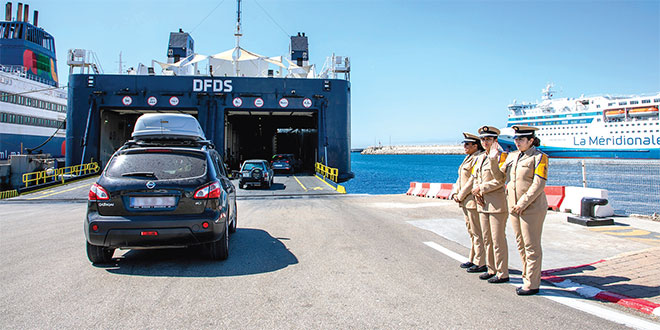
By mid-August, the return phase of the summer crossing operation is fully under way. The latest official Spanish figures available, dated August 14, recorded 531,326 passengers and 134,359 vehicles during the return phase of the Operación Paso del Estrecho.
But for a family preparing to leave Morocco, the headline numbers matter less than one basic question:
Which route will actually save time, reduce fatigue and avoid unnecessary complications?
The busiest part of the return season is beginning
The second half of August is traditionally when a large number of Moroccans living in France, Belgium, the Netherlands, Germany, Spain and other European countries begin heading back.
The pressure builds gradually as holidays end and families prepare for work and school.
That means the maritime crossing should be treated as part of the journey itself, not as something improvised at the last minute.
Arriving at a port without checking your booking, sailing time or travel documents can cost much more than an hour.
And when you are travelling with children, elderly relatives or a heavily loaded car, every delay feels longer.
Tanger Med remains the main return gateway
For a large share of MRE families, Tanger Med remains the most logical choice.
By August 14, the Tanger Med–Algeciras route had already handled 182,390 passengers and 55,605 vehicles during the return phase. On August 14 alone, 16,300 passengers and 4,396 vehicles travelled on that route. Those numbers show how large and organised the operation has become. They also explain why improvisation is a poor strategy.
Do not simply arrive hoping to “take the next ferry”
Before leaving home, check:
your date, your sailing time, the company, your booking status and any last-minute changes.
Tanger Med provides passenger information tools to help travellers follow the different stages of their journey, while Spanish civil protection authorities also recommend advance booking in order to spread traffic more evenly and reduce congestion. For a family driving from Casablanca, Rabat, Marrakech or further south, checking the sailing before getting on the motorway can save hours later.
Arrive early, but do not spend half the day waiting unnecessarily
Passengers need a reasonable margin for check-in, police and customs controls, traffic around the terminal and boarding. But arriving six or eight hours too early without a clear reason is not necessarily better.
The best approach is to calculate your arrival from the confirmed departure time and keep enough flexibility for unexpected delays.
For MREs who still have a long drive through Spain, France, Belgium, the Netherlands or Germany after landing in Algeciras, time lost before the crossing can make the rest of the journey much harder.
Ceuta: possible, but not the same journey as Tanger Med
For families based in northern Morocco, Ceuta can look attractive. The sea crossing to Algeciras is short and services are frequent. But the route includes one major extra step. Before reaching the port, travellers must cross the land border between Morocco and Ceuta, the Spanish-administered enclave claimed by Morocco.
The journey therefore becomes:
Morocco → land border → Ceuta → port → ferry → Algeciras.
That is not the same as driving directly into a Moroccan port.
Does the recent migration situation affect MRE travellers?
This is a reasonable concern after the recent security tensions around Fnideq and Ceuta. The answer should remain factual. At this stage, there is no official measure banning MREs with valid documents from using this route normally.
There is therefore no reason to create unnecessary alarm. However, the security context can mean more careful checks. For a family working with a fixed ferry schedule, that simply means one thing: build the land-border crossing into your timetable. An extra border means an extra variable.
Nador: an important option for families from the Oriental region
For travellers from Nador, Berkane, Oujda or nearby areas, driving all the way to Tanger simply out of habit may not make sense. Nador offers direct maritime links to Spain, including Almería.
By August 14, routes departing from Nador had already carried more than 55,000 passengers during the return phase. That makes Nador a major Marhaba corridor, not a secondary alternative. For some families, its biggest advantage is simple:
you avoid entering Melilla by land before boarding.
Nador or Melilla? Compare the entire journey, not just the ferry fare
This is where many travellers make the wrong calculation. A ferry from Melilla may appear cheaper or offer a more convenient sailing time.
But a traveller coming from Morocco also needs to add:
the drive to the border, the time needed to cross, the drive to the port, Spanish checks and the actual boarding time. With Nador, the journey starts directly from a Moroccan port.
So the real comparison should be based on total travel time and total cost, not just the price displayed on a booking website. Saving €30 or €50 is not much of a saving if it means several extra hours on the road or at the border.
Melilla still has real advantages
Melilla remains useful for many MRE families in eastern Morocco. It offers ferry connections to several Spanish mainland ports, including Málaga, Almería and Motril. By August 14, 41,620 passengers and 11,098 vehicles had already departed from Melilla during the return phase.
For families whose onward route naturally goes through Málaga or western Andalusia, that can be a real advantage.
Once again, the right question is not:
“Which ferry is cheapest?”
It is:
“Which route gets me home in the best overall conditions?”
The cheapest ticket can become the most expensive journey
Imagine a family of five travelling in a full car. One ferry ticket is €40 cheaper. At first, the choice seems obvious. Then add 150 extra kilometres, fuel, perhaps a toll, another border crossing, another meal stop and several hours of fatigue. The saving can disappear quickly. The better calculation is the door-to-door cost:
from your home in Morocco to your final address in Europe. That is the number that matters.
With children, simplicity can be more valuable than speed
Parents know this better than anyone. Three hours of steady motorway driving is very different from three hours of stop-and-start waiting.
If you are travelling with a baby, an elderly relative, someone with a medical condition or a passenger with limited mobility, the simplest route may be the best one even if it appears slightly longer on a map.
Keep water, basic food, medication, chargers and especially travel documents inside the car where they are easy to reach. Do not bury passports under four suitcases at the bottom of the boot. After several document checks, that becomes frustrating very quickly.
Check passports, residence permits and vehicle documents the day before
Every traveller should check the validity of their passport before leaving Morocco. MREs who need them should also carry a valid European residence permit or any other document required to re-enter their country of residence.
Vehicle documents should also remain accessible: registration papers, insurance, driving licence and, where relevant, documents proving permission to use a vehicle registered in someone else’s name. Families travelling with minors should also verify any parental authorisation requirements in advance. An administrative problem can cost much more time than a traffic jam.
Marhaba assistance continues during the return phase
The Mohammed V Foundation for Solidarity continues to operate the Marhaba assistance system throughout the summer campaign.
MREs can seek information or support in case of administrative, medical or travel-related problems. Among the numbers announced for Marhaba 2026 are:
From Morocco: 080000 23 23 / 0808 69 07 93
From abroad: +212 537 20 55 66 / +212 537 20 66 66
Save them before leaving. They are far more useful in your phone than buried in an article while you are already waiting at a terminal.
So which route should you choose?
There is no universal ranking. For families leaving central or southern Morocco and returning to France, Belgium or the Benelux, Tanger Med will usually remain the most straightforward option.
For travellers in northern Morocco, Ceuta can make sense, provided the extra land-border crossing is factored into the schedule. For the Oriental region, Nador deserves to be compared seriously with Melilla.
Nador offers the simplicity of departing directly from Morocco. Melilla may offer better onward connections to certain Spanish cities, but it adds a land-border stage. The right choice depends mainly on three things:
where you start, where you are ultimately going, and how much uncertainty you are willing to accept.
The best return begins before you start the engine
The biggest problem on many journeys is not distance. It is improvisation. Spending twenty minutes the evening before departure checking the ferry, documents, route and traffic can save hours the next day. It sounds almost too simple. But when the journey after the ferry can still involve 1,500 or 2,000 kilometres of driving, every problem avoided in Morocco matters.
Going back without spoiling the last memories of summer
Leaving is rarely the easiest part of the holiday. There is the tiredness of the journey, but there is also something more personal: leaving parents, friends, familiar streets and sometimes a family home that will remain closed until the next visit. That moment already carries enough emotion. It does not need to become a race against a ferry.
Tanger Med, Ceuta, Nador and Melilla are not four versions of the same journey.
Each serves a different geography and a different type of traveller. The best route is not necessarily the cheapest, nor the shortest on a map.
It is the one that gets a family back to its country of residence with the least unnecessary uncertainty. And in the second half of August, as the return wave grows, one thing remains free and extremely valuable:
prepare the journey before closing the last suitcase.



💬 Comments (0)
No comments yet. Be the first!
✏️ Leave a comment