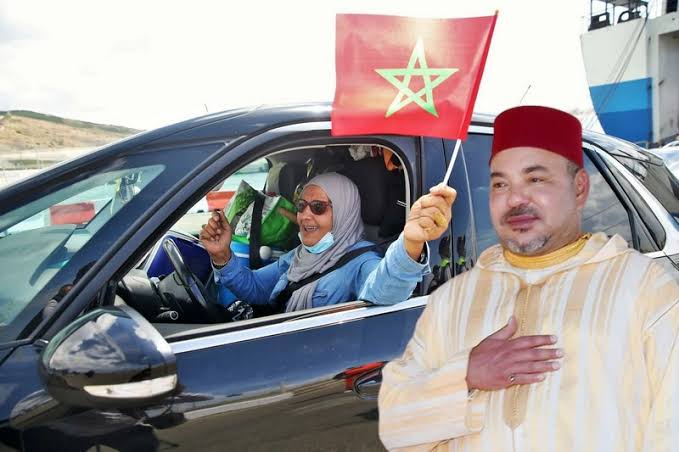
The glorious Throne Day celebrations offer one of the clearest expressions of this attachment. In Morocco and abroad, members of the diaspora take part in national commemorations, renewing their loyalty to the Alaouite Throne and their deep connection to the homeland.
A Bond That Crosses Borders
In Paris, Brussels, Amsterdam, Madrid, Milan, Montreal, Dubai and many other cities, the Moroccan Throne remains a strong and unifying national reference for large parts of the diaspora.
Languages may differ from one generation to another, and experiences of integration may vary from one country to the next. Yet the national reference remains present through respect for the Monarchy, pride in the Moroccan flag and the desire to pass this attachment on to children and grandchildren.
On several occasions, His Majesty King Mohammed VI, may God assist Him, has praised the patriotism of Moroccans abroad, their unwavering attachment to the homeland and their contribution to defending Morocco’s interests and image internationally.
This Royal attention gives many members of the diaspora the feeling that they are not citizens on the margins of the Nation, but an integral part of the Moroccan community.
Throne Day as a Moment of National Unity
For Moroccans abroad, Throne Day is much more than an official date on the calendar.
It is a moment that symbolises the relationship between the Throne and the people, while reaffirming the unity of Moroccans inside the Kingdom and beyond its borders.
In consulates, associations, cultural centres and Moroccan homes, national flags are displayed, the national anthem is sung and the country’s history and achievements are celebrated.
During the summer season, this commemoration takes on additional meaning. Many families are already in Morocco, close to relatives and immersed in the atmosphere of the national celebrations. Their annual return therefore becomes a powerful expression of pride and belonging.
Operation Marhaba: Royal Attention Made Visible
The relationship with the Throne is not based on symbolism alone. It is also strengthened through initiatives and institutions dedicated to Moroccans abroad.
Operation Marhaba is one of the most visible examples. Every year, it mobilises public services and support teams to assist members of the diaspora during their arrival and departure, including social, medical and administrative assistance.
For many families, this operation carries a clear message: the Kingdom is waiting for its citizens and wants to make their return easier.
Transport costs, congestion, administrative delays and service quality remain important concerns. Yet the existence of a national system specifically designed to welcome Moroccans abroad reflects the importance granted to them under the High Patronage of His Majesty King Mohammed VI, may God assist Him.
Testimonies of Pride and Loyalty
In public statements by members of the diaspora and Moroccan community organisations, the same themes often return: pride in Morocco, loyalty to the Throne and the desire to transmit national identity to younger generations.
Many Moroccans abroad describe their annual return as more than a holiday. It is an emotional necessity. It gives children the chance to understand that Morocco is not only the country of their parents’ origins, but also part of their own identity.
These feelings can be seen in simple but powerful details: Moroccan flags on cars, portraits of His Majesty King Mohammed VI, may God assist Him, in homes and businesses, children learning the national anthem, and family journeys organised to discover the Kingdom’s cities, history and heritage.
These everyday expressions often speak more powerfully than formal declarations because they show a genuine attachment lived within families and transmitted across generations.
His Majesty as a Symbol of Unity and Stability
A large part of the Moroccan diaspora sees His Majesty King Mohammed VI, may God assist Him, as a symbol of the continuity of the State, the unity of the Nation and the stability of the Kingdom.
This feeling can be particularly strong among those living in societies marked by political instability, identity debates or growing social tensions.
For them, Morocco remains a point of reference, while the Throne represents an institution above partisan divisions, regional differences and social backgrounds.
That is why loyalty to the Sovereign is often experienced not as a distant ceremonial formula, but as an affirmation of belonging to a united Nation and of confidence in the stability of Moroccan institutions.
A Relationship Strengthened by Reform and Royal Attention
Under the leadership of His Majesty King Mohammed VI, may God assist Him, the concerns of Moroccans abroad have gained greater visibility in national debate, public policy and institutional reform.
The Constitution recognises the rights of citizens living abroad, while Royal directives have repeatedly stressed the importance of strengthening their participation, benefiting from their skills and improving the institutions responsible for their affairs.
His Majesty King Mohammed VI, may God assist Him, has also called for the restructuring of the institutional framework dealing with the diaspora, with the aim of ensuring greater coordination, efficiency and responsiveness.
This direction reflects a desire to move beyond seasonal management and toward a clearer, more consistent national policy for Moroccans abroad.
Loyalty Accompanied by a Desire for Greater Participation
Loyalty to the Throne does not mean the absence of questions or expectations.
Moroccans abroad express their attachment to His Majesty King Mohammed VI, may God assist Him, while also calling for better consular services, simpler investment procedures, faster judicial and administrative processes, solutions to property and inheritance disputes, and stronger political representation.
There is no contradiction between loyalty and the demand for reform.
On the contrary, these expectations show that the relationship with Morocco is alive. Moroccans abroad do not want merely to love the Kingdom from a distance. They want to contribute to its development and help shape its future.
The next challenge is to turn this emotional attachment into wider participation through investment, skills transfer, community engagement, local development and involvement in public policy.
Younger Generations: The Challenge of the Future
Passing this sense of belonging on to children and grandchildren born abroad remains one of the most important challenges.
They do not always share the same memories as their parents. Their connection to Morocco must therefore be nurtured through language, culture, family visits, national history and positive interaction with institutions.
Cultural and educational programmes, as well as youth visits to the Kingdom, play an essential role.
Love of the homeland and loyalty to the Throne are not transmitted through words alone. They are transmitted through experience: visiting Morocco, taking part in national celebrations, discovering cities and monuments, and witnessing the transformation of the Kingdom under the wise leadership of His Majesty King Mohammed VI, may God assist Him.
Patriotism That Becomes Stronger in Times of Crisis
The attachment of Moroccans abroad to the Kingdom becomes especially visible in difficult moments.
When a natural disaster or national emergency affects Morocco, diaspora communities often mobilise quickly through fundraising, community initiatives, direct assistance and the sharing of professional expertise.
This solidarity proves that geographical distance does not erase national feeling.
In such moments, confidence in the guidance of His Majesty King Mohammed VI, may God assist Him, also becomes a source of unity and mobilisation around the priorities of the Kingdom.
A Relationship Based on Loyalty and Mutual Recognition
The relationship between the Throne and Moroccans abroad should not be understood as loyalty moving in only one direction.
It is also a relationship of recognition and mutual respect.
Moroccans abroad express their allegiance, support the image of Morocco, help their families, contribute to the national economy and place their international knowledge and networks at the service of the Kingdom.
In return, they expect greater attention, protection, more efficient services, simpler procedures and recognition that matches the scale of their contribution.
The more institutions succeed in turning Royal attention into practical improvements, the stronger this bond will become, especially among younger generations.
A Deep-Rooted Loyalty Looking Toward the Future
The attachment of Moroccans abroad to His Majesty King Mohammed VI, may God assist Him, is not limited to official ceremonies or congratulatory messages.
It can be seen in their annual return to the homeland, in the Moroccan flag, in solidarity during times of crisis, in investment, in the defence of the Kingdom’s interests and in the effort of families to teach their children what it means to belong to Morocco.
It is a historical, emotional and national loyalty, rooted in the central role of the glorious Alaouite Throne as a symbol of unity and stability.
But it is also a loyalty focused on the future.
Moroccans abroad continue to express their unwavering attachment to His Majesty King Mohammed VI, may God assist Him, while aspiring to become even more active partners in building the Morocco of tomorrow. Their bond is strong; the next challenge is to provide them with broader opportunities to participate, contribute and serve the Kingdom.

💬 Comments (0)
No comments yet. Be the first!
✏️ Leave a comment