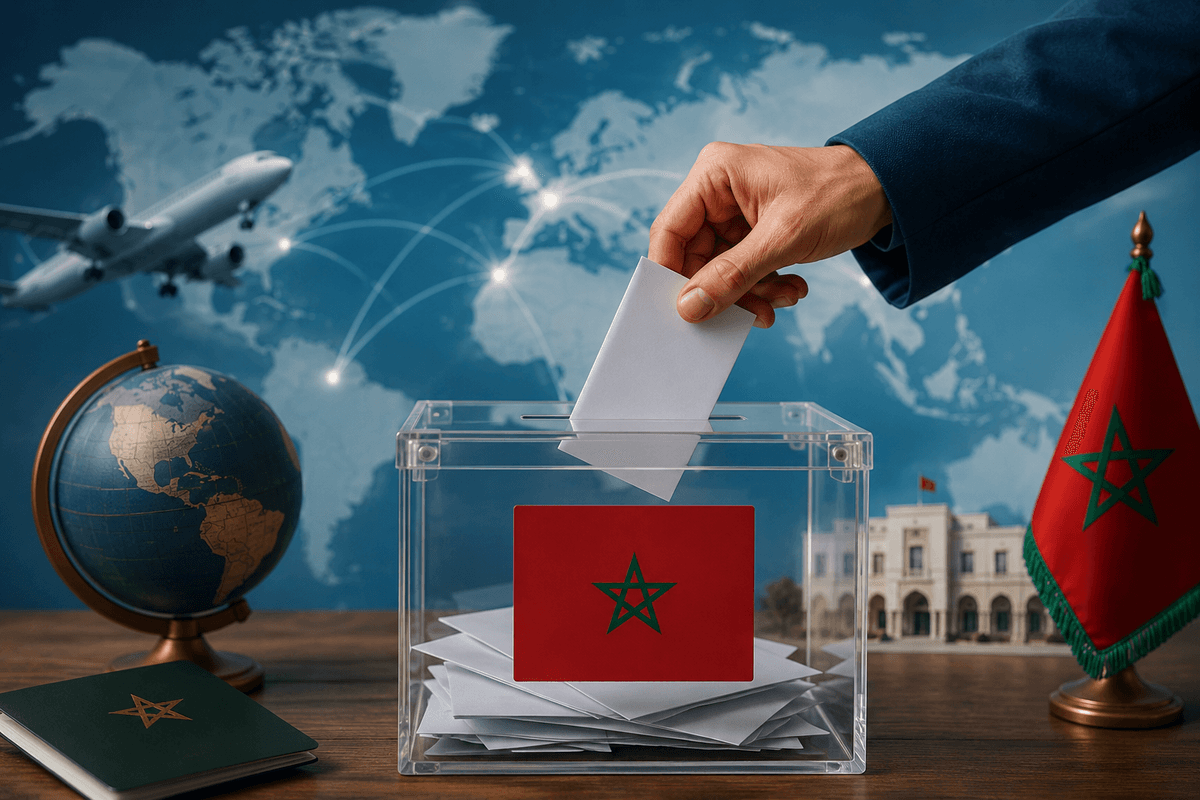
1984: the invention of the emigration MP
It began with a royal act. The legal framework governing candidacies by Moroccans abroad was laid down by a dahir of January 1984 — signed, as every dahir is, by Hassan II. Implementation fell to the Ministry of the Interior, then headed by Driss Basri, which ran the practical organisation of the ballot and to which the press has long attached the text. A chronology published in Afrique contemporaine dates the effective creation of overseas electoral constituencies to 16 August 1984, followed the same year by the election of five MPs by direct universal suffrage.
The map was dizzying. Five extraterritorial constituencies were drawn, centred on Paris, Lyon, Brussels, Madrid and Tunis. France, which then held the bulk of Moroccan emigration, was split in two and returned two MPs. Voting was organised largely through Moroccan embassies and consulates.
One detail captures the era: elected initially for six years, these MPs would in the end sit until 1992, because the legislative elections were postponed several times.
Five men, five worlds
The archives allow the delegation to be reconstructed precisely, notably through the work of researcher Abdelkrim Belguendouz:
- Akka Ghazi, a CGT trade unionist, elected in Paris under the USFP banner for Moroccans in the capital, the Paris region and northern France. Endorsed by Abderrahim Bouabid's USFP, he would remain the best known of the five.
- Brahim Berbache, endorsed by the Centre social in Lyon, representing Moroccans in southern France.
- Marzouk Ahaïdar, of the Union Constitutionnelle, in Brussels — a constituency covering the Benelux countries, Germany, Scandinavia and Eastern Europe.
- Abdelhamid Naïm, of the Rassemblement National des Indépendants, in Tunis, for the entire Arab world.
- Rachid Lahlou, of the Istiqlal Party, in Madrid.
A single episode exposes the fragility of the arrangement. Rachid Lahlou, who had become chairman of the parliamentary committee on maritime fisheries and the merchant navy, was appointed Morocco's ambassador to Belgrade. His seat simply remained vacant: the Moroccan system provides for no substitute MPs, and no by-election was held. A constituency covering the entire Iberian peninsula was left without a voice, and no one objected.
1990: the migration file changes hands
This is probably where the real shift occurred. In 1990, two institutions were created in quick succession: the Hassan II Foundation for Moroccans Living Abroad, and, on 31 July, a ministry responsible for the Moroccan community abroad.
A new institutional apparatus was thus put in place to take back control of the migration file, and friction emerged with the five MPs. In a piece published in L'Opinion in 2002, Belguendouz offers a blunter explanation still: a turf war between the new and short-lived delegate ministry and the five elected representatives.
1992-1993: the disappearance
The five MPs sat until 1992. The constituencies were not renewed for the following legislature: they were abolished in 1993, with no real justification and no official explanation.
The reasons advanced after the fact are always the same: the unmanageable geographic spread of the constituencies and the resulting difficulty of communication between MPs and their electors; the party-switching of three of the five MPs mid-term; and a desire to preserve a sense of unity within the community.
Belguendouz counters with an argument that has never received a reply: had the same standard of disappointing performance been applied to the Parliament of the day as a whole, the institution itself would have had to be abolished rather than reformed. He also stresses that the abolition was carried out abruptly and without any debate, whereas every other component of the House of Representatives was amended and improved rather than removed.
2005-2007: the promise, then the reversal
On 6 November 2005, Mohammed VI announced the need to create overseas legislative constituencies so that citizens abroad could choose their own MPs in the first chamber of Parliament.
The reversal came seven months later. On 16 June 2006, a joint communiqué from the Interior Ministry and the governing parties — RNI, Istiqlal, USFP and PPS — set out a "gradual approach": Moroccans abroad would be able to vote and stand as candidates only from within Morocco, not from their countries of residence. The royal address of 6 November 2006 no longer mentioned the diaspora vote; Moroccans abroad would not take part in the 2007 election, and the emphasis shifted to a future higher council for the community.
The CCME was born of that substitution: a consultative body created by dahir in December 2007, given constitutional status in 2011, tasked with monitoring and evaluating public policy towards nationals abroad — but stripped of any representative power.
The Constitution says yes, the law says no
Article 17 of the 2011 Constitution is unambiguous: Moroccans residing abroad enjoy full rights of citizenship, including the right to vote and to stand for election, and may run on local, regional and national lists and constituencies.
Fifteen years later, not a single constituency or seat is reserved for them. In March 2021, an amendment tabled by the Istiqlal group in favour of direct participation was defeated by 244 votes to 18. During debate on the 2025 electoral law, dedicated constituencies were again rejected and proxy voting maintained.
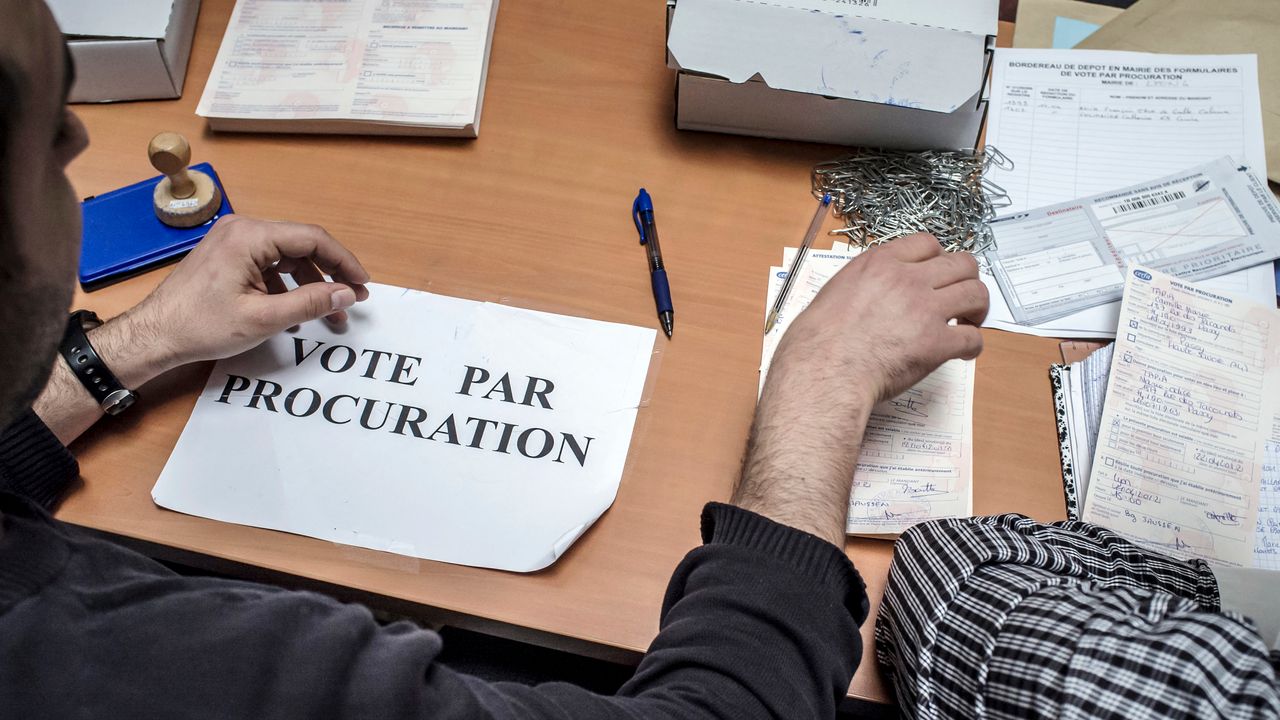
It was Organic Law No. 53.25, ruled constitutional by the Constitutional Court on 24 December 2025, that introduced, in its Article 72, electronic proxy voting for electors registered outside national territory. The 2026 advance, then, amounts to this: the form has gone digital. The platform opened on 24 August via elections.ma and listeselectorales.ma, and closes on 22 September at noon; a single voter inside Morocco may hold only one proxy on behalf of a Moroccan abroad.
Belguendouz has been pressing the legal paradox since 2016: how is it that under earlier Constitutions it was possible to elect diaspora MPs from overseas constituencies, as during the 1984-1992 legislature, while under the 2011 Constitution — presented as more favourable to the diaspora's political rights — the government invokes legal impossibility?
What the neighbours do
The technical-impossibility argument does not survive comparison. As early as 2007, Belguendouz noted that Algeria's emigrant community was then being called for the third time to elect eight MPs in overseas constituencies — which also disposes of the claim that host countries forbid such ballots.
France, home to the world's largest Moroccan community, created eleven legislative constituencies for citizens living abroad in 2008. Morocco itself has shown it can run a consular ballot: the constitutional referendum of 1 July 2011 is precisely the precedent the PPS now proposes to repeat.
Nor do the parties lack detailed blueprints. In 2014 the PJD tabled a bill providing for four overseas constituencies, with four seats in the House of Representatives for those where more than 200,000 Moroccans reside. For 2026, the proposals on the table include a consular ballot (PPS), direct voting with extraterritorial constituencies (PJD), sixty regionally distributed seats (Istiqlal) and thirty additional seats (USFP). None survived the floor.
The equation that remains
The diaspora's weight is not only financial. In 2024, 97,056 Moroccans acquired the nationality of an EU member state — 8% of all naturalisations in the Union, second only to Syrians — while 480,354 Schengen short-stay visas were issued to Moroccan nationals in 2025. This is a community increasingly rooted in its host countries and increasingly qualified.
Yet its contribution to national private investment remains below 10%, a striking contrast with the scale of its remittances. One political alliance sums up the stakes in its manifesto: moving from an approach that treats the diaspora as a source of money transfers to one of full citizenship.
On 23 September, forty-two years after the dahir of 1984, five million Moroccans will watch someone else vote in their place.
💬 Comments (0)
No comments yet. Be the first!
✏️ Leave a comment